In lesson two we talked about the first traffic pyramid. Today we’re going to discuss the second. This is another framework that, once you understand it, will pay dividends forever.
The first traffic pyramid showed the intent of the prospect. The second shows the intent of our marketing efforts.
From top to bottom the second pyramid is awareness, engagement, and conversion.
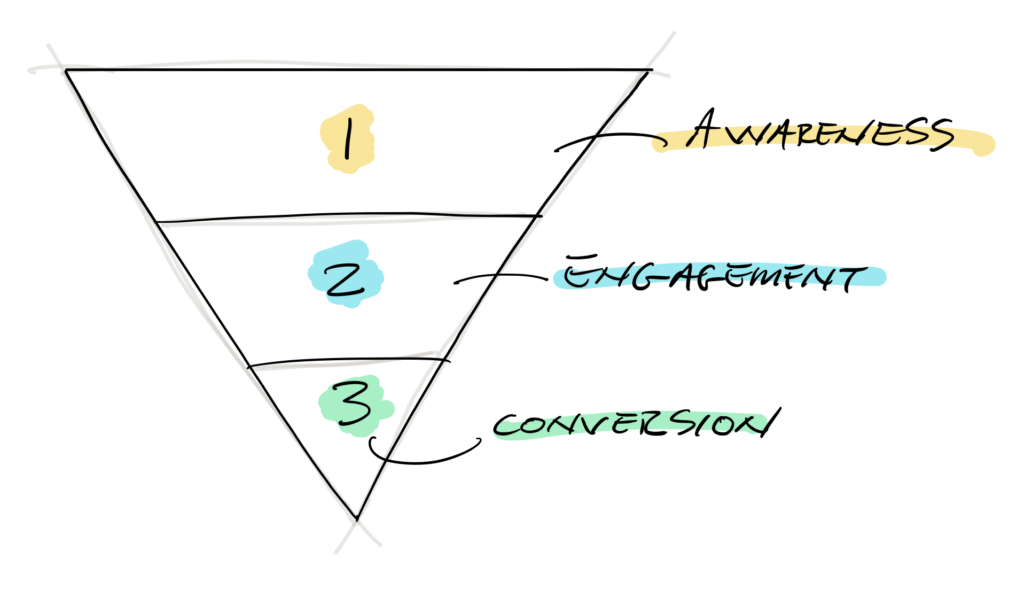
Awareness is the point of initial contact, when you transition from unknown to known (but not well-known) for a prospect. I want to be clear that awareness is not necessarily first contact — it could be a series of touch points over time that, taken together, make you and the promise(s) you’re making to your audience visible to a prospect.
Engagement is when we want the prospect to do something to take a step toward us — comment on something, opt-in for gated content, attend a webinar, etc.
And conversion is when we’re focused on making a sale.
This model works for all traffic. However, it’s very important to understand the goals for each part of the pyramid when we’re paying for traffic. Let’s look at some examples.
Awareness — top of the funnel. This is a place to share content that demonstrates authority (and empathy). Video and text both work. Image ads work too (they’re harder to get right in my experience). The value is in the content itself — it’s meant to be consumed and shared.
If you’re using video, what matters is consumption:
- What percentage of people watch 50% or more? 95%?
- How frequently is the content shared?
- What do people say in the comments?
- What questions do they ask? (Pro tip — use the questions to link to other content, or to develop additional content.)
If you’re using text, I recommend including as much value as possible in the ad itself. Don’t force a click-through to more information unless there’s a compelling reason to do so. Demonstrate your understanding of a topic, pick a novel perspective, take a stand that’s appealing to a motivated minority of your prospects. Be memorable and share-worthy. Likes and other reactions, sharing, and commenting are useful indicators.
One thing to be aware of in a social environment like Facebook — despite your best efforts you’re going to attract some jackasses in every market. That’s just the reality. Don’t let it get under your skin. Let people’s comments reveal who they are — that has nothing to do with who you are (unless the comments are accurate!) I like Todd Herman’s approach — his team creates a poster every month with the top negative comments from his Facebook ads so everyone can laugh at it. My approach — use the delete key with enthusiasm.
Engagement — middle of the funnel — overwhelmingly is lead generation. It’s entirely possible to skip the top of the funnel altogether, and rising advertising costs often make this a necessity. Most paid traffic campaigns start with the middle of the funnel. It’s an effective way to test if something is interesting enough to cause action.
The typical middle of the funnel campaign is a big, specific promise fulfilled by a lead magnet, or a multi-day series of emails. Webinars also are middle of the funnel campaigns (with elements of conversion too when selling is involved).
This seems like a great place to mention why I like André’s Sphere of Influence approach so much. It’s the best method I’ve ever found for combining top and middle of the funnel together in a way that creates the impact of both while keeping costs low.
My favorite method is to use long form Facebook copy as a pre-screening page one of an SOI funnel, continue the journey through the multi-page pre-sell site, and then convert to leads (or sales) from that first touch point. That is a lot of heavy lifting for one campaign and I haven’t found anything that does it better than Sphere of Influence.
Conversion — bottom of the funnel — are campaigns that are designed to lead immediately to a sale. These can be campaigns designed to go from A – Z in one step (a typical customer acquisition campaign). Or, in my experience, a more effective way to convert with paid traffic is to use behaviorally-based retargeting to make offers at the appropriate time in the customer journey and with the appropriate messaging. (“Buy now” 24/7/365 is not necessarily the appropriate message…)
Structuring effective conversion campaigns is dependent on your business and your approach to traffic (paid or otherwise). Next we’ll talk about this in more detail when we borrow Stephen Covey’s idea from The Seven Habits of Highly Effective People and we “begin with the end in mind”.
Your homework for today is to look through the content you have, or a short list of content you could create, and assign that content either to top or middle of the funnel.
NEXT: Work Backwards