Amanda Bond: We love the rants!
Leslie: Bring forth the rant!
Mary: There goes your calm day, Shawn 😅
Sarah: I agree, this has been a really inspiring call! I’m gonna need to find another few hours to listen again 😄
Mary: I think I’m gonna have to timestamp the whole call 😂
Amanda Bond: Time stamping the end of that perspective at 1 hour 26 (so I can remember to go back and listen to it again later).
Penny: OMG – YES – #PREACH…
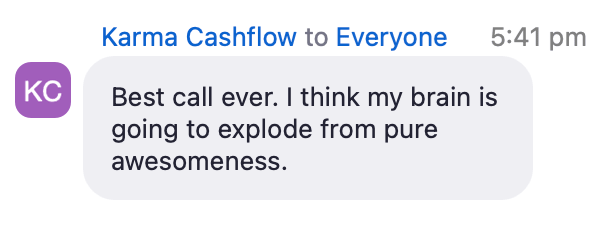
Karma’s comment after 3 hours 41 minutes in.
Here’s the link to the Google Doc with the submitted questions (we covered these first, then moved to live questions from attendees).
Transcript
[Shawn] All right. You wanna, do you think you wanna jump in? You ready?
[André] Yeah, go for it. I mean, it’s, there’s only two questions, right? So we we’ll be open. We have 15 minutes.
[Shawn] Let’s we have 1, 2, we have 3, 4, 5, 6, 7, 7-ish questions. And one of which we kind of answered already that we didn’t answer already.
[André] And we’ve got a Q and A question coming.
[Shawn] Yeah, those of you, it looks like we’ve got some questions starting online. So we’re going to have lots of time today. So ask questions. And if you want to ask questions about previous material, that’s cool. Let’s not ask questions about the modules that we already haven’t covered yet, just because we don’t wanna jump ahead. Although you may convince us to later, who knows? This will be a great, and I think we’re, we probably have an hour’s worth of questions to answer so we can open it up at that point and we can really dive deep into any specific questions anybody has on the call. We don’t have to stay here for three hours. But just, let’s not miss this opportunity to really engage on anything that may be holding you back. All right, I’m gonna jump in and just I’ll read the question. If I read the question and I get to decide who answers it first. So if I don’t have a good answer, I can just hand it over to you. That’s really my whole strategy, I assume, as obvious to everyone. All right, here’s the first question. This is from Rich. How do you decide which value newsletters to repurpose for your website? How do you think about that? Have you ever republished an entire series of VLNs to your site? It seems like a great question for you to start answering, André.
[André] I can answer the second part of that, which is easy. We have offhand, the one I can remember because Mary asked a question in the comments and I responded and I replied that this morning, which is our durable business. Last year, we did a far part. It wasn’t necessarily VNL, it was a series that spun off the VNL, which we then published to the website. So it’s similar. We’ve never done more than two VNLs as part of a, like a themed thing. So I can share the link to the durable business one. I’ll find that link in a sec when Shawn is talking. As to how do you decide what to repurpose? The thing is most of the stuff that we write is evergreen in nature. We don’t tend to write stuff that’s so tactical that by the time we hit the publish button and send the email out, it’s wasting away, it’s degrading, we don’t do that. So we can really publish every single newsletter that we send. And most emails that we send could easily end up on the website. One of the things we do is we slightly modify them. So we’ll take out any chat we’ve that we’ve done. That’s specific to the emails because there’s a relationship that’s already been established to everybody that’s receiving our VNL. So we could have more of a lighthearted thing. We could mention stuff that’s happened. We can create some context that makes more sense to people that have been paying attention. But then when we repurpose those, we kind of strip out some of that stuff. So the article or the piece on the website is a standalone thing minus all the stuff that could seem weird that context stuff. And then one of the things that I I’ll mention, I mean that we add sometimes when it makes sense is if we’ve republished anything to the website and it’s thematically linked to something else that’s maybe not obvious necessarily. We’ll link that up in the photo lock. Like we will hard code. We are not using any plugins with us. We will say, if you enjoyed this or the insights over here, hit home with you this is related and it’ll be a link to another article that’s either literally relevant or completely thematically relevant. And we’ll just link to that. So someone that’s pulling on that thread and reading that thing when they get to the bottom, there’s more threads to pull and they can go deeper down the the rabbit . You get that link charms.
[Shawn] Yeah, I mean, but my first reaction was we don’t really think about it this way. And then the moment I thought that I realized, well, yeah, we have a bunch we’ve thought about it that way. So I think there are two ways you can think about this. When I say two, I’m going to get to 20, by the time I’ve finished talking probably, but the two broad ways to think about this are assume from the beginning that you’re going to want to this one, this whatever content you’re creating for your VNL on your site and act accordingly, or you just create great content and then realize after the fact, oh, yeah, that really should go on the site. And it sounds, I mean, that sounds absolutely idiotic. But it changes the dynamics a little bit. And the only, I think the only reason I know that is this summer we switched from a biweekly schedule to a weekly schedule. And we also, prior to that, we sort of made this deliberate decision that we were going to be writing VLS that were really standalone articles. And that we wrote them, that the email was written knowing it would be published on the site as a piece of content. That’s different than creating a value newsletter and then just dropping it in the site later when you’re like, oh, this was a good series, it’s worth publishing. It’s just, they have different dynamics. And of course, this is all dependent on you’re having a type of newsletter that fits into this format where you’re creating or you’re curating content. So there are lots of decisions that go into this. But I think when you strip everything away, this is always true. When you strip everything away, the fundamental question here that rich has asked is how do you decide which VNL you post on your website? That question is actually further downstream from the more important question, which is, how do you decide what you believe is valuable for your audience? That’s the question to answer first, everything else is mechanical at that point. It’s just platform stuff like, like you decide something is about like, worth sharing with your audience, and then you just figure out what platforms are going, how you’re going to share it. You’re going to send it by email. Are you going to post it on your website? Are you going to add it somewhere in a course? Are you gonna put six or seven of em together and make them a free course? Is there part of that content that you realize could be tangential and you could run with a soap opera series, like it opens the door to something, but it really, everything starts with this question of what is most valuable to my audience. And sometimes that’s time to you sensitive. Certainly if we’re talking about email marketing in the fall of 2021, iOS 15 is on everybody’s mind. One of the two most important metrics for understanding email performance. One of those two open rates is going away. We can’t use it anymore accurately. And the more to time passes, the less accurate open rate becomes because email or Apple is essentially obscuring open rate by opening everybody, by sending the signal that everybody who’s using Apple Mail has opened their email. So we can’t trust that data anymore. So that’s a timely, important piece of value to share with an audience now. And then oftentimes what we’re sharing is timeless, right? Like the simple testing framework, from Sesame Street,. I wonder what if let’s try, right? That’s not going to go away that testing, as a way to think about how to test ideas, that framework is not going to go away in the next three or four decades. So it’s just, and it’s valuable, right? That’s everything comes back to this central idea of what is valuable, knowing what that your audience doesn’t, when it’s time to sit down and create something, whether it’s a newsletter or a series, it doesn’t matter. The first place to start is what would be interesting and valuable to my audience right now. That’s I think to me, that question is at the core of everything. When you answer that question, all the details reveal themselves. Anything on let’s add to that one. I see you just typing away here, what the hell are you all you putting?
[André] I’ve just added that link to the doc, seeing anybody else’s got access to that. And whoever’s listening to this and is not on the call, can see the links.
[Shawn] All right, let’s move on to Francis’ question. I like this question a lot. I think it’s going to be fun to answer. So here’s Francis’s question. One thing I’ve always struggled with is what to give away for free in the emails I write, I tend to want to share and educate a bit too much. You have any good frameworks or questions I can ask myself to make sure I’m sharing valuable insights, but not going to the point where they feel like they no longer need the course or coaching anymore. That’s a really, really good question. So good that you should answer it first.
[André] Yeah, I’m worse at answering questions like this. I’ve said many times that we are in the inside business, so we are try and figure out between Shawn and I what insight can we share in a certain piece? So if it’s the VNL, what do we want people to unpack? At no point, there’s nothing we can put into a newsletter that’s gonna prevent anybody from buying our courses. And in fact, it’ll be the opposite. It’s a newsletter that’s constrained by X many thousand words. We could obviously do a series, but even then, it can only scratch the surface as going through the died of email, we could… last week’s Q and A call was 35,000 words. So when you add up all the Q and A calls, you look at the course, it’s just too big to ever be able to worry about sharing the whole thing. It can’t be done. So we think more narrowly, what is a single little insight that we can share that would be how helpful to somebody valuable to them, relevant to them, to their business. And then we’ll, we’ll work backwards from that. That’s, that’s one way to do it. Shawn’s better at framing questions. I just kind of go in there and I don’t always lucky, I’ve got Shawn to tell me that.
[Shawn] You’re just setting me up ’cause you wanna hand off the question, I know what’s going on here, I know exactly what’s happening. I’ve mentioned a million times, my second favorite quote is always the beautiful answer who asks a more beautiful question. I know this is not my thinking, but at least 15 years ago, if not longer, I internalized this idea that the … I think this is like a Tony Robb’s idea. I’m sure he still from Jim or somebody else, but borrowed, sorry. This idea that the quality of the questions you ask yourself determines the quality of your life. I think that’s a Tony Robbins idea. And it’s true. I remember like some of the examples that were given, again, I think it was Tony Robbins, like if you wake up every the morning and you ask yourself, why does my life suck? Or your brain is agnostic. It’s just gonna go look out and find reasons to tell you like, well, this your life sucks because… But if you wake up every morning, you ask yourself what could I do today that would be great? What could I be grateful for today? It’s just by changing the questions we ask. Everything downstream changes as well. So I just, I love to me the most powerful thing I’ve ever stumbled on is the power of asking a really good question or looking for a really good question. When you find a really good question, everything after that, just fundamentally changes. So having said that, that wasn’t intended to be as set up, but I’ll make it a setup. So the question what to give away for free and emails is a shitty question, right? That’s just not a quality question. Because it’s has too many implications, right? That there’s somehow there’s a difference between free value and paid for value. It’s just the wrong way to think about it. To reformulate this question, ask yourself, what could I communicate to my audience today that could make their lives meaningfully better? Well, hell that now you had a thousand answers that you could come up with and your brain just starts firing off those answers. And then you look for that, but when you try to bifurcate like, oh, I want to give stuff away, but then I also have to make money. It creates a false dichotomy, right? There’s a psychological effect, when you’re giving things away and freely giving things away and really sharing insights that I don’t think it makes somebody think like, wow, why bother buying anything from this person? It actually makes them think, well, if this is the free stuff, the paid stuff must be incredible. I mean, I don’t think there’s a downside other than overwhelmed when you’re really emphasizing the free content, I mean, yes, there are some frameworks I’ve heard past, which I don’t like, one was popular for a long time is that you give away the why and you sell the how. But again, that’s a bifurcation that I hate. I just gross, but oftentimes your audience needs to understand why and what, and often what your insight, is that you’re framing things for your audience in a way that they can understand it. I mean, that to me, and I realize I’ve been looking through the comments and hearing this a lot that people are really struggling. Like what rises to the level of an insight versus just information. And an insight, I don’t think it’s black and white. An insight is different for different people. Some people have an aha moment with something that you feel like was just information. And then others look at something that you believe was an insight and they’re like, oh yeah, of course, that makes sense. So it’s not as cut and dry. I mean, I think if we wanna talk in terms of frameworks, insights are more likely to be found in second and third order beyond thinking. That’s where to go look for them. And in the example, I think we’ve given here a few times, but this observation that most people who are not going to buy, or most people who buy over the course of two years are not going to buy in 90 days, that’s information for some people, that’s an insight. But then when do we get into second order thinking about that. And third order, fourth order thinking, that’s where all the insights are. It’s like, well, if that’s true, then the real risk in the short term is that we screw up by trying to sell more to the few people who are going to buy anyway. But then we’re likely to, to undermine the potential for future sales, that will happen if we just don’t screw it up. Well, that’s an insight, that’s a second order consequence of upstream information. So, do you give away insights? I’m sure it’s… I guess the best framework I can think about is if you are custom building the ideal prospect, you have lots of time and you could sit down and think, okay, what if for someone who is going to not all only be ideal a hell yes, a 10, when they see this offer that I have, what needs to be true before that happens? What needs to be true for them? Like what needs do they need to have? What do they need to feel like that they’re capable of? Like what emotions line up with this decision and what, in order to get the most value from the offer that you have, what do they need to know and be prepared to do, like, make that list, really get clear on it and then give all of that away. Because you’re making good customers, you’re making good prospects. And why not? I mean, why wouldn’t you. Again, it gets, so this is where we get into the better questions, instead of asking yourself what do I give away free in my emails, ask yourself if I have somewhere between seven and 700 days, that’s approximately that’s within the framework of when someone’s going to buy quickly or someone’s gonna buy over two years. So when I have seven to 700 days to make a perfect customer, what would I share? And then just get after it, start sharing it. And some people are gonna in, day seven, they’re gonna, oh shit, I’m ready. I wanted this before I even got here. I’m ready to go. I believe all this stuff, I trust you, off we go, I’m buying today. And then someone else you’re going to build them incrementally one email at a time, one good interaction at a time, and then day 700 arrives and all that work that you’ve put and has created this perfect customer. And then they’re ready at that point in time. So that’s the best way I would think about it. Don’t think about it as like I’m given away too much, just give and educate and watch what happens because that, it it’s magical when that happens. All right. Anything to jump in there.
[André] Yeah, I mean, what you’ve just said, that’s a perfect way of thinking about, all of us have an idea of what our ideal customer looks like, feels like, how they need to think. And if you want first order customers, then you can go to many websites and you can see the, the quality of articles or stuff that they write. It’s very different to, if you’re really challenging people to think through stuff. And to have those moments, those insights, those aha moments, which is causing them to think in a way that they weren’t thinking previously that obviously pulls them forward. They’re gonna want more of that. They’re gonna want to see the the paid courses. And so there’s a reason why the type of information that we share is like that. And again, everyone’s different. Our ideal customer, Chris isn’t necessarily somebody else’s perfect customer. But I like the way that to use that as a frame is just think about the type of people that you want as customers. And then what can you share that’s gonna pull them forward. Those sorts of people, and if anything repel the other ones, the people that you don’t really want as customers. ‘Cause again, it’s easy to get just any customer, but it requires a lot more work and thought to get a certain type of customer.
[Shawn] That reminds me, I worked with a coach years ago and she said, never put out bait for fish you don’t wanna catch. It’s so brilliant. Just such a brilliant insight. I was guilty of that and it was weird. I’m like, why I’m doing, I’m getting the wrong clients. Why am I getting the wrong client? Well, as soon as I had that thought, I’m like, well, of course, like it doesn’t make any sense. I think there is one caveat here too though, which is maybe two caveats, one be cautious of the cognitive loads you’re requiring of your audience. It’s very easy when you’re an expert and they’re not to get, the curse of knowledge and really lay it on. And it’s complicated and it’s a lot, right. It’s that can repel people, even people who want to who it could be an ideal customer, it can repel those people. So take your time. I think trying to feed a single, really, to focus on crafting a single idea that somebody can understand at the end of whether it’s 1500 words, whatever it is, but that you’re leaving them with an idea. And your job is all of our jobs. When we’re inside the tent of knowledge and communicating with people who outside the tent of knowledge or making their way into the tent, our job is not to make it look complicated. Our job is to make it look simple. And when I say simple, I don’t mean simplistic. This is my favorite quote is all over window homes. I would not give a fig for the simplicity on this side of complexity, but I would give my right arm for the simplicity on the far side of complexity. So we are in the far side of complexity business, all of us are. ‘Cause from the outside things look complex. And when you spend a really long time inside a space, or you’ve done the work to understand a space, the byproduct of that should be able to draw attention to some of the simpler truths in there. To take lots of things that seem like they’re different and collapse them into either a single theme or a single idea. And perhaps even bring that all the way down to the discipline it’s self. And this is something that André and I have talked about inspired by a podcast. I listened to several months ago that we think we can reduce marketing down to two words and like that’s the ultimate. And then you sort of build out from there. We did something very similar with this idea, this sort of triangle of awareness engagement in conversion. That was an emergent distillation of a lot of really complicated things. And that’s a lot of what you’re communicating in your emails in other marketing is bringing this complexity down to some simplicity that’s enough that somebody can understand it and begin to frame their world around that and that, that gives them some value. So, alright. I feel like we’re going off the reservation here, so let’s move on. The next question was from Karma about bridge emails. We answered this in this week’s workshop content, and we’re going to update the bridge email module the very short answer here, differences between hard bridge and soft bridge. Almost all the bridge emails you create are going to be hard bridges. The exception, a soft bridge is an except where somebody raises his or her hand before op-tin and indicates interest in a product or service or something. So you’re getting the active intent early, but you send them through a hybrid re relationship building series that has a soft bridge that says, and now it’s not this isn’t the language, but you are going relationship building, a transition with a soft bridge to a story powered promotion, all in sort of one sequence that soft bridge works because someone has already told you at opt-in, that they’re interested in a product or a service or a something to purchase. Everything else is a hard bridge. And they’re two types of hard bridges. There’s a that’s solo bridge and an embedded bridge, a solo bridge is a standalone email, like the one that was sent for the workshop. And one that was sent to everyone who didn’t know in the art of email about the art of email and the workshop. Standalone emails that are like, Hey, this is going happen if you’re interested, raise your hand. That’s a solo bridge. An embedded bridge is when you have the interest list link embedded into something else, like a value newsletter, for example. And we’ll write all of this up and put it together, anything to add to that André, before we jump into your story path thing.
– Yeah, let me just mention two nuances that may not be obvious. And again, we’ll clarify this in the module. So the one is the one use case that as Shawn has just articulated is you go from a relationship building, there’s a soft bridge, the transition, and then there’s a story power promotion. And it feels from the person going through it, as a single sequence. There’s no interruption. But the way that you creating these things, there are still separate. There’s an IBS, it’s a separate sequence. The very last email is that soft bridge component at the end of that, you then trigger the story part promotion, through the automation. So they don’t feel that it just happens. And then through your story part promotion, it then sends them whichever one, if it’s the first time they enter your world, it’ll obviously send the the first story pod promotion that you have in your stack, if you have multiple in a stack, it’ll send them the first one, which is why it’s good to, when you create these things, you will create the first story pod promotion that, people are gonna get that one first, you will craft that one in such a way that it’s the first promotion you would want somebody to be exposed to as opposed to the second and fourth and or third time. Someone’s at that point, they’ve really been through one and or two. And so there’s some context there and those can be different. So that’s just the one nuance. And then the other one is with a solo hard bridge. So you send out a solo email to everybody and you asking people to raise their hand, if they’re interested for something, it’s important that that email certainly it’s going to everybody lack of VLN does. It needs to be broadly valuable. At the same time, it’s calling out people that are interested in this thing behind the click, the raise your hand click. So that needs to be explicit that when they click this thing to raise their hand, they know what’s gonna happen after it, but at the same time that that email itself needs to be valuable to those people that aren’t gonna click that. So it’s not just like a single promotion email that goes to everybody. That’s not really valuable. So I think those are the two little nuances that maybe be aren’t obvious.
[Shawn] Then the second part of this question is in the bridge email module, do you think you can break down the André’s story path image, I’m gonna drop a URL into chat, so everyone can see that image. Do you want to narrate that and sort of walk through that?
[André] Yeah, I mean, this is partly my simple monkey brain is that that there are many story frameworks out there, and for me, I need something visual. That’s the first thing. And the second thing is my favorite frameworks are not some hybrid of many frameworks, all mashed together with my own pieces added. And then there’s this thing that emerges, that kind of makes sense to me. And this is one of it. This is a whole bunch of various, story frameworks collided together. And this is the one that makes most sense to me. So on the left hand side, you’ve got the ordinary world. This is where everybody is now, and everybody’s trying to get somewhere, right? So that’s the new life new world, the desired future state, whatever that thing is. If you’ve done this correctly, there’s a certain amount of tension between the ordinary world and the new world, the new life, whatever it is. So those are the two boxes on the left and right. And then between that there’s stuff that happens. And one of which is kind of the story brand, what’s his name? The story brand guy? Donald Manna. So, he’s got this nice one and he’s visualized it as well, which is helpful for me, where there’s a guard and you can meet the guard and the guard’s really on this journey. And he shares some valuable insights where you can help somebody move between these two states, at least that’s how I’m visualizing this. So the guard, which is us, which is people in a market that have a certain level of expertise that it’s our job, our fiduciary responsibility to try and help somebody to get between these two points. So the information that we share, the insights, the stuff, that’s the magical item, the sword, the “Lord of the Rings,” there’s this well, that thing in my mind is this information that we share with somebody, and it’s not gonna pull them from the ordinary world to the desired future state. But it’s gonna help them get there. They’re still gonna be obstacles, the obstacles aren’t gonna suddenly vanish. Although they may change based on the insights that the guard is gonna share. So the conflict is still there. It may just be different but they can get with the map with the magic light. So I think that’s broadly speaking. What’s kind of articulated inside there, I need to draw that better. It’s pretty ugly. It looks like Shawn’s handwriting.
[Shawn] See, everything was going Fine. And then right at the end, you put a knife in my ribs. I don’t know what you’re saying. I try so hard. It’s funny too, as I was looking at this, it’s funny how we have such different approaches to at some of these high levels, like everything in this drawing, I’m like, yep, absolutely. But when I actually sit down to write it’s funny how, like, for me, it’s like blue box green box, right? I’m like, where are they now? Where do they wanna go? It’s like, there’s all this sophistication in between, of course. And maybe that’s just outside my conscious awareness, but it’s, I think maybe the lesson here is, you have to nail that first. You have to really understand where is your prospect right now? And where does your prospect, where could they be? And they have an idea of where they could be, this new life. They have some thoughts on it. We need to meet them where they are with their thoughts. They probably don’t, they don’t have full knowledge of it because that’s why you’re an next, they’re not. But that tension is what sets up everything in between. So I think that’s everything else that you said makes a lot of sense. All right, let’s move on to Rich’s question. And Rich actually asked, looks like you asked three questions, but I think what I’ll do is I’m just someone what asked earlier about dropping the questions in chat. So I’m just gonna drop all of this chat and then I’ll sort of pick it apart one at a time. So from Rich, about the bridge email you wrote, this is the most effective framework to identify the essential needs of an audience and match those needs precisely to the product or services you offer. So, first question, is there a feedback loop in here to really nail identification and matching with their needs? Or do you mean that by raising or not raising their hands only? I’ll jump in here then ave you jump in. So the feedback loop is hand raising, right? That’s what lets us know now, of course there that’s the first of many pieces of information. So if you think about, you have a bridge email to a PLS, so we can use the art of email as an example, we had two bridge emails, two separate audience segments, two PLS is running. So we have lots of different pieces of data. We have a piece of data that says people who already own the art of email, this particular point in time X number of them were interested in a Y format workshop. That’s a piece of data. Then we have additional data from that. And of those people who raised their hand and said they were interested, X number actually were interested enough to purchase. And then we could continue to look at how many people attended the various Q and A calls. We could look at the number of comments. We get the types of questions. There’s a richness of data. And the bridge email sets all of that up. And the bridge email is sort of the entry point of that data. And we could do the same thing for the other segment. So how many people on our list who did not own the art of email said they were interested in it. And then of those people, how many actually were interested enough to purchase, and then how many people who purchase were also interested in the in the virtual. That’s all rich data to have. The feedback loop though. Here’s the challenge with interpreting this as a feedback loop beyond some really broad strokes, which is this idea that we never step in the same river twice, right? So we’re never going to be able to replicate that. Simply because context has changed, the point in time we did this is often very true with the PLS. The point in time we did this cannot be replicated. This was a, there was some, the pen up demand for what was thought to the air and for which we’ve now changed to the art of email. There’s a brand new course. They’re like all of those factors come to, they coalesce around a singular event now in the future, if it’s not a PLS, if it’s a story powered promotion there, yes, there can be a fee back loop in there that we could look at where, let’s for the sake of argument say on email seven in our emergent marketing onboarding series, our relationship building series becomes a choose your own adventure. We could start to assess how many people, first of all, how many people choose the adventure next at all? And then what adventure do they choose? So do they choose awareness, engagement, or conversion? We could look at all of that data and try to, but then it gets to this like, I think Seth code called it, something around, basically everything becomes a porn site eventually where you are like so hyper optimized for every single tiny variable, and you’re moving stuff around. And I don’t know that there’s a lot of value in that into trying to make like, okay, this one email, we get a certain response and well, what if we wanted to increase that response? Well, at what point are we messing things up versus making a full system available to an audience and letting the audience find their way through that system, knowing that 85 ish% of the time, they’re just going to be engaging with content and they’ll have the ability to raise their hand when they’re maybe interested in buying things. I think that’s really the difference here. And not the temptation to gain the system to try to squeeze a few more sales out of it. Hey, that scares me a little bit. Any thoughts on that, André? I don’t even know if I’m answering the question in the right direction at this point. I’m just hurt about your handwriting comments.
[André] Yeah, they haven’t seen your handwriting yet, so-
[Shawn] There’s nothing wrong with my handwriting. Oh my God.
[André] So, one of the most important elements and this is kind of implied perhaps, but it’s the quality of the signal that we get. So it has been very intentional about, so if you’re sending out at a hard bridge, whether it’s part of a newsletter or let’s just keep this simple, and it’s a solo hard bridge, it’s a single email that’s going out and let’s just make it even simpler, it’s going out to everybody on the email list that’s outside of an RBS. So everybody available gets this bridge email. Well, it’s the quality of framing that hand raise that is probably the most important factor at that point in time. And again, as Shawn said, if you had to send out that identical email one month earlier, or three months later, that signal you could back will be different because people are in different places. So you can only, we are in this point in time, when you decide to send something out, that’s when you’re sending it out. And then it’s the quality of framing that in the most precise way, that the people that are raising their hand, as we articulate in the bridge email module, there’s this metaphorical idea of, pains, gains, and jobs to be done. And we want those signals to be really high. Everybody’s thinking about inside of them, their heads differently, some people are trying to move away from pain and others are want to move towards pleasure, but so framing that in such a way that you can try and tease out all the sevens, eights, nines, and 10, those people and everybody else, we don’t want them to raise their hand. So that’s more important. And obviously that’s a feedback loop. But it’s not about trying to get as many clicks as possible. It’s about getting as many of the best clicks possible for whatever’s gonna happen after the click. After the click can be different things, it doesn’t have to be a PLS, but if it is a PLS, it needs to be clear that this happening, it’s between these dates and, even if you wanted to share the price, it’s gonna be this much money. So people know that you don’t have to share the price. That’s just something. So I dunno, that answers the question, but I think that’s-
[Shawn] I talked for 10 minutes and I don’t think I answered the question at all. I’m gonna move on to the next question. It’s funny, this next question is something that I’ve been having a conversation about this with one of our mutual friends, Aaron for months. And yesterday, normally I would’ve had a conversation sort of, I check in with him every week. Normally would’ve had this conversation tomorrow but I’ll be driving to Boston tomorrow. So I had the conversation yesterday and it’s really, it’s the answer to the question Rich asked that I would’ve given a much different answer to, I think, a much less sophisticated answer to it yesterday. So on a credit, Aaron, I can’t share his full name just for his privacy, but this a, there’s a lot of Aaron’s thinking that’s inspired us. He’s brilliant. So here’s the question. Do you use the results of these bridge emails, percentage of raised hands replies, comments to influence your paid ads to build better customers? So there there’s a short answer here, and then there’s a, a much more nuanced answer. The short answer is no. A variety of reasons. Because the systems that we are designing for the paid ads that we use, we do not expect monetization on our paid ads in the short term. And that’s not true for everybody. I mean, a typical direct response model looks at three different metrics, right? So it’s cost to acquire a customer, and then average order value because there’s there’s of that very first sale. So that’s, where we get this distinction between front end and back end. There’s a front end sale designed specifically to offset or eliminate the cost to acquire a customer. And then there’s LTV, which is lifetime value. And how you measure the, like the timeframes that you choose for those things dramatically influences how the business operates. So many of the, the large direct response companies that you’ve heard of before, particularly many in the financial newsletter space, their business model really is around this idea of recouping approximately 80% of the cost to acquire a customer over the first 30 days, and then making their money over the six months. Now that that’s a business model, but it creates so many downstream effects. Our business model is because it’s so wildly different, doesn’t creates very different effects. So our business model is we’re not trying to monetize. we’re not trying to offset the cost to acquire a customer in the first 30 day is that’s the first change. So I, and I’m mentioning this because if you don’t understand that distinction, then it would be very easy to just number one, dismiss what we’re talking about and say that doesn’t make any sense because it doesn’t make sense in a context where you need to recoup the cost to acquire a customer in 30 days. Like our model doesn’t make sense for that. But what it does make sense for, and this is really the larger insight that I think is worth sharing here. When we look at the sort of four decades, more than four decades of experience, and we look at the lots of insights from other people like Dean Jackson and others who have really sort of looked at how sales tend to graph over time, and where sales happen and the nature of most markets. When we look at all of that information, what it really distills down to is this trust that if we don’t screw things up, right? So if we don’t do something wildly stupid, if we focus on building relationships for the majority of the time that we’re interacting with an audience, and then we let our audience raise their hand at opportunities to monetize the relationship. If we do those three things, we believe that the net result is going to be revenue positive, significantly res revenue positive, not within 30 days, very unlikely. We’ll get a pretty strong signal within 90 days, right? The 15 or 20 ish, whatever the small, the minority of people are going to buy are likely to buy in that first window, they’re gonna buy and we’re going to get some kind of signal. And we are pretty confident that that signal that we’re going to get is going to far offset the cost to acquire those customers, but we don’t get wound up about it. But what we believe in more broadly is that we’ve created this system that we can comfortably pay to add people to because the system is going to produce a series of results. One of which is financial. And if we just focus on those sort of three principles, which I think are irreducible, and this is the conversation Aaron and I have been having really where we got to yesterday. The first one being don’t screw things up. So don’t, there are a million ways to screw things up to, not do what you say you’re going to do, you push for the sale really hard. Or like, there are lots of ways to screw things up. So don’t screw things up, don’t go after the wrong audience, like all that stuff. So don’t screw things up, emphasize building the relationships for the majority of the time that you’re communicating with your audience, like overinvest in relationships. And then create opportunities to monetize those relationships, but where the other person is raising their hand to show interest. If we do those three things, we’re confident that the result is going to be positive in financial terms. So we’re willing to invest money in that. That’s a very long no to this question. Because I think if we try to do what this question suggests, which is, first of all, we would have to change things pretty quickly, right? It would this decision to use percentages of raised hands and replies and comments to influence the paid ads, we would have to shorten the cycle of relationship building early because there would be too much distance between the ad and the when somebody raised the hand so immediately we would start making decisions that are counter to the larger decisions that are foundational for us. And to be clear, we’re not investing 15 million a month in traffic generation. And if you are doing that, then some really significant amount of money, and you have a direct response model and you need to recoup 80, 100% of that cost to acquire a customer, to keep the ball rolling every month, then the model we are suggesting doesn’t make sense. But conversely, this idea that somehow the direct response model is the best model for everyone, that doesn’t make sense because that model has requirements. And this is the thing that’s unspoken. I don’t wanna go too far on a tangent here, but this just gimme a chance to rant for a second here. I didn’t think I was gonna rant it all today. ‘Cause I felt super when I woke up and I wanna rant. So here’s my rant. There’s nothing wrong with the direct response model at all. What’s wrong with it is this idea that it’s the only model that everybody should use. So, 20 years ago when we were all sort of fumbling around trying to figure out like what was digital marketing going to be? And no one really knew. And then it was sort of this battle between the brand crowd and the direct response crowd and the direct response, both of them sort of gone different directions. And then there are some hybrids and other things, but really the direct response model became the model that a lot of the gurus began to promote. And that has almost become the default model. Like there’s just sort of this underlying assumption that, of course you have to do it that way. And for all of these reasons, but what no one ever shares, I say, no one, which is rarely are two things. One that model works for a small segment of the larger audience, period that’s just that’s reality, that’s gravity. And two, there are requirements to do that model well, one of which is to have a lot of money to invest in traffic acquisition, right? If you can make the numbers work with a 2% conversion rate and still make your customer acquisition in your AOV work, like that’s fine. But to do that, you’re going to need to be spending tens hundreds of thousands, if not millions of dollars on traffic acquisition to make that work. And most for the people in our audience, aren’t spending that level of money on traffic acquisition. And don’t want to take the risk on to do that. So when you’re unwilling to do the two or three things that are crucial to make a model work, don’t choose that model. That’s the alpha and the omega, period. So just be aware of that in your decision making. So this is a, I feel like this is a very long circuitous answer around this question, but there’s a really powerful question within Rich’s question about how we use things that happened later to go back and make about how we acquired our customer or how we acquired our prospects. And what we are suggesting is if you build the system, like we describe in the art of email, the system is so good, and it’s so responsive to people that you can comfortably add customers to it, or add prospects to it, knowing it’s going to produce a financially positive result. Now that doesn’t mean go out and sell the farm and dump all of your money in it and cross your fingers. But it means that because this is a system that you’re iterating over time and that you’re building upon the feedback of your audience and, and seeing, like, for example, a PLS that worked really well, that then you start taking some of the ingredients and you make it with story powered promotion when it’s evergreen, you’re building everywhere on successes and the system begins to do something that no part of that system can do on its own. And that is the point at which magic begins to happen. Now I’m gonna shut up. Now you go ahead and answer this question.
[André] I don’t have anything to add.
[Shawn] Come on. That’s only cause that’s paid ads question. All right. We’ll move on to the next question. We get you running your yap about this one. This is question number four. Do you ever add, actually, do you ever ask people who don’t raise their hand after bridge email why they did in the following value newsletter, for example, or is that too granular or too big pain in the butt. There’s one other reason we might not do this, but yeah. So do we ever do that, André?
[André] No, we don’t.
[Shawn] Why not?
[André] Because I mean, it’s implied, right? I mean, we’ve sent an email out and we’ve framed it very well. And it’s essentially, we are asking somebody, are you interested in this? And when they say no, based on their behavior, they’ve said no. And again, if we ask, I mean, I’ve asked in the past when we trying a million different things and wanna understand why certain population of people aren’t responding. And then we ask, people’s responses aren’t always helpful because it’s specific to them in that moment. And that little piece of information is not gonna be, it’s not necessarily something that can make this thing better at the time. It’s just somebody’s was just, this was just the wrong timing for them, which is, that’s all part of while we do these bridge emails, do you want to raise your hand? And no, there could be a million reasons why it’s no. And that’s okay. So I don’t know if you have a better answer to that.
[Shawn] No, I just, I think about this, the answer to this question from my perspective is three words; asked and answered, right? That’s it, you kind of said everybody, Hey, anyone who’s interested in this, raise your hand. The majority of people didn’t raise their hand. You asked, they answered, move the hell on. I’m like super sensitive to this because I grew up and I’m assuming she’s never going to hear this. So I grew up with a mother, she would ask me something and if I gave the wrong answer, she would ask follow up questions like, are you sure? Because she had in mind an answer that she expect, she wanted whatever, and it could have been anything. Like, Hey, you wanna wear these pants to school, right? No. Are you sure? And then it was sort of like this back and forth until I essentially agreed. So unlike hyper hypersensitive to this idea of ask and answer. But I think in general, a lot of people are right. Like you ask your audience, is this something you’re interested in right now? And if you are click on this thing. And when people don’t click on the thing, don’t go back and try to get them to explain to you why they didn’t click on the thing. I mean, what I wanna know instead are the people who did raise their hand, what do I do for them? Like everyone who said no, great, like they’re not paying attention. I don’t need to know why, but what I really want to know are the people who raise their hands. Why did they their hand? Because now I want to make sure that I’m giving them exactly what they want. So it’s just a matter of where you look on that spectrum and yes, you can make some, sort of macro level inferences from this. Like we did a promotion in August. I think we’ve said a few times recently promotions in August. It just didn’t perform really well. And so okay, lesson learned, but if we do everything that we did in August in January and we get the same result, well, now we have this other piece of information. Which is all right, maybe it was in August. Maybe it’s just the offer. And it’s possible. But if we do the thing that we did in August and got a suboptimal result and we get a really great result in January, well, what does that mean? I mean, first of all, it means probably don’t do it again in August. It doesn’t mean every January it’s going to look like, I mean, this is just, again, we’re just into the stream occasionally and the world around us is changing so rapidly. Particularly as in the last 18 months, the world has changed radically. So anything that that’s happening now would be really difficult to try to optimize for and to go ask somebody why they, I mean, I have no idea why I do things. I can give you a perfectly rational, likely false answer to justify essentially every decision I ever make. So if you’re like, Hey, why did you buy such and such? I’ll give you an answer I’m certain it’s not accurate. I believe it in my mind, I’m not overtly lying to you, but to go ask thousands of people why they didn’t do something, I dunno, I don’t see any value in that.
[André] Yeah. This system that we build, these out of email inspired systems, it is operating in a complex chaotic world of randomness. And you can’t think … you can’t reduce it down ad then think that that reduction is something that’s gonna be meaningful for next time. That’s just the wrong way of wrong way of looking at this.
[Shawn] All right, I’ll move on to the next questions. I think this next question is just going to open the door to something extremely really powerful. So here’s the question. The bridge emails are a big inflection point. I can’t tell if I’m looking for too much from them because the long timeline for most buyers makes immediate feedback less useful, or not enough because we want to stack as many seven and through tens and this would seem like a source of customer modeling, is any of that right? I’ll jump in. And then I think we’ll probably ping pong on this one, but I sort of have a thought to share. I think the bridge email is, well, let me take one quick step back. A lot of what did we meaning, André and I over the last, I dunno, 8, 9, 10 months, was really take André’s ideas of sort of the core ideas that André has contributed to the world of email marketing. And then I’ve used those with clients, but there was a lot of sort of this backing and forth of me, I seek to understand things. So there was a lot of me asking questions. And then when André would answer the questions, I would sort of mentally model the downstream consequences and I would go back and say like, “Okay, well, if what you’re describing here is true, then these as implications would be true. And how does that fit into the overall system?” So there’s a lot of really, and often we change things to be clear that we would kind of go back and say, okay, there is a better way to explain this. And we were, it was this constant, like smashing it together, tearing it apart, smashing the new thing together, tearing it apart, to get to something that feels irreducible, right? Like that you need all of it. And there aren’t parts of it that you should remove. And that aren’t gonna have really significant effects. Like we want this to be in sort of Einstein’s idea as simple as possible, but no simpler. With all of that as context, the bridge email for me is the thing that I think makes the whole thing work. And by that what I mean is, it does these two things really well. It rewards attention for the people who are the sevens through tens. And it protects inattention for the people who aren’t in that point time. And of those two things, I don’t know that one is more important than the other, but I do think that the consequences of protecting inattention are profound. Because, we’ve all experienced a being on somebody’s email list where it’s just too much, right. And we stopped paying attention at some point. And we’re not engaged. Our attention is finite in many ways. And one of the ways I think our attention is finite is that when we’re engaging with a certain topic or a certain idea and a market, whatever it is that our interest ebbs and flows and when we’re did we’re interested. And when we’re not, we’re largely not, I think the bridge email models that so well, and it prevents this thing from happening where it’s like, Hey, just, people can just ignore me if they’re not interested in the promotion right now and I’ll just send it to everybody. But what you’re basically training people to do is to learn how to ignore you, right? That’s the worst thing in the world we would ever want to train our audience to do. And what the bridge email, I think unlock that I believe it’s super power that really makes the entire system work as well as it does, is that by not training people to ignore your messaging, when they’re not interested, it has the effect of training them to pay attention to your messaging because it’s less. They’re not getting every thing that you’re doing and what they are seeing, they’re seeing in response to what they’re interested in in that moment when they’re raising their hand. And the consequences of that single decision, that single mechanism, I think reverberate throughout all of the art of email, if the way I think about things like this from sort of like a theory of constraints, or just a basic causality logic model, is what would happen if we removed any piece of the system, would the system be better or worse? Would it fundamentally alter the system? If we just assume for the sake of argument that we have a robust art of email inspired system, and it has every part, so people come in, there’s a relationship building series, either for a particular product or in general, there’s a consistent value newsletter, we have soap opera series that sort of set things up and then bridge emails connect anything where someone needs to raise their hand to show interest whether or not it’s a soap opera series, which is primarily educational, a promotional series of story powered promotion or PLS, which is educational and transactional like that gatekeeper. If we have all of those things, what could we remove and still have the same system? And to be clear, I do think in different scenarios, there are things that some people can remove, right? If you have an enrollment only like a time-bound cohort based enrollment system, I think you can get rid of story power promotions. You can just deal with PLS each time. So yes, that’s quote unquote optional. But one thing that clearly is not optional in the art of emails, if you take out the bridge email, the entire system falls apart, it stops working. I mean, it will work, but it will not work the way it should work or at the level that it could work. So the centrality of the bridge email, it is so day am important that wrapping your head around how it becomes the gatekeeper is so incredibly important. And to see that as the thing that’s always, if the way I imagine it for our audience is I know we can do whatever we want and really go overboard and communicating with our audience. We can send lots of emails. We can talk about our stuff when it’s time to talk about it. We can sell when it’s time to sell. All of that I can be completely comfortable with, because I know a mechanism exists to protect everybody who’s not interested right now from seeing any of that. And I never have to feel like, well, we gotta be careful, the people who aren’t really interested, we wanna give them a little something it’s like, no, I don’t have to worry about that. And it’s because the people who are reading what you are writing in your emails are almost always actively interested in it. That yes, they may get a newsletter once in a while everybody gets them and they’re not paying attention, and that’s fine. That’s not creating too much cognitive load. It’s not bothering them. I can’t emphasize this enough. The central importance of the bridge email. So when Rich says he feels like this is a big inflection point, he’s not sure if he’s looking at too much, you can’t think too much about the bridge email. It’s that important. There’s your setup, André. Make that sound smart.
[André] I’ve got nothing. Yeah, I’ll just add to the fact that the whole idea of the bridge email was born from the idea of modeling and rewarding behavior. So subscriber behavior, and the only way to do that is by framing something in such a way that it pull someone’s attention forward. And the only way to do that is by obviously framing and context, and then, having a mechanism in there that allows people to raise their hand. This idea of the bridge email is more refined now, I think it’s easier to wrap your head around this idea of a bridge email than when I first started to do ORs wanna madness where it was just really this me trying to model behavior. And the only way to do that is to email and recognizing the fact that at any point in time, any subscriber, we not gonna have their attention. It’s just impossible. If you’ve got 100 people adding themselves to an email list every single day, well, six months out, that doesn’t mean that 100% of subscribers are gonna be interested in whatever you got to say. I’m gonna use that word again. A CellScope, it’s this oscillation of attention from high to low to, I’m interested to, I’m not interested for a million different reasons because we operating in this chaotic system of life. And we just operate our little businesses within that. So there’s these external factors at play all the time and it influences, and it affects people’s behavior. They’ve lost a job, they’ve they having a divorce, things are happening that affect stuff that we are thinking that we have controlled over. And we don’t. So these bridge emails or these mechanisms to ask people to raise their hand, it’s there to reward what to put out attention, and then all obviously reward attention. And those people that just aren’t paying attention, there’s no need to pit them over their head and try versions of blood force trauma to try and get their attention. We don’t have their attention at this point in time and maybe next month or next week or tomorrow it’ll be different. I think you’re right in the fact, the idea behind the bridge email makes this all, you can’t take that away because then you have a system that’s not responsive to subscribe behavior. It’s just a linear thing. And we are all on many email lists and one of the broadly speaking, most email list or the way that people interact with their subscribers, it’s all very linear. It’s broadcast emails are going out all the time and whether it’s a promotion or a newsletter or whatever, it’s just, these emails go to everybody all the time. There’s no nuance inside of it. If you’re not paying attention, you just don’t read emails. But then as Shawn said, you can train people to just mentally opt out. So they may still be on the email list, but they’re not paying attention forever. So understanding the idea behind the bridge email is fundamental to creating a system that’s gonna respond in a way that’s just gonna be amazing. So that’s anything I’ll add.
[Shawn] And it’s interesting, to surface assumption. I think this is another, this is right up there with the power of questions, right? So the ability to surface assumptions and to look at them in the cold light of day and say, is this true? It’s such a critical skill and its very uncommon. But here, as you were talking, I was thinking about one of the hidden assumptions in conventional email marketing. So most, if you ask, if you wind up 100 people have some, reasonable amount of experience with email marketing and say, Hey, do you send all of your offers to everyone? And most of them overwhelming, they’re going to say yes. And then you say, okay, why do you do that? Why would you do that? Simple question. Most people are going to say some variation of a belief that there’s no cost to doing that because… First of all, there’s no extra cost that this one of the things that you hear all the time said about email there’s, it doesn’t cost to send more emails. So why not send more emails, which is just so ludicrous, it’s not worth addressing, there’s no financial cost. But the assumption that you can just send things to everybody all the time and that there’s no cost to that, so why not do that? There’s no downside. That’s such a flawed assumption. Of course there’s a downside because every time you send some something to somebody who’s not interested in that something, they move just a tiny bit or sometimes depending on the context, a significant ways away from you. Of course there’s a cost to doing that. So the assumption that we can just send any time to everybody and the people who will respond, will respond and everybody else, there’s no downside, it’s so fundamentally ludicrous to think of things that way. And once you externalize, once you draw attention to the fact that there is a cost for doing that well, then you make different decisions. And that’s really a lot of what we’re talking about here is we’re just, we’re drawing attention to the reality of the situation in every level, right? There’s an underlying reality around how people general behave when they purchase, people who are going to purchase how they actually purchase. That can be modeled. So why not adapt systems to, based on the reality of that, but there’s also others thing. Other parts of this reality that we need to adapt to one of which is there is a cost of… Attention has a quality to it. And there’s attention can be diminished incrementally when we continue to show things to people they’re not interested in that’s human nature. So by not doing it, that’s one of the, you know what I mentioned before, don’t dump shit. Like don’t make these dumb mistakes. That’s a dumb mistake to just assume everybody wants to see your stuff all the time. It’s an easily correctable dumb mistake. And the mechanism to correct it is to use bridging emails. That’s a short answer question. So we have some non module specific questions. So this will be interesting. This is Ricardo. I will drop this into chat too. All right. Here’s the question and I think I’ll probably read, I’ll read through the second question. In the case that you have a premium or high ticket offer in our running ads to a typical application funnel, how would the non-linear world look typically a prospect goes from a to landing page to VSL, to application to call, I guess it’s like blurring the lines of sphere of influence in the art of email, the process after they opt in to see the VSL and don’t fill out an application and 100% be excuse the sort of ified with serialized narrative. I’m wondering if there is a better upstream approach, especially when spending a lot on ads for a high ticket offer. You wanna jump on this one first, or you want me to jump on this one?
[André] I don’t have a good answer that’s connected to paid. My answer will be closer to what you were saying earlier on about direct response versus the different response different approach. So, I mean…
[Shawn] Yeah, I sense an answer in this one and this which will turn into a rant. So the rant, so why not? Why not keep ranting. There’s a presupposition. I dunno if it’s a supposition in this and this is so common, so Ricardo, I’m not singling you out, but this is such a beautiful example of a presupposition, which is, and we mentioned this, I think on the last call. I wanna have an opportunity to just mention this over and over and over again. The idea that most people who are likely to buy from you over two year period, the tiny minority of them are going to buy in the first 90 days is it is gravity. It’s not something we made up. It is the reality of the situation. So when you create and this is the very typical, when you create a funnel approach, that’s add to landing page VSL to application, to call you are creating a system that is only going to get you a small minority of people, period. It doesn’t mean it’s good or bad. It just means you’re limiting your business to a tiny slice of the market. And if in the more are you optimized to get more of that tiny slice of the market, first of all, there’s an upper end to it, right? Second of all, you always run the danger of off people who would otherwise buy from you later. Like that’s a downstream consequence. I love this idea of like, can you armory like something that is contrary to the foundational principles of the art of email? Well, I mean, sure, you can get a little incremental gain from it. The better thing to do here is to think differently about what you’re doing. Of course, Ricardo has introduced a really important point here which is they’re spending a lot of money on ads. So they can’t just throw caution into the wind and say, oh, we’re gonna rebuild the system entirely, cross our fingers and hope that it all works. I get that. However, the money that you’re spending on ads, the signal that you’re getting from the funnel that you’ve created from the entire approach, everything that every result you get is a downstream consequences of the decisions that you’re making of how to get that result, period that is inescapable. So to try to do the thing that’s suboptimal better the upside to that is very, very low, right? You might ma and, and again, I don’t know what you’re looking for for upside though. So maybe you can get a 20% better, and maybe 20% better makes a huge difference if the numbers are right, sure. But the reality is when you send people through that model, you’re going to create a certain type of prospect and you are not going to get the bulk of the people who might otherwise buy your high ticket offer. So what do you do? That’s really the question Ricardo wants. And now that I’ve bitched about what doesn’t work great. What does work. Two very wildly different approaches, one, you just re-engineer the whole thing, but you’re spending a ton of money on ads, and I get it, you don’t wanna do that. So but the question I think I would ask myself is where in this system can I intervene so that I don’t do the thing that’s likely to annoy the person who might otherwise buy later and build that relationship and not compromise that relationship. So later when they’re ready, we can meet them where they are. So add the landing page to the VSL. That’s a little tough. And depending on what like what you’re presenting in the ad, if it’s urgency and curiosity, and like all of that has downstream consequences, but one intervention you could make in the system, is you could go add to landing page, and maybe at the level of the VSL, you could create a fork in the road and you could give people an option and say to really make it almost it’s like add to landing page. Maybe that’s where you break things out and you let people choose. And what they can choose is they could choose the VSL, they could choose like an email mini course. Seven parts, whatever it is. The VSL is designed specifically to increase urgency and to keep a tension focused and to get to the sale as quickly as possible, which in this case is to get to the application and then the call to make the sale. If the ad is attracting, if the ad is so focused in the landing page or so focused on urgency, then bifurcating, if the VSL around urgency is not a good idea, you have to you’d have the whole. And actually now that I’m saying this, I think I have a better approach to this. I’m going to make the assumption that the ad here is designed to get people into the VSL like that it’s the urgency about it, the curiosity, whatever it is, is all of it is synchronous and congruent around that. So where I would make the intervention instead is I would have a different ad that tones down all of the stuff that’s really focused on the VSL, I would have a parallel application. I would have a parallel quote unquote funnel where the ad is much more long copy much more focused on being the red velvet rope. The landing page has higher hurdles to get people to go through it, much more sphere of influence style. There is no VSL. There a multiparty email series that email series then leads to a fork in the road, and that fork in the road as they can do an application and that the rest of the system works, or they can continue to sort of be in your world where then the world building really begins at earn, you have a newsletter, you have all these things you’re contributing value to them. Those two things run in parallel based on the assumption that there’s a much larger audience that you can get when you take these different approaches. And then what I think I would do after I build the parallel system is I would then look to the system that you already have, and I would use behaviorally based retargeting to figure out where people drop out of the system that already exists to drop them into the other system instead. So people who go from ad to landing page and don’t convert, don’t opt in, I might re target them to the other landing page with different messaging and or people who get to the VSL page, and don’t proceed past that, you just lost them there, I would have that perhaps re target to the other model. Just being on the idea this is an assumption that I don’t know if this is true, you would have to test this, that the people who didn’t some significant percentage of the people, just few assumptions here, assumption number one is the nature of the system you’ve created already is attracting a subset of the audience, not the full audience. So having a parallel system that attracts a broader audience, that’s one assumption. May or may not be true, but I would be willing to bet it’s true. The second assumption that I’m making is that some people who get sucked into the system that you’ve already created are not ideal for that particular methodology and that if you got them out of that approach and into a slower more relationship focused approach, that you would get additional value because you’ve sort of missed with one segment of the audience that you’re already getting. So that’s how I would approach this question. That’s a lot of thinking out loud, but that’s sort of how I would do it.
[André] Okay. So let me think out loud here as well. So I’m gonna use somebody that we know, what we’ve heard, we’ve spoken to her before, and we know that she’s done some of this and then I’m gonna make some assumptions just to see where this goes. But so has a really big business. And few years ago, when I was speaking to her, she was using a ski and influence inspired front end, that significantly outperformed what she was using before that. And her front end offer is a $297 a month continuity. So that’s a pretty big hurdle. And she made a paid advertising from Facebook work extremely well. So add to a sphere influence style front end, that then went, there was an email up to, and then there was the offer page. Now she got that whole thing working. And if you just look at it as a linear funnel, I think you can make a few incorrect assumptions based on that. Because she has a huge non-linear world built around this linear idea of a final where there’s an ad, there’s a landing page or a series of landing pages. And there’s an email, and then there’s an offer. And then people bar and the whole thing works and she’s making millions and millions and millions from that. But when you zoom out, she’s got this huge world that she’s been building for a decade plus. She’s got a podcast that’s popular and it’s easy there’s credibility everywhere within the context of the world that she’s established. She’s buying these ads to, and sending them to landing pages in the context of all this other stuff happening. And so this is where I’m gonna make an assumption that if she changed her name, built an exact replica of her front end funnel removed all the world building component, like no podcast, all that stuff gone, and drove the same ads to that same linear thing, I don’t think it would perform at all. This whole thing works, I think because of the world building that’s surrounding it. I suppose to try and address Ricardo’s question is maybe start to build out the world building component of this. So then this more linear funnel is operating within a nonlinear system. And there’s other things that are at play, even though it seems like there’s a linear component to it where there’s an ad spend on the one side and some sort of ROI that’s fairly close to that on the other side. But I think it’s the non-obvious things that are contributing to the success of some of these things. And it’s easily missed. So I don’t know if you agree with that or not, but I suspect that the world building component has a huge effect on what makes some of these things really effective. And then when you look at it through a lens, that’s so narrow, you’re only seeing little parts of it that may seem linear. You’re not getting an accurate representation of reality for that business.
[Shawn] And it’s made me think of something too, this is missed all the time. And I know we miss it too. It’s just human nature, but we see the things that happen and then we optimize for the things that happen. But what we forget to do is to think about all the things that didn’t happen and ask ourselves, why didn’t that happen? So let’s in the context here, let’s assume it’s this we’ll use Ricardo’s descriptions, very typical, not unique to Ricardo. So let’s just assume that tomorrow we get together . And we hire Amanda to run our Facebook ads and we don’t have someone who knows what they’re doing and we’d be like, okay, we’ve got a Facebook ad, we got a landing page, we got a VSL, we got an application, then we got a call center. And then we watched what happened. It was like, oh the hell with world building, like, what’s that gonna do? And we get this result like, oh, okay, that’s great. So then we can only go optimize again and we get another result and we keep doing that and we see the effects of what we’re doing, but what we never notice is that there’s some, I would guess significant number of people who go through that and then go look to see like, who the hell are these guys? And they go look and they don’t find anything. They just find our funnel. They don’t find it, there’s no other world around there. And because they don’t find it, they disappear, but there’s no signal in the system that tells us that the absence of other stuff contributed to them not becoming customers. So we just never consider it. And the only reason this pops into my head, which is it’s kind of a weird example because I felt like I overreacted to it, but now I’m starting to think maybe I was a dumb ass, Which has always, I mean, that’s how it just so everybody’s clear. That’s not unusual. That’s how I spend most of my day is just like, realize that I thought something in that complete dumb ass because I thought of it. When we did the interview with Jonathan Boyd, he was one of our good friends. And Jonathan has exactly this structure. It’s not an application or a call, but it’s a low cost VSL. So Jonathan just for everybody out to refresh everybody’s memory since primarily Google display network traffic too, he runs an online guitar school. It goes to a landing page is like 1600 words. And then he has an opt in at the time that opt-in someone would see a VSL with a $27 front end offer wildly successful. You literally built a seven figure business. I think like six months from zero. I mean, he’s brilliant and he’s wonderful, wonderful, wonderful human being. And we very shortly after we just gave away the interview. And very shortly after someone sent an email and said, I can’t believe you guys are recommending this scammer on and on and on of course the person wasn’t a customer. And when I asked that I was like, what, first of all, why do you think this person’s a scammer, right? Like what are you talking about? And I said, Jonathan is a friend of ours. Anything that we said about the quality of his business, I would stake my entire reputation. Anything on it. He’s a dear friend, like, period, what the hell are you talking about? But what bothered that person was, he said, well, I went and looked around. He doesn’t have a YouTube channel. And he like made this list of things that in his mind would have made Jonathan more credible. And because he didn’t have them, he wasn’t credible. Now, of course, at the time, I just continued to communicate back and say, Hey, we don’t have a YouTube channel. We don’t use Twitter. There are a million things we don’t do, like focus, do less better. But what the point that I missed in that feedback, which I didn’t connect the dots until just now, when listening to André talk is that, that person represents a lot of people who they’re exposed to whatever that you’re doing. And because you have no world that surrounds it and they go looking for that world and they don’t find it, there’s no, there, there they disappear, but there’s nothing in the system that shows us that signal. It’s the absence of a signal that’s important. And how the hell do you optimize for the absence of a signal? Really, the only way to do it is to create the infrastructure that we create the signal, and then go see if there’s any signal there. So do some word building, and then get a sense when, I mean, just think about Ricardo’s example here. If he just added like, created a little bit of structure around that, so that when somebody went to the VSL or whatever, in his emails, if he created some additional articles, or there was a website that people could go to when there was, there was content there, and there were other things, he started to build that world, he would actually be able to see the signal that was unseen before. And that would let him know, oh, wow, some people who go through this thing I’ve created are looking for more. And I know that because I’ve created the thing that lets me know that they’re looking for more, but if the thing doesn’t exist, you never see that people are looking for it. And that, to me, that just seems like, I mean, it’s sort of one of those weird things like in order to understand if world building works, you have to build a world. Well, sorry. And that’s kind of how reality works, I think. Let me change my mind in an hour, but I think that’s true. You have to do a little bit of world-building before you’re going to know if world building influences your business. And I was actually curious about this. I haven’t told André this, that this is a big deal. André has an idea about the value of a PLS. We wrote that, this isn’t that, I seriously, I haven’t told him this yet. So you may just get rid of me at the end of this or say something about my handwriting, but you had this idea that he incorporated the PLS module. And I thought to myself, I don’t know, I’d never seen evidence of that. Now, listen to how I phrase that statement. I didn’t say I don’t believe it, I said I don’t have evidence to support that, but I knew where I could go find it. And so I went and looked, I went and looked in our analytics. So here here’s the central idea, right? We’re not talking about the PLS this time, but when you’ve created a PLS, we often put that on our site for world building and André thought, which based on a lot of experience is that people who, because that’s out there, it creates new entry points into our world. And that some people are going to go into those entry points and go through the PLS series and then become customers as a result. And because of that, it makes sense to put the PLS sort of out on your site, after the fact, if that works in your situation. And that was intriguing to me. It was only intriguing because I didn’t have experience that suggested that was true. So in the data that I have available to us, I could go look at our analytics and see, okay, at what rate do people go see our PLS content and son of a bitch, they do it quite a lot. So it was interesting, right? Like if you would ask me, and I don’t know if I would’ve lost the bet, I don’t think I would have lost it, I think I would have just not taken the bet. But if you had said, you got to take a position here either way. How many people in a given 30 day window actually go look through PLS content, Not promoted, it’s not out for the world to see it’s just organically finding PLS content. How many people do that? Is that a lot in aggregate? I would’ve said, I don’t think so. And that’s not true, actually, it’s a decent amount in aggregate that was measured over 30 days. So from that perspective for us is world-building valuable, yes. If we didn’t have those things out there to get the signal, I wouldn’t be able to say yes or no, but because we’ve built a world and the thing is out there that can register the signal, I can go look and say, you know what? Yes, that is in fact true. And because of that, because it’s there, we can measure it. So this is all a wild circuitous way to come back and say, if you want to understand the effects of world-building, you have to take some time to go out and begin to build your world, and then watch what happens. And what you’re going to see is that it begins to have an effect in an overtime, as it builds. It has an exponential effect that grows over time. So I know that was a long answer. I can’t believe, I didn’t tell you that already. All right, anything to add to that? Do you want to react to me double-checking second guessing you, I did. I second guessed you. We just admitted that the first time we’ve admitted in public, we do this to each other. Just so everybody’s clear. We second guess each other all time we argue about we fight tooth and nail until we’re both satisfied that the thing that we’re putting out in the world feels right to both of us. So this is not at all unusual. Just sounded better when I put it in that context.
[André] Yeah. I think, I mean, I might have the advantage that are just inherently believe that certain things work. So even absence of any data or any evidence, and this comes down to the whole idea of belief, you believe in a God there’s no scientific evidence to back it up other than the same, quite of belief. And there’s many things that I’ve done in my life within the context of marketing and business, that I just believe that a certain path is the way to go. And then I’ll just double down and I’ll head down that path. And then things emerge from that, oh, look that it’s working now. That’s great. I could go down that path, and have no problem doing that. And I think part of this whole idea of world-building that started a long time ago is that it just, our email system exists in a larger system and that is this world building the world and the world exists in even our largest system, which is called reality and laugh and it’s interacting with other things on the internet. I suspect that with to go back to Brooke Castillo really quickly, that when she’s driving paid traffic to her little funnel there must be many people that just look there and they’ll click on the podcast link, and then she’s there and then see, she’s got 600 podcasts, they’d go back a decade and then binge five of them and then purchase, next day. But when she’s looking at a stats not up there I drove paid traffic two days later, converted great, things working. Well, it’s working because of all the other things, it’s not working because there was an ad and the landing page and an offer. And then it just magically worked. That magic was external to what just happened. It’s the world building component that influenced that conversion.
[Shawn] That’s funny too, because this is something we never talk about, but it’s so funny how we have such different approaches and how synergistic they become though. Because you’re just to reiterate what Andréa said in comparison terms and André can heal. And I think a lot of what you’re describing is an emergent property of experience that you have this feeling that this is the right thing to do and you follow that. I’m always on the other side in. If I can’t find evidence of it, I’ve got to go find it, or I’ve got to do something to prove it to myself. And it creates this really funny mix of just both of us hammering at things until we both look at them and say, okay, we’re both the combination of all these things. We both are willing to say that, yes, that feels right to both of us. It’s just so funny. I know I stressed the hell out of you, which is I enjoy it because if you’d stop giving me about my handwriting, I wouldn’t have to do so much, but keep it up chuckles. There’s this other phrase to be aware of too, which I’m sure all of you have heard, which is the absence of evidence is not the evidence of absence, right? So if you have a system and you say, we don’t get it. We don’t see any clear benefit from world-building. So why bother? Well, the absence of evidence for that, it doesn’t mean it’s not working, right? Like in what André just described as a perfect example, somebody could find Brooke Castillo through a paid ad, kind of have a certain opinion of her and whatever. Something happens weeks ago by a friend dimensions, I found this person, their stuff’s incredible Brooke Castillo. And then the person like, oh, okay, they go back and they look and they find Brooke’s podcast. And then they realize, and they listened to a couple of things and nothing really happens. And they leave and a month goes by and then something happens in their life, like some dramatic change in their life, because a lot of what Brooke teaches us is self coaching. And because of that thing that happened, then they go and they click on this other ad and they become a customer. And then somebody is looking at analytics. And if they’re looking at simplistic analytics, using like last click attribution, and they’re like, oh, look, this person clicked on this ad. And that made them a customer. Well, that’s, first of all, that’s ridiculous. That’s not at all what happened. And then if someone’s sophisticated and they say, well, last click attribution has tons of problems. And maybe they’re using a sophisticated system, like say wicked reports. And they look, and they’re like, well, wait a minute. This person who became a customer here last click, actually first click was an ad three months ago. And then you get this other richness of data, like, oh, that’s what happened. Bullshit, that’s not what happened. The system misses the serendipitous reference from a friend. It misses the fact that they went and they looked at podcasts and had a certain, like, it misses everything in between. So if you then optimize the system using something robust, like wicked reports is very robust, but even as robust as it is, it’s never going to capture the complexity of human behavior. So I’m uncomfortably reaching the conclusion that I should rely more on how I think things should work and feel about them then I’m on the actual data, which I’m coming closer to André’s opinion on this one which now makes me super nervous. And we’d better move on. Yeah, we should. I keep not wanting to swear because I’m scared I’m gonna drop an F bomb and then that’s why I don’t wanna rant. And then I just drop the F bomb. So the doors open it’s over, I’ll just start swearing. I’m not, that’s true. Let’s move on to Anthony’s question. First question from Anthony. Of course, André and I have a little conversation to have later when we have to work through all of the things that we’ve just exposed to everyone here. Here’s the question. What are your thoughts on the strategy, I don’t know why strategies is in quotes. I’m curious now, what are your thoughts on the strategy of running front end and backend offers? As you know it very well with the typical funnel approach, marketers are trying to break even, or lose some money initially to get a customer using a low cost offer and then sell a more expensive product later as the backend. Since funnel is no longer something we need to worry about, should this front end backend strategy be thrown out the window as well? And I’ll jump on this one first. ‘Cause I don’t like bluffing. Front-end, back-end those distinctions, consider that a spectrum like what’s a front end offer versus a backend offer? I mean, I guess there is one clear definition of front end offer is the thing that you show people first often associated with paid traffic often to monetize the costs of paid traffic and to lower the threshold to purchase based on a false assumption, incidentally, which we’ll externalize in a second. But based on the false assumption that a customer is always all things being equal, a customer is always more valuable than prospect over the longterm. And that once you can get customers for free, this is direct response 101, once you can get customers for free or close to free means that the cost to acquire the customer is offset by the initial average order value of that first front end offer everything else it’s the gravy train. Right at the back end, You’re in all the time, but the money is in the backend. There’s truth in all of this, but, but, but, but there are some assumptions in here too. So here’s the assumption. The assumption number one that’s not true, we’ve written them out to this. André just destroyed this very well, not too long ago in one of our PNLs, which is this idea that somehow a $7 customers is wanting to buy a $700 product is there’s this it’s such so stupid. I almost don’t wanna say it out loud. The idea is that if somebody buys anything, they’re more valuable than someone who doesn’t. Maybe more valuable means the likelihood to buy something else, but so that mindset is so easily undermined. The internet is with free plus shipping book offers that disprove this idea, right? It’s like the free plus shipping book offer say 1095, 995, 10 95 price point bump offer at 20 bucks upsell one, upsell two, 50 to maybe 100 to 250, and you try to get your cart value up. So you’re getting customers for free. And then you’re trying to sell them a $2,000 offer later. This idea that if you can just get people to take out their credit card for 10 bucks, that they’re infinitely more valuable when it comes time to sell them something for 2000 that’s bullshit. That’s not the reason to do it. The reason to do it is to get a bunch of customers for free. And to get to build a list for free. That’s the way to do it. And there’s sure, right. There’s there’s no reason not to just recognize that the people you’re getting with that strategy are a small segment of the audience. They’re the 15 to 20% who will buy fast. And you can build an entire business around those 15 to 20%, but you can’t build the same business to get the other 80%. That’s just a fact. So it’s not backend versus front end, it’s what do you do in the beginning, and does that preclude you from getting most of the people who would be your customers if you did something differently on the front end? And it doesn’t, again, it doesn’t have to be either, or. In ClickFunnels is built on this idea incidentally, which is two step opt in, if you’ve ever bought anything through a ClickFunnels funnel, what does it do when you go to buy something? And if you don’t buy it, it’s a two-step process to buy. The first step is lead gen, right? You put in your info and you click next, or you go onto the purchase thing. Well, that that’s lead capture. It’s not obvious that it’s lead capture incidentally. And then if you’re like, you know what? I don’t want to buy this. What the hell was I thinking you take off? Well, now you’re a lead. There’s still value in that. So now you have these sort of three prongs, or you’ve got people who didn’t buy, people who bought the low cost offer, and then people who bought the low cost offer plus other stuff. And you hope all of that blends together. But that attracting people with a front end offer is it’s attractive to a small segment of your audience. So when you make that front end backend, you get all the benefits of customers for free. Essentially, if you do it right, if your offset, your cost of acquiring a customer with your average order value, and you can build a big list for free. Essentially I mean, you have to put whatever money comes in and then you hope that that evens out or close to it. But that has consequences. And the alternative, and again, there’s no this isn’t right or wrong, it just creates downstream effects. And you’re not going to get the majority of the audience with that approach. And you just that’s, I don’t know any other way to say it. So having a backend more expensive, in a backend, backend generally is thought to be more expensive, but it doesn’t have to be. You can have a series of backend offers, right? Build a relationship with an audience over time. That’s what we do. When our highest price point is 4 95. And is that a backend? Well, we don’t have a front end, so it’s not a backend. It’s just an end. It’s not even an end, it’s beginning, right? So when we make these artificial buckets, I think that what I’m trying to get to here, which has taken me so long to get here, when we categorize things, those categories have consequences. And every day we sit down to a buffet of consequences. So when you make it a, when you embrace front end a front end to offset the cost of paid traffic and make your money LTV on backend, there’s nothing wrong with that. It just has consequences, both good and bad. Good consequence, you can often build a business faster because you’re putting money in and getting money out. You can invest more money in and get more money out. There’s plenty of benefit to that, but there are also some downstream consequences that if you run a business like that only, you’re missing out on the majority of what makes that business work, that strategy work really well, comes at a cost of not being attracted to the majority of people who would eventually buy that same offer from you over a longer period of time. And you just need to be aware of that in that decision-making because you can’t get that strategy to do both things. You need a different strategy to get the totality of the marketplace. I think that’s my not so simple answer. It took me forever to get there. What do you think about funnels front end backend?
[André] Yeah, I think I’ll use a product that we don’t actually have yet to maybe put on a certain thread here. I think for us, we don’t quote have a have a backend as Shawn said, but at some point when we finally release TLB lab, we might make a decision at that point that we only gonna offer TLB lab to our audience. So it’s not available on the website to somebody that’s doesn’t really know us. Because it’s a top of product that is really for people that know us and the way that we operate and wanna hear us think out loud. So it’ll be a mechanism for people to hear our thoughts and be a part of our how we think about things. And that’s not really relevant to somebody that doesn’t know us. At that point, when we finally do do that, that product may not exist on the website at all. It’ll only be… that offer will only be to people on our email list, but then it might even be narrow than that. We might make a decision that we only gonna offer it to customers. So a customer of one or more products only they will be people that will get the bridge email to raise their hand, to be part of TLB lab, maybe. So then that in both of those cases, it will be a backend for us. But that’s not because it’s the backend it’s, I mean, it’s more a decision because the top of customer that that’s going to be relevant for, we don’t want people to join TLD lab and then unsubscribe one month or two months later, we want people to come and love it so much that they stay on for an entire series or a year or whatever that is. That’s what we want. So how do we make that happen? Well, probably only exposing it to either a portion of our audience or our email audience that already know us. And then it’s not available on the website. So I suppose in that context, we could have a backend, but maybe that’s, that’s just a better way of thinking about content methods. So I’ve got-
[Shawn] Move on to the next question here, is an agency question, so I’m scared to even look at it. All right. If you run a marketing agency and charge clients, a monthly retainers and face-to-face communication plays a critically important role in winning and keeping clients, would you still implement everything mentioned in the art of email? I think value newsletters and customer onboarding series will still be highly relevant, super useful, but not sure about the other components. Can you please shed some light on this? This is a great question. Well, I mean, I ran an agency for 22 years, so how would I use the modern art of email in my head, that same model? So I charge clients monthly retainer. We did some project stuff, but it’s mostly a monthly retainer plenty of face-to-face communication and digital face-to-face Zoom communication. Would I still implemented, I’ll do it this way. What would I implement? If I decided today that after reviewing the depths of my soul on this call to André, that we were parting ways because of the how rudy is about my emails and the fact that we argue all the time, which you now understand that we’re just gonna part ways I’m gonna go back and open an agency again, which for the record I’m never going to do, and not even if Jesus Christ himself showed up and asked me to do it. So how would I use the art of email? Would I use a relationship building series? Yes. Would I think my audience would likely read it? Yes. I would create an art of email relationship building series around this idea of how to make an ideal customer. And I would really try to get rid of the people who are not going to be ideal customers. And I have a shortlist of customer avatars who annoy the hell out of me. And I would make sure that I called out every one of those avatars in my relationship building series and beg and plead with them just to just please unsubscribe and never bother me again, because I’m so jaded and working with certain types of clients. So yes, I would use a relationship building series. Would I use soap opera series? Yes. Let me actually ask the better question. What would I do after a relationship building series? I would probably go from a leash relationship building series to, I would create multiple relationship building series because we have different offerings pay traffic primarily and then some more consultative strategy stuff. So I would create those first as entry points because I would want to make… as much as I’d want it to make good customers in those series I would really actually be using those as screening tools tools to deliberately inject red flags, to get people to bail who weren’t the right. We just call them out on their behaviors. And just by way of example, so people can understand like what kind of behavior. The thing that irritates me most in the world as it is a former service provider or people who would hire me because of my expertise and then tell me how to do my work or argue with me about how I did my work when in fact the decisions we were making, I forgot more about what we were talking about in the moments before that meeting and then the client would ever know in their entire lifetime. So that was not a real big one for me. I didn’t love that one. And I would call that out. I have a good story. I’d like to spend a day with Peter Schultz, who was the first American CEO’s German born, but first American CEO of Porsche. And he mentioned the story that he when he went to Porsche, he realized he could tell people what they wanted them to accomplish, where he could tell them what he wanted them to do. He couldn’t do both. So I would have that in a relationship during series and get people to self-select, right? Like if you really want to be able to be a hands-on manager with a service provider, I am not the person for you, it will not work. And I just want you to know that upfront. So I would make relationship building series that way, and I would probably overemphasize that, I would probably make them longer. I would not give somebody the option I mean, they certainly could pick up the phone, I would not encourage somebody to try to become a customer until they had gone through that screening series. Because I would want that to really, I would want that to be an educational tool for them to know how to be a customer that I could work with well. You may have a different approach to this, but I’m just sort of thinking out loud of how I would do that. After that, what would I do next? Obviously bridging emails would protect everything. I think I would get most value from the combination of relationship building series and story powered promotions. And what would I do? I would do relationship building series first. I would do customer onboarding series next. That’s something that I had a real blind spot for. And it would just be I would to walk them through what to expect cause I often repeated myself. Things like this is very typical for a service provider. This is very typical for me, especially when I was doing a lot of Google ads, I would come in and within the first 30 days often increase results. Whatever was important to buy singular double digits and then decrease ad spend simultaneously by it with these 50%, because so much in Google ads is waste. So that would happen immediately. And of course the client think no sort of areas, like they think two things, one over, which is, wow, he’s a genius. And two, not so over, which is every month is going to be like this. Well, you can’t do it every month. So to have a customer onboarding series that match the inflection points of a really a service provider relationship and to pre-frame what was going to be happening next in the relationship in a positive way, rather than what I found myself doing a lot was trying to explain it after the fact usually irritated and wondering why they didn’t understand it themselves. So rather than saying in one three, when the client is starting to say like, oh, our improvement this month, isn’t nearly like it was month one and be bashing my head against the wall and say what it have explained to me how that would be possible mathematically. Like instead of doing that, it would have been better with a customer onboarding series in month two to start setting up and framing this idea that, of course the thing that the improvements are going to diminish over time, the scale, because we’re bringing I could frame it with some sort of metaphor that we’re bringing these these accounts or these campaigns into this tighter focus and what we’re going to do once we get that firing rate and running really well is when we start to layer on new campaigns when we fix what already exists, but we’re not going to get the benefits out of the first campaign at a certain point. Like I could frame that in a way that would have prevented problems down the line. So again, thinking out loud. relationship building series first, customer onboarding series shortly after. I might actually do those in tandem first by order of priority of my business. Paid traffic would have been by far the biggest. So I would have done the relationship only service for paid traffic first, customer onboarding series for paid traffic, right after that, then gone back to relationship building series then the customer onboarding series. And then I think after that, I would probably start, I would protect the tension with a bridge email and then I would have a way to either level up customers. So for example, somebody who insisted on doing Facebook didn’t want to do Google, I would have a way that they could self-select to a story powered promotion that would augment what they’re already doing. And that’s probably, I would probably spend most of my time there converting existing customers to better customers. ‘Cause I didn’t want thousands of customers. And then I would also, I could probably repurpose the up leveling ones, reframe them and then have a way for people who went through relationship building series didn’t become customers right away at the time wasn’t right for them, but that they would have a value of newsletter of course. And then I would have an option that they could self-select like, whatever the up leveling story powered promotions I created, I would have those be independently or chained together somehow that someone could say, oh yeah, I’m interested in paid traffic. So tell me how you think about chip paid traffic? And then I would frame it with something like, really when I think about paid traffic, 85% of all paid traffic comes from Google and Facebook. So those are the two things that I focus on and we’ll talk about Google first, Facebook second, and then how we put it together third, and I would sort of chain those things together into a longer soap opera series that you could call it a soap opera series or a storyteller promotion that would lead eventually to a call. And within that at certain points, I would give them the ability using like a Dean Jackson, super signature to when they were ready. I would feel like I’d given them enough info. I just want to get up. I don’t want to give them the opportunity to contact me until they’re on the other side of good relationship building series. So that’s a very long answer to this question, but that’s it. And that’s the thinking out loud. I think that’s broad strokes, how I would think about it. André, any thoughts? That’s I mean, we worked with together with clients, you’ve worked with clients. Any thoughts of how you would approach the client scenario?
[André] Just through observation, both Shawn and I are big fans of David C. Baker and Blair Enns, they’ve got this podcast called the “2 Bobs” that we both-
[Shawn] Just lost your André. I don’t know if everybody else did too.
[André] Can you hear me now?
[Shawn] Now I can hear you. There you go. And now I can’t hear you. Anybody else, André? There you go, now you’re back. Keep trying. “2 Bobs” was the last thing I heard. Blair Enns. So you are cutting out for everybody. It’s Blair Enns and David C. Baker “2 Bobs.”
[André] Yeah, so they both have independent client-based businesses, but this thing that they do together called “2 Bobs” which is, the link I’ve just put inside here. So this is part of their world-building. I mean, you could also look at this as their VNL. I don’t know if they do like the newsletters to the email list, but if anything, if they did their newsletters that would go to their subscribers would be just announcements for the next episodes, for example, but they have their podcast series the way that I’m seeing this. This is their world building efforts which they both do together, even though they have completely separate businesses and they come together and they just have these 30 minute conversations that are amazing. And it’s just these two guys interacting, talking about a certain thing. And then at 30 minutes, it’s all over and they do it again. I don’t know if they’re doing weekly or whatever. That’s either you can think of that as part of the world-building that could surround an email thing. And at the same time, it could also double up as newsletter that maybe just announces the podcast or, maybe they have newsletters, I’m not sure, but you could certainly have a newsletter within a consultancy I would’ve thought, but I did like their podcasts. And I think that’s, that’s an idea of world-building that I would introduce to the service based business. If I had one.
[Shawn] The content of that podcast is extraordinary for everybody wondering to the “2 Bobs” is a reference to the movie “Office Space.” You wonder like what their names aren’t bobs what’s to bobs because we can see the red stapler the swing line stapler in their logo, and they haven’t even seen office space. And as a two consultants who come in and comical, they’re both named Bob and was two bobs. So that’s such a good podcast. I just realized we’re like two hours in and we have tons of other questions. We’re just sort of leisurely walking along and you’re thinking we have all the time in the world and we don’t. So, all right, let’s get our heads out of our to gear.
[André] Let’s get together.
[Shawn] Let’s get together here. This is Mary. I’ve been writing emails since several years back now, and sometimes I’ve written what I consider to be a really good ones. She bought 1.0, so she has a nice background. But any ideas for RBS is in the story promotion start to form in my mind. And it occurred to me that I could go to my autoresponder service and recover those old good emails to see if I could use them somehow. But I’m afraid that by doing so, I’d be noodling my creativity and writing process and somehow messing with progress a writer, do you think it can be a good idea to reuse old emails or would it be better to start off from scratch, asking the people who link to their old emails all the time? Why don’t you tackle this one? I have a very, what I think is a short answer to this one.
[André] Yeah. I think you think you should totally use your old emails. Even somebody like Ben Settle does this all the time. I mean, he’s got such a catalog of emails, he sends daily emails, so he’s got like a million emails and we’ve had conversations where he laughs, where he’s gone to a conference and we all hanging out drinking beer and he knows the he’s not gonna be able to send his daily emails. So he just goes back two years, three years, whatever grabs a whole bunch, cues them up and then drinks beer. He doesn’t even redo them really, but I think using them as inspiration to create new emails, I think that’s a great idea.
[Shawn] Yeah. I don’t have much to add to that other than, every once in a while we’ll be working like this certainly happen working on the art of email, it happens when we write VLS, I’ll go back and read emails. We’ve written and just think like I’m proud of them. Like absolutely I’d love. And many of them they were seen by a small, especially if it’s a story powered promotion and our PLS, they were seen by a very small segment of our audience. And I’ll go back and I’ll in their, and oftentimes what’s in them is really important for lots of people. Like it it’s very valuable. So yeah, absolutely go back and reuse. I mean, you can, there’s sort of how you think about this is, do you reuse parts? Do you think about what you said in the past and how you would change it now? And there’s so many ways to repurpose this. Like you could share something that you thought in the past, and now you think about it differently, something you thought in the past that you realized was far more important than you realized at the time. And here’s why it’s so important now that you have the perspective of looking back over a decade and there’s so many ways to take something that you’ve already written and of show some humility. There are things I’m sure that I’ve written in the past. I would look at now and think it was laughable. I can’t believe I thought that was true. That’s valuable too. And it’s valuable to explain why, especially if the thing that you thought in the past was true, isn’t true, but conventional wisdom still thinks it’s true. Like there are million ways to repurpose what you’ve written in the past in ways that are valuable to your audience. So, yeah. Andy’s question, which I’ll drop in chat. The overall strategy, would you be able to provide an example, provide some ideas on how one can apply the art of email to local, even regional businesses, for example, carpet fitting business, or boiler install our business and service based businesses. I can see how I can apply art of email for accounting services, but finding it somewhat harder to figure out something for local businesses that actually provides some kind of service in people’s homes. So I’ll jump on this one first, so I can think of four or five examples. First I think I’ve mentioned this already. We did a solar installation this year, it was two or three years ago that we first had somebody come out and talk to us about it. And then we went with that same company. They did maintain a relationship between then and when we made the purchase, they could have done a lot better with that. That’s a local business. They service a probably 250 mile radius around where I am. I’m thinking of other things you mentioned of boiler installers and stuff. We have a highly efficient oil boiler in our home. I would much rather upgrade that to something more like wood pellet boilers, sort of a new thing. But there’s so many questions around decisions like that. And so many ways to think about decisions like that, that you know, I think maybe carpet fitting less. Some like internal house systems stuff or contractors certainly. I mean really any business where… most businesses can be relationship businesses, right? I own 70 acres and I have, which I take care of myself primarily. I own a tractor and I don’t mean a lawn tractor. I’m own a real tractor, 55 horsepower, four a ton agricultural tractor. I have a service relationship with a company, an expensive service relationship, frankly, with a company that comes out and works on that. I mean, I have relationships with the people who come out and are doing the work on it with the company itself. They could certainly, they could replicate experiences, like I’ve thought about this summer about upgrading to a new tractor and talked to the service person about it had a long conversation. I’m sure that’s a conversation lots of people, a question, lots of people have, right? Like, should I upgrade or not? And the service person completely talked me out of it and was like, listen, we’ve got 30 years of history and experience with the engine in this particular tractor. And we know it’s Bulletproof and the new ones because of emissions and other things, we have no idea what’s gonna happen with those. So don’t upgrade. He probably saved me conservatively $25,000 including trade in and other things. I would’ve gone from, I probably would’ve, Yeah, I probably would’ve spent another $25,000 only to find out that maybe I shouldn’t have have, so that’s the kind of thing that happened. And these are just every business. I think almost every business has the carpet installer one’s hanging catching me off guard a little bit. Just because I can’t, I don’t have any carpet in my home either. So there’s that. But I think any of these businesses, just to take a step back and ask yourself, what are five to 10 questions that my customers have, right? Like just, and you can make the list, I mean, you know because people are asking you all the time and in some levels you wish you didn’t have to answer ’em all the time. Well, that’s the first connection with them. Just answer those, you’re the expert, whatever it is, you’re the expert. If you’re a carpet installer, you’re the expert on carpet fitting. Like what’s happen, I’m trying desperately to find a carpet fitting example. I’m sure there are things that are new in carpet all the time. Like your new there, new are probably new materials. There’s probably stain resistant versus not, they’re probably different, all kinds of different things. And most of those things it’s likely your audience doesn’t know. So educating your audience, how to become better customers. I mean, that’s, any business can benefit from that. Doesn’t if you’re a local contractor, certainly because oftentimes that’s a multiyear planning thing before you even hire somebody. You’re like right now, I’m guessing in the next few years my wife and I are gonna have some work done in our home. There’s so many things I’m thinking about. There’s so many things I don’t know. So I would love if there was someone who sort of had that reputation, who could tell me about, okay, if you’re thinking about a big project, a big renovation project, like here are the 10 questions that you need to think about and, and really lay that out. Like, there’s just so many ways to come at this. So yes, absolutely. Local business, same strategy works. You might need different parts of it, and it may be a, I’m just thinking out loud here. It may be one really long relationship building series. Or it may be a relationship building series that sort of gets into soap opera series, or it can be a relationship series, building series and then a biweekly or monthly value newsletter, but there’s so much value in that. And then give people opportunities to raise their hand when they want more. If someone wants to raise their hand and say, tell me how to make a good decision about installing a deck. What considerations do I need to have a deck installed? That’s just hope opera series, five things to think about before you install a new deck. And it could be things around materials. Sizing like the things that influence price, and just there are infinite opportunities to do this. So, yeah, that’s how I would think about using this, but I think about the art of the, as being like a Swiss army knife, right. It’s just, you just kind of open the parts that make sense for the thing and use them in a way that makes sense for you.
[André] Yeah. For some of those businesses, I’d probably emphasize the sphere of influence inspired front end. Perhaps more like the carpet one ’cause people are landing on a site because they’ve done a search because they interested in getting their carpets done and there might be a few different decisions they’re making or so you can do a lot of that stuff on the website before they even get onto email. And then obviously those people that end up on the email list do exactly what Shawn just said. So yeah, I think it can definitely.
[Shawn] We’ll move on to Jen’s questions. A few, actually one question and then we’ll over hand questions, right? Jen’s questions are around reengagement series. I only have to about this My question is about your reengagement email series for list pruning. You mentioned that your series is four emails, long getting unengaged subscribers, four opportunities to raise their hand so they don’t get deleted off your list. What does a reengagement series look like? Do they all have the same message repeated four times across the four emails? What frequency are they sent out? I don’t remember we’re seeing a real example of your reengagement series since I’ve been a subscriber for a long time. That’s because you pay attention, Jen. It would be nice to see an example to model as best practice. So before I hand this one over to André, my only contribution to this question is be very careful now in the world of iOS 15, that the primary signal that was being used for engagement versus non engaged was open rate. We cannot trust that anymore. So don’t, this is not the time to go on a wild email list purge based on people who are not opening your emails or to think ’cause of the way Apple’s handling this, that all of a sudden your open rates are extraordinary. We cannot rely on open rate anymore. So, André has a great piece on this about using clicks. I think we, we did it as an email together, but you really wrote 90% of that 95% of that, about using clicks and encouraging clicks to model engagement. It’s imperfect enough right now that it scares the hell out of me being to aggressive with. But that may just be lack of knowledge. So I’ll hand it over to André who actually is knowledgeable about this.
[André] Yeah. We need to find a place to put this inside of the out of email. And I’m thinking maybe there’s a module that we haven’t released yet, which is more of an ongoing module which is the advanced one. We just calling it the advanced one because there’s stuff in side there that don’t have a nice home and nice place to live. So it’s the catchall place and maybe we can put our one inside there just so you can model it, not copy it because it’s really I’ll need to did again. I think there’s some things we say with stands are there that are specific to us, but it’ll give you a general idea of what we say. And again we trigger that thing manually it’s not automated in the sense that the system automatically triggers this thing and just you wake up one morning and you’ve got 2000 less subscribers. That’s definitely not what we do. But we can manually trigger this thing based on certain criteria. And then the people will then go through it and they need to raise their hand just like a bridge email and clicking a link that’s that always works. So our first email just draws attention to the fact that tracking is imperfect. And you may be receiving this even though you are reading our emails, but you’re certainly not clicking the Amex. So if you wanna stay on the list, you need to click the link and it kind of unpacks that over over four emails, but that’s the general idea. It’ll be easier just to share that inside of the advanced module, I guess.
[Shawn] Cool. All right, let’s move on to our the hand raising during the event. We do have anonymous attendees. Yeah, I don’t see that in a list though. So maybe that’s just how that works. Here we go. From Karma, do you think PLS product series are more powerful and do better than promotions? Wonder if they’re due to the nature their time bound. That’s a great question. We can answer next week when we talk about PLS. We can just answer it now. I think André and I have different opinions on this, so we may, maybe it’s we’ll just answer it now and then next week, we’ll answer it again and see if our opinions are closer together. I think a PLS in general is going to be more powerful than a story powered promotion, simply because it has built in urgency. It closes. And I think the consequence of the fact that it ends and they have to make a decision is always going to if we’re defining powerful as increasing likelihood to buy in a certain period of by definition, it has to be more powerful. All things being equal and all things are never equal, but that that’s my thought on it. André, your thought SPP versus PLS.
[André] Yeah. I mean, I don’t think they two things that need to go into a ring and spiral it out because both of them work within the same system, to produce results. So one of the, each has pros and cons, and there’s a reason why both exist inside of an audit of email and supply system. And they both contribute to the revenue and engine because everyone’s businesses are unique. And I think most people will use combination of both. The reality is you can’t don’t do a PLS every day. You probably can’t do one every week. It’s unlikely that you can do one every single month. So PLS is all kind of things that you do a few times a year for most people. So that’s it. Yes, they, they can make a lot of money when you do them. But on the other hand, a story power promotion is like a PLS that can run every single day. And it can run every single day because it’s in a system that’s is responding to people’s behavior and people so long as you’ve got a lead flow coming in, people are being gonna be clicking on these links and triggering story part promotions all the time, while you’re sleeping every single day, if you have a big enough system and you have enough lead flow, you could certainly be getting sales every single day. And if you look back, the sales are all coming from story part promotions, or their story power promotions, and maybe you only do in that context, you’re only doing one or two or three PLSs a year. In that case story power promotions will outperform a PLS all day long measuring it over the course of a calendar year. Other businesses, they either don’t have enough lead flow, they don’t have enough offers. It’s easier to just to do PLSs. When you look at it over the course of a year, then the PLS will contribute to more money because maybe there’s any one or two story part promotions and they kind of link to affiliate offers because somebody who doesn’t have enough offers of their own, maybe they only got one product. In a world where you only have one product, then PLS is really the thing and SPPs are really gonna be wrapped around affiliate promotions and things like that. So it really depends, but I think the point is they both contribute and they can both contribute a lot and one’s automated and that’s beautiful for what it does and the one’s not automated and that’s beautiful for what it does. And together it’s a thing of beauty once you have this thing working well, and if you’ve got lead flow coming in and you’ve have enough time to build out your auto of email inspired email system, when you look back, both of those things will have a huge contribution to the amount of money you make.
[Shawn] I think I’m gonna change my answer. I think my answer is that the question’s unanswerable. Some of the reasons you mentioned in other things too. Let’s say you have a static list where that doesn’t have, you’re not getting a lot of new people on the list. Every time you do a PLS and somebody buys that offer you diminish the potential for that offer being purchased again, because fewer people own it or more people own it. So there’s a consequence of the PLS model that is influenced by how you get your traffic. There’s just too many things that can be like, It just can’t be a situation where all things are being equal. I mean, I guess we could have a scenario where every day you get a hundred new leads and over the course of and you off, you would never offer the same thing PLS versus story power promotion, really. So, like, there’s no way to say over the course of, I mean, in an ideal world, to answer this question, you would have a PLS, maybe cohort based system running in parallel with a on demand story powered promotion version. And you would run say three to four promotions per year. And then the rest of their list would go, they would kind of do it whenever they wanted to. And then at the end of the year, you would tally up how many you sold from the PLS versus the story powered promotion. There’s just no way to run those side by side. This is a classic example of the answer was both. And the fact that both exists means you model the system to your business and you have more tools to work with. So yeah, I wanted to change my answer. It’s always funny to hear what I’m thinking at first and then change my mind midstream. All right. Second question from anonymous. When setting up your value newsletter, do you may them similar to a soap opera series where one flows into another with story, or do you also make them standalone? Don’t you answer this one first so I can think.
[André] Yeah, I think, they mostly standalone because newsletters have big enough gap between the frequency in which you send. We send two a month and sometimes we can automatically connect them, but to have, which is 24, essentially 24 attempts at a newsletter over the course of a year. So it’s not really a great way to create a narrative that’s gonna be 24 pieces long plus people are gonna be receiving these things at different times unless you have a evergreen newsletter. So yeah, I think they just standalone bits of value that connect to the world. So they connect to previous things, they connect to future things and they independently valuable. I think that’s my answer.
[Shawn] All right. I think I’m gonna take a different approach and I’m gonna disagree with you. Not disagree, I’m just gonna say something that thinks the opposite. But not call it disagreement. Well, and I’m focusing on how we do it, but I think we are the story that connects everything together, right? Like I think so you could look at it one way. Is it one long soap opera series from beginning of the year to the end? Well, depends on how you turn it. Depends on how you turn the kaleidoscope and what you’re looking at, right? So on the one hand, the content, there is an underlying, we’re talking about a specific subject, but we’re talking about that specific subject in many different ways. So it’s hard to find the content that ties it together, but our perspectives certainly tie it together. So if you look at it through the perspective lens, a lot of what we’re doing is we are reinforcing a worldview that we have that we believe in with an audience. So I think you could look at that as a conceptual soap opera series. But we don’t think about it that way. So this is another both end. We’re both things we’re saying are both equally true, which is looking at it one way, this isn’t something where we have like thematic things within a larger arc, but we’re not planning any of that in advance, but it is an expression of who we are and like sort of our DNA and how we collaborate. So that’s always is gonna be present in. So it’s both and simultaneously. And just before we move on the next question, Karma had mentioned there that he had asked that question because of the wanting to know, and his particular situation, he doing some doctor visits, which should he focus on? So the question, I guess, the question or the answers we gave or were nonspecific were sort of how to think about those, the PLS versus story power promotion, conceptually, I think the better answer here for you karma is send us an email and give us a little more info about sort broadly speaking of what you’re trying to accomplish and some other constraints. And we can answer that that better specifically, ’cause I just don’t feel like we have enough information to answer that well, so please do that and we will give you a better answer. Next question. How do you create content that only gets interacted and shared by the reader to their network? Oh to get what are the barriers to making a landing page going viral? I dunno that I have any good info for this one. So I’ll have you answer this one.
[André] It’s not something that we even think about. We are not on social media. We recognize that some of our content is gonna be shared outside of our control. We don’t need to draw attention to the fact that, Hey, click the share button if you like this, sometimes we do that more subtly, it’s certainly implied some enjoy something and they feel compelled to share it. People do it all the time and we just see our stuff show up in, in certain newsletters that somebody cited something that we’ve written. And I only know that because I’m on this other person’s newsletter and then I see it, I think, oh, that’s nice. And then I’ll respond and say, thanks. But we don’t think about, we don’t plan it. It just happens organically. And these are these are these things that are outside of our control. So we don’t really focus on too much other than what we have control over, which is just producing the best content we can and working to create our happy customers. And within the context of doing that, there’s gonna be viral elements, but we don’t have any of these social share plugins. Use them if you want don’t add anything against them, we just don’t have any. That’s my weird answer.
[Shawn] Yeah. I mean the short answer here is I never think about this and virality is an emergent property, but I did just drop a link into Michael Simmons’s article. It’s called “Blockbuster: The Number One Mental Model for Writers Who Want to Create High Quality, Viral Content.” That’s Michael Simmons’s thing. The article is exceptional, absolutely exceptional. So yeah, the best thing I can do is point you to somebody who’s answered this question better than I can. All right, next one. When you are in a really narrow niche with the subject matter itself is pretty small. For example teaching one particular meditation technique, how do you produce more free content that is not in your course? That’s a good question. This gets back to and this is sort of a marketing idea that has that has been around forever expanded on. So the first iteration of it is the idea that people don’t drills because they want drills, they buy drills because they want to make holes. So focus on the hole. And then Seth Goden came along and said, people don’t buy drills because they wanna make holes, they buy drills because they want make holes that they wanna hang shelves on the wall, that they can put pictures of their family because that they like how they feel when they see pictures of their family and that they were able to do the work themselves to make that happen and on and on and on. So I think that’s a really good model for thinking about giving away free content is that there’s only so much to say about the technique. Don’t talk about the technique, talk about and figure out why the person, what benefits somebody wants from learning that technique and how their life changes as a result of knowing that technique and what things might lead up to them, wanting to know that technique in all the million ways that, that cascades throughout their life, when they know how to do this thing, like that’s where to focus your attention. Not on the thing itself, it’s never the thing, right? What we do is, the mechanism of sending email and all of that, that’s a vehicle, right? Like if we woke up tomorrow and there was no email, we would figure out different ways to communicate with audiences. Because it’s the relationships with the audiences, it’s all the interactions, interacting with people to help bring value out into the world. That’s what we care about out. Like everything, it’s just an expression of that. So when we’re creating free content, it’s a lot less about the how to do all of these things, it’s the why would we want to do these things and how, and like mixing all of those together. So the narrower the niche is on the one side, the more you need to focus on the why and the one side, that’s probably a better way to think about it. You think about this one?
[André] Yeah. I think that’s great. That’s exactly the right way to think about it. It’s the paintings on the walls, the shelves, things like that.
[Shawn] How do you feel after 90 days of meditating consistently with this particular technique, how is your life different? And dimensionalize it. Someone the thing that used to make you angry, doesn’t make you angry anymore. It’s just a million ways to go about that. This is an interesting question for the two of us. What are some best ways you got customer insights via surveys or polls to show back with the rest of the audience numbers, how have you structured it in the past and what have you learned in the process? So I can only speak to however long I’ve been around for 18 months or so in this collaboration with André. And since then we’ve done one survey, Googled poll of some sort, Google Doc of some sort. We asked, I think, seven question scale of one to 10 or six, and then the last one was open ended. And the richness of that data was just so incredible. We just really got a sense. Some things were surprising too. Like I was surprised to see that there wasn’t really a lot of interest in us doing interviews and other things. So lots, lots of ways to do that. I don’t know that I trust the wrong word. But I mean, it’s a small, I guess we trust it. I mean, we certainly react reacted to it. It was fun as hell to read it. And just to hear all the different things and to see that hundreds of people took the time to reply. But I don’t think this is something that we would build in maybe once a year. I don’t know who we do much beyond that. André, what do you think about? André has a plan where we’re gonna do this every month, next year. I think these customer insights and surveys and such.
[André] I think the big ones like these ones look the survey the polls. As Shawn said, we’ve done it once so far. Maybe it’s something we do each January to give us some context for the year ahead, but there are other mechanisms that can be used that are more specific and more laser focused that can be maybe exponentially more valuable. But again, it depends. And it’s stuff that I’ve done in the past. We haven’t rigged it up yet to do it live. And it’s something that we are gonna talk about in the advanced module. I can share broadly what it is now, ’cause it’s connected to this. And it’s using the idea of the, of the VIP email. So we revealed part of that in the story part promotions module. So if you look at module part two of the story part promotions, you’ll see one expression of the VIP email idea. So there’s other ways of doing that. So for example, you could have an automation that doesn’t go to the customer. It can go to us. So as soon as somebody owns this is just an example now, so the moment somebody owns all of our courses, for example all of our core courses, we could get a notification and we could reach out to that person, fire our personal email and say, Hey, we’ve just noticed that you’ve purchased this, that happens to be you own all of our stuff. Do you fancy jumping on a Skype Zoom call and just, we can have a free form discussion for 20 minutes, half an hour, whatever, and just see if we can help you think about integrating this into your business for example. And so we would get these notifications and schedule these outreaches. And then we would jump on the phone and actually have real conversations with somebody that owns all of our stuff, for example. And we would have such rich insights from those interactions that these are things that don’t scale very well, but the insights you get from it have massive consequences because, we can integrate them, we could alter the way that we think about our offers or the way that we frame the offers. This is all this amazing stuff by doing something that doesn’t scale. And so the VIP email is just one expression of that. And again, it doesn’t need to be triggered when somebody bars all the courses, it could be combinations. It can be, there’s just a million ways of thinking about these things. And you can create systems on the back end that do certain things that don’t necessarily email somebody. It could email us, and then we reach out and do stuff that is part of a feedback loop. That’s all I’ll say.
[Shawn] I think the only thing I would add to this is quickly is that sometimes people do this the opposite direction and it’s kind of, it’s an interesting mistake, I think. Often the focus is on the people who do the thing we don’t want them to do. So somebody refunds and it’s like, oh, reach out to ’em. Why did you refund? What could we have done better in all this thing? It’s flawed thinking, right? It’s like what you wanna optimize for the people who are doing the thing you want everybody to do, right? When someone purchases something and they actually put it in the use and you see signals of that through comments and engagement and questions and participation and things like this, those are the people you wanna find out, like optimize for them. Don’t optimize to get the people who are you’re probably not going to get a much effect if you especially ridiculously low refund rates, but even in an environment with somewhat high refund rates, I’m trying to remember the Dan & Chip Heats book about this. It’s one of my favorite books. But they refer to optimize for bright spots. Figure out it’s “Switch.” That’s such a great book. They use the term bright spots. Look for the bright spots in your business, the VIPs and optimize your business based in the bright spots. What do the people who do the thing, when you’re successful in your business, study that and then make more of your business, do that. And it’s such human nature to try to focus on the other end and to make like the things that are not going as well, a little bit better. It’s just, it’s a different way of thinking about it. But and it doesn’t directly tie to this question. So I’ll move on. All right. Karma asks, is it okay in the first email and it BS to talk about your backstory or should it be dedicated to what your subscribers are gonna get emails or both? I saw my first RBS email. I talked a lot about myself and then I read it again. I felt awkward, we all Karma, that I talked about myself and not sure if you… My first thought about this is I try to be interested before I try to be interesting and I don’t really try to be interesting. I just spend most of my time, anything that, if I’m trying to do something, I’m trying to be interested. That’s sort of how I approach life. ‘Cause I’m just naturally of curious about everything. So that would be the framework through which I would think about answering this question. So I would, in general, especially in that first introduction, the first connection I would be trying to …. I would be overemphasizing empathy in being interested in the other person and deemphasizing talking about myself. Now, it doesn’t mean that’s the right answer for you, sometimes talking about it depends on how it’s framed and what the expectations are. That really is the answer. However, you framed the entry point into your world, the next thing that happens should be the next thing that makes most sense within that frame. So if you frame it as a I’m gonna sort of tell you about how I got here and why that’s relevant to you and they get their first email and you tell ’em why you got there and how that’s relevant to them. Well, that’s perfectly congruent. It’s what they expected and you gave them that. But I think all things being equal in general, the more the first email is a sets the stage for the value that it’s going to be about them. I think that’s a better decision. So, and just to be clear, we all feel awkward reading everything about ourselves, especially when we talk about ourselves, it’s human nature. So that’s not the way, don’t let that get in your way, the decision that you need, the framework you need to think about is if someone is new to your world, what is the most valuable thing that you can say to them first that frames the conversation that follows. And if that is saying to them, in order to give you the most value over the next seven days, I need to take a step back and explain to you how I got here, because that will be relevant to that conversation. That’s perfectly okay. Just put that little preface on there so that you’re helping them orient the story into the larger narrative. I think that’s how I would think about it. André, how would you think about that one?
[André] Yeah, I’ll give a very broad response. You’re gonna have to pick up the value from within it. One way that I’ve wrapped my head around this is by reading fantasy books. There’s a guy you can go to YouTube Brandon Sanderson, and he writes these epic fantasy books. They’re amazing like 800 page pages for a single book. And it’s part of a trilogy or it’s part of a series. He’s got some YouTube classes he does it at a university where he unpacks different parts of the process. And he’s got a really interesting one that’s wrapped around world building how info dumps are done badly and well. So you can think about if you want to give somebody your backstory, that’s kind of part of world building in the sense that maps to what Brandon is saying in the fantasy world, where fantasy done badly in the beginning of the book where it’s trying to establish world building in a world, that’s different to what the readers welders. So there has to be moments where these world building components have to be given to the reader so they can understand stuff. And when it’s done badly, there’s huge blocks of boring world building stuff. And then the story is kind of injected inside of that. And it’s very jarring, it’s boring and it doesn’t work well. And the way that masters do this that are really good at their craft is they is they inject world building components in places where it makes sense and matters, but they’ll do it quickly just enough. So it contributes to the narrative and it actually makes the narrative stronger because now it’s more clear that the person reading it understands that part of the world that only to understand the entire world to understand that part of the story. And I think, you can do the same when you are doing your backstory stuff. It can get injected in not in a big block of text. And then you’re trying to figure out how you’re gonna talk about them as opposed to talking about you. I think it can be all them, which is the story component and the world boarding component, which is the you part can get stuck inside there in a way that that makes that flows better. So it’s difficult to explain without showing examples and obviously reading a fantasy book, an 800 page fantasy book isn’t the easiest example to give if that makes sense. That’s kind of how you can do that. So you can inject your bits of your backstory inside of the context of an email. That’s mostly about them, but it’s more powerful because in and amongst they’re mostly about them part is the stuff that’s about you that makes mostly about them part more powerful. So that’s small.
[Shawn] All right. Move on to Gamo’s question. This is an agency specific question. I double check that we didn’t really answer this previously. So, all right. As an agency consultant, I’m thinking of using a multi-age pre-sale site to a relationship building series to a value newsletter, multi page pre-sale site is about me, how I think how in different RBS is all about my thinking and where it came from, how it works , and how it could work for them. VNL regular tips, ideas, thoughts, insights they could use. Would you say this is a good process and understanding of how to use the art of email, no offers being included in any of the above. So first they answer is go back to the earlier. I essentially wrote this before we did that, but I think the thinking out loud about how to use the art of email from an agency perspective earlier probably answers most of this. We didn’t cover the entry point being a multi pre-sale site. The only thing I don’t like at this question at all is there’s is the me and the I part. We, as agency owners and as consultants, we are at the center of things, but I don’t think that’s the way to think about this. Put the ideal customer at the center, right? So the ideal customer is trying to solve a certain core number of issues, or again, a certain set of gains. You can think about jobs, pains, and gains. If you want to your ideal customer, that’s where you want to meet them. You don’t meet them to talk… it sounds funny, but they’re not there to talk about you. They’re there to have you talk about them, right? That’s the distinction. So when they show up, talk about them. And in talking about them, and I think there’s and I can’t remember the specifics on this, but I think there’s some pretty compelling research that when two people communicate, if one person listens to the other talk about themselves for a long period of time, the person who did all of the talking tends to feel like it was a really good conversation. I can’t remember like the specifics, but it’s kind of that, right? Like if one person is just reflecting back on the other, what they’re saying, the person who’s doing all the talking feels like it was a really great conversation. Well, it’s very true in agency and consulting relationships. And so again, people there, it sounds crazy like, they need to know that your approach is different that on and on on, that’s not where you meet them. You meet them by establishing that you are a guide, Luke, Skywalker showing up, Luke Skywalker didn’t know didn’t know anything about the force. Didn’t know anything about becoming a Jedi. He didn’t know any of that stuff, but Luke Skywalker met Obi-Wan Kenobi, who met him where he was as a farmer, and then showed him the world that could be available to him at no point did Obi-Wan Kenobi talk about what a great Jedi he was, never. I mean, he didn’t know until whatever, and he’s on the death star and pulls out the white saber and has that it was Darth Vader. Like it was really only then that you started to think of this guy was actually a Jedi too. And maybe that’s not the best metaphor, but I kind of liked that metaphor, right? When your ideal customers show up, meet them exactly where they are and then begin to show them what could be. And what’s appropriate at that point and continue to do that you’re not focusing on you, it’s always about them and how you can help them or how you’ve helped others like them. And then when you get to the, the value newsletter, the event at that point, you’re sort of established yourself as a guide so that the tips and the ideas and others are coming from this perspective, it’s the same thing my dad taught me when I was younger. And I think I’ve shared this elsewhere. My dad described it this way. We were at, I was fifth grade. We were at a martial arts so that my father was a, when he died, he was a legitimate eighth degree black belt, one of two non Korean black belts at that rank and take whatever in the world at the time when he died. Dojo printed out certificate the real deal. When I was in fifth grade, I was not in martial arts at the time, my father was, we went to a tournament and the person who was running the tournament had just achieved the rank where his title changed from Mister to master. It’s very common when this happens to people for 25 plus years who’ve referred to you as mister, now then they see you and then they just forget when they call you Mister. No disrespect is intended, but this person, several people called him mister, and he jumped up on a table. And I remember this very distinctly, and it was sort of wagging his finger on this group of black belt. And me for hanging onto my dad’s arm, but just wagging his finger saying, I am a master and you will address me as such. And my dad looked at me and he said, you’re going to meet two kinds of people in your life. You will meet people like that, who demand your respect. And then you will meet other people who command your respect. Don’t demand, people’s respect. So when we talk about ourselves, when someone shows up and we say, Hey, not only am I an expert, I am perfectly equipped to tell you all of the ways in which I am an expert while demonstrating my expertise. We’re demanding respect. Don’t tell people you’re an expert, be an expert. And what experts do is they meet the people who are coming to them for expertise, where they are, and then they take them on a journey. And at no point there’s a true expert ever have to tell somebody else that they’re an expert, the expertise is evident. So I would suggest that that’s the short answer to this question, which is meet your prospects where they are and take them on a journey where the evidence of your expertise reveals itself so clearly, yet in no way, could somebody point to it and say, this is where he told me how smart he is. That’s how I would think about this question. André, any thoughts to add for this one?
[André] No, not really have any two words, which is demonstrating expertise. And that’s the short version of what you’ve just said.
[Shawn] Yeah, there you go, cool. I love this next question. This is like, I don’t know if this was just thrown in, just to give us something entertaining to do. This is from DG. Nothing sells like BS. How do you think politicians succeed by lying? What are some lessons in it for product creators like us? What are some ways to rile up the base? Do you think cult of personality is useful in info marketing? How much do you think about the psychology of the customer and how do you become their favorite talking end without lying like politicians? I think I’m gonna let you have this one first, because I’m not sure if I’m just going to laugh my way through this one or if I’m going to rant my ass off.
[André] I’m looking forward to the rant. That’s not what we do. And but there’s people that have businesses that this is what they do. So it’s difficult to talk about something that we don’t do. I don’t have an answer.
[Shawn] I mean, I guess that’s the real and mean we don’t, this isn’t our thing. What could we possibly say about it, but let’s look at some of that. Is this true? I mean, nothing sells like BS. Well, what’s your timeframe? I mean, BS sells for awhile, sure. How do we think of politics and succeed, but I don’t know politics sort of its own thing. What are some lessons in it for product creators like us? I think the biggest lesson is don’t fucking do it. There’s the F bomb. Damn it, I didn’t want to use the F bomb, but I mean, that’s the bigger lesson to me. We look at this and we think, nobody likes bullshit. We don’t like politicians. We don’t like the endless, it doesn’t matter which side of the aisle you’re on. We can generally agree, both sides of the aisle are full of shit. With rare exceptions, right? It’s just, you don’t go into politics because in general, you’re not going into politics because you want to be a better person in general. But so is that who we should look to? First of all, no, let’s not look to them. Because we can just immediately. So then, but let’s get into like the subtext, which is what are some ways to rile up the base? Easiest way as to throw stones at somebody else, we kind of do this. We throw stones at the funnel model. But we throw stones because it’s bullshit it doesn’t work. And it works for a small segment of the audience. And look, we’re willing to put a stake in the ground and show you with hard evidence. It doesn’t work. So it’s when we throw stones at things, we don’t throw stones at people. We don’t call out individual and like, I’m going to in a second here. So I just want you to violate what I just said, so how do we rile up the base? First question is why would you want to? Do you want it because I’m guessing that, in the United States, we sort of, our political system is really certainly very polarized right now. The Republican party and I’m agnostic about this. Don’t get wound up and send me emails about how I’m wrong about politics, because I just, I’m not right or wrong. And I don’t, it just is, but there is certainly a narrative that the Republican party feels like it has to move closer to its base and you can find a narrative that says they’re not particularly excited about that in many examples. So that it’s not because the Republicans have sure this is true for progresses is what’s fine. The point is, if you rile up the base, you’re beholden to a riled up base. I don’t wanna be beholden to a emotional audience that I got riled up. So I don’t wanna do that. Do we think cultive personality is useful in info-marketing? Hell yes, it’s useful. Grant Cardone, Tai Lopez, and these guys are building empires on calls of personality. Is it good or is it bad? I don’t want that business? Partly because I don’t, that’s just not who I am. It’s not who André is. Or do we have a cult of personality that we’re using an info marketing? We certainly have personality that we use in our marketing, but we don’t, we don’t make it about us. I don’t think. And if we do it’s an accident. But can it be useful? Yeah, absolutely it can be useful positively and negatively. Lots of positives though. I mean, think about people like Tim Ferris, He has a cult of personalities, but a lot of good the world. You don’t have to love the guy. But he has a certain personality. Sam Harris, Jordan Peterson, they have big personalities. Pisses off some people make some people happy, like, sure. So cultive personality, if you want to cultivate that and you’re willing to pay the consequences, which is what you would have to put yourself in the public spotlight, you’re gonna have lots of people flaming you. And if you want to spend half your day in Twitter wars with people, sure have at it there’s just, there’s consequences. Again, every day you sit down to a buffet of consequences. And if you’re okay with the consequence of having to live your life that way and show up at events and have a certain persona. Absolutely, I just, we don’t want that shit, not at all. And how much do you think about the psychology of the customer? How do you become their favorite talking head without lying like politicians? Again, why? Why would you wanna do that? I mean, thinking about psychology is very important, right? Nir Eyal’s work “Indistractible” and other things and you know, the work of Amos Tversky and Daniel Kahneman “Behavioral Economics,” tons of psychological insights that we can use that aren’t just as human nature’s reality, it’s gravity. So yeah, we should learn about this stuff, but learning about psychology of customers so that we can become a favorite talking head, but then not being able to lie, that’s a lot of constraints, right? Oh, I got it. I mean, if I want to be their favorite talking head and get it, and I wanna be able to lie like politicians, so I feel a little constrained here, but I guess this is a fun question. That many ways I feel like, maybe one of us could have written it and dropped it in here just to be a funny thing to answer. But the broader thing is here when you do this, whatever choices that you make, this is a broad answer to a lot of questions, whatever choices you make for your business, you have to live with. And when you make those choices, open your eyes wide and ask yourself if this is wildly successful, is this the business that I want to live? So Karma’s question earlier as a PLS, better than a story powered promotion. There’s generally probably no direct answer to that, but PLS, a business based around product launch series, is a different business than that. The different demands of the business it’s automated based around story powered promotions. Each of those decisions has consequences. And are you willing to live with those consequences? But lying your ass off to sell stuff online and getting people pissed off and trying to make everybody else bad while you’re good, and trying to figure out the latest psychological hack to get people to like you, so they buy your shit, I want nothing to do with that. I don’t wanna learn anything from that. All I know about that is that I don’t want it and that’s enough, right? Like, so I guess that’s the short answer, I guess I could’ve gotten too. It just took me awhile to get there. That’s what a fun question.
[André] I think it’s also worth recognizing that some people who happen to be who could fit into that category they’re not doing it for the reasons like they’re trying to engineer this. It’s just like a Jordan Peterson, Shawn and I both have huge respect for Jordan Peterson. And we listened to his stuff, everything, the guy’s a genius, but he has a very powerful, here’s a message he’s putting out into the world that’s important. It’s ruffling many feathers. It’s there’s haters out there not doing it to be able to talking head he’s doing it because he has this need to put out this message that’s powerful. So it just so happens that he’s talking here because of what he’s doing, but don’t reverse engineer that. He’s just, that’s a consequence of what he’s done. And even though he knows that there’s all this, it’s affecting his health and all these bad things, it’s still worth them doing it because he has this desire to put this message out into the world. I mean other things you need to recognize. Certainly, don’t try and become somebody else. Each of us are wired in a certain way and couldn’t do that even if we tried. So, why try?
[Shawn] I wanna try damn it. This is going to be out of line. We thought this is gonna be the shortest cost gonna be the longest call. There’s something fundamentally wrong. It really is. It’s partly, it’s just, we just have fun talking with everybody. So just it’s enjoyable. All right, this is from Joe. I felt as if this is answered somewhere already and I missed it. I apologize for evergreen story power promotion offers. What are your favorite ways to ethically leverage urgency? Where’s the balance between apply and little to no sales pressure versus the aggressive Deadline Funnel level of urgency. I love to tell Jack about that. Jack Born’s the creator of Deadline Funnel. He’s our dear friend of ours. The reason I ask is that with some of my client’s feedback, I’ve read dozens of times and customer development research from her audience stated that they appreciated being pushed to finally make a change. So they appreciate a little pressure to purchase. Hope that question makes sense. I’m going to answer this one first for two reasons. One just because… two, because then I can switch my earbuds because my AirPods are just dying. And I think we’re going to have slightly different opinions on this one. So this will be curious. My first thought was, don’t apply sales pressure, let that emerge like on and on and I get it. And I’m also, I think back to something I heard Jack say Jack creative of Deadline Funnel at one point that many people have to give them a clear reason to buy or they won’t. And it’s in their best interest to buy. This is I think I’m gonna take a broader approach here, answer this. This is something I’ve been thinking about a lot lately. And one of the things that we embrace is JD Ram strategy of preeminence. The part we don’t talk about and the strategy of preeminence is that we have an ethical responsibility to encourage our customers to buy at a frequency and rate where they get the most frequency and sort of breadth, where they get the most value, right? That’s part of the strategy of preeminence. And I’ve had this conversation a lot lately, a couple of weeks ago. I think it was John Calvin who really nailed this. I can have the quote somewhere that I can share later. What John said, it was sort of the theme and others have said it. And it’s really important. If you have an ethical business that sells a quality product, so first of all, just that, if the thing that you create adds value to the world, you have an ethical responsibility to encourage people who will benefit from that value to pay for it essentially. And it doesn’t, there’s a spectrum here. It doesn’t mean you get people who shouldn’t buy for whatever reason buy, but you do in that scenario, if what you have created will make your prospect’s life better objectively better, you do have a responsibility to sell that thing to them. In some, again, if we believe this sort of strategy of preeminence. The broader thing that John said that it really has really stuck with me is that, especially if you’re in a market where there are unethical sellers, the responsibility increases because people are going to go buy, right? So someone who’s interested in email, I’ll just use the email as an example. And this is a raw thought for the moment. So just sort of take it as, as you will. It’s not fully formed yet. That’s something I’ve been thinking about a lot. There are lots of really shitty email marketing courses out there available. There’s some good ones too, but there are a lot of unethical bullshit email marketing courses out there. People who are interested in email marketing are going to buy courses on email marketing. So if we have something that we truly believe is better than the competition, and we do, we have an ethical responsibility to sell it. To make it available to people. If we believe it can demonstrably improve their lives. And that framework really is important to think about. I’ll share one quick story from a dear friend of mine, Barry I’ve quoted before. He’s the one who said that if you want to have a business that makes money while you sleep, you better be prepared to do some work when you’re awake. Barry mentioned that one of his wife’s friends was going to one of the higher barrier as a consultant. So Barry trains Barry has a very successful landscaping business in the UK. And he has a coaching program where he coaches landscapers to improve their business and dramatically improve the quality of their lives. Barry was going to work with, had somebody that won’t get the details exactly right. But there there’s somebody that he was supposed to work with, but he just didn’t want to take his money. And his wife asked him and said, do you believe that your training could demonstrably improve this person’s life and Barry said, absolutely. Unequivocally. And then she said, how can you deny him the benefit of that coaching? How can you feel okay about that? That’s a really interesting reframe, right? So for André and I, if we really wanted to take this to its logical conclusion, if there’s somebody wandering around our world that says, I’m really interested in email marketing, I’ve got this list of people I engage with. I want to do that better. What do you two think? There is a one way to frame this conversation is that we should do everything in our power to convince that person to take advantage of the value we believe that we can create for them. The problem is, this goes off the rails when we don’t really know how to evaluate that. So you just try to sell everything to everybody all the time. That’s where this gets challenging. So somewhere, and this is where my thinking isn’t 44, but somewhere in all of this soup, I think is a framework where once we get the signals that said, the person has raised their hand in a certain way, or has answered something that tells us this person, that this thing can give them value, then it is our responsibility to make sure they extract the maximum value possible from us. I think that’s the answer. It’s not fully formed yet. So I’m going to miss a little bit of your answer, André. So go ahead. I think I’m gonna hand this off to you, switch my earbuds and then come back and find out how you’re disagreeing with me.
[André] I gonna slightly disagree with you? So everything that Shawn says, there’s a danger where you read into that in a way. I mean, Shawn just ended it off quite asking and the fact that we know that, if you’re selling something amazing, we have an ethical responsibility for people to borrow that because it’s gonna impact the world in a very positive way. It’s how we do that, which is the difficult part, because we are communicating in mass with our audience and not everybody is right in any one moment. So we have these systems in place that filter people around and try and get to the point where we putting the right offer in front of the right person at the right time, in such a way that it’s moving them to take a decision that we know that’s gonna be in their best interest. One of the things that is obvious with a story part promotion is it doesn’t have the same natural urgency that a product launch sequence does a series does. We all know that urgency works. It’s easily abused and everybody does it. It’s easily abused a lot of people are happy to abuse it. So it’s one of those things that I think Shawn and I are very sensitive about that. It’s easy just to go overboard and then just include urgency everywhere. And then there’s gonna be some instances laugh when you’re doing a story part promotion where urgency has to be engineered because it doesn’t have natural urgency associated with a product launch where there’s a hard open and close. I think using tools like Deadline Funnel is certainly one option and we’ve done it before. In fact, I’ve done it to the point where you can’t tell the difference between a story promotion and a product launch sequence. They look feel the same, quite the same. Everything’s the same. You can’t tell that they’re not the same other than the ones is completely automated, but it has all the elements. And the reason why that’s not inside of RBMs email currently is because of the danger I think that it can be overly abused. So that’s why it’s not inside there currently. And at some point we may put it inside there. It’s basically using Deadline Funnel because that’s some of the technology behind it. I mean, you don’t have to use Deadline Funnel, but it certainly helps parts of this thing work better. Then there’s the ethical piece because at that point, people can then just amp up the urgency to the point where it gets ridiculous. And because everybody that’s raised their hand to get inside of a story upon promotion is then gonna experience this, that urgency effect. And it’s fine when it’s a real open and close, but when it’s like weird, say it’s like a fake, open and close that’s where there’s this gray lines that need certain people are happy to jump over them with both feet and others don’t really want to, and others happy to have one foot on either side and we are sensitive to this. So that’s why that component doesn’t exist inside of email yet. And maybe it won’t, and maybe it will, if we can be convinced to put it inside there. But yeah, it’s a good question. Creating urgency is a great thing. It’s easy to abuse these things. That’s my answer. I don’t know if you heard any good, any of that.
[Shawn] Actually my computer black screened I had to boot up my laptop to hear that. So that was a little weird first time on me. I won’t make any Mac comments just because it’s too easy, but first I think that’s the first time I’ve ever had a black screen on a Mac. Only problem now is I don’t see anything in the Q and A, because I just jumped back in. We still have questions in the Q and A, right?
[André] We do have a few. Are we gonna move on now?
[Shawn] Yeah, let’s move on. Do you wanna drop the copy of the question in the chat so I can see it probably the best thing to do. I don’t know why I can’t see ’em, that’s weird.
[André] So that’s from anonymous.
[Shawn] I’m not seeing the chat either.
[André] It’s let me put it into this chat, then everybody could see that.
[Shawn] There you go. What are your thoughts in a single trip wire offer that someone’s using directly after they opt in before they even get their first relationship building? You answered this one first, because I know, I don’t think we disagree on this, but I think we’re going to have really different perspectives on this. So you first-
[André] Yeah, I mean, I think we touched on a daily on that we’re not fans of the tripwire concept for many reasons. One of which is a $7 customer is not the same as a $700 customer. And so we just don’t do it. I mean, I’m sure you can make it work. It depends on what you’re selling, I suppose. If you’re only selling $20 stuff then a $7 why I’m sure is a good strategy. But I think for the majority of people that’s selling higher ticket things, that’s just a strategy that doesn’t work broadly.
[Shawn] Yeah, that’s a hard one to answer. So much of my background. I was running paid traffic and paid traffic and you have to monetize it. So I get it. I totally get this question. I think the answer to this question gets back to the buffet of consequences, right? So if this is your business, do you have a trip wire to monetize your paid traffic costs? So you can scale which, okay, I get that, scale for free essentially. It just has consequences. One of those consequences is you’re attracting a small segment of the audience that would otherwise buy and are not likely to things that you’re doing to make this model better are at the expense of the longer term. Maybe, I mean, you could change it. You can improve it, I guess. The other challenge of course, is that getting somebody off, and this is another observation for Brooke Castillo that she ended up free plus shipping book offer for a long time and it just didn’t work because people would buy $10 books. Generally aren’t people who buy $297 courses with this. And this is probably less true now because the iOS battles with Facebook and some of the effects and optimizations, if we’d had this conversation a year ago, I would have also said that at least in my experience when Facebook optimizes for a low cost customer, that does have some consequences on the type of customer they find. So when you have a, I saw this happen a lot where we ran a lot of Facebook traffic and a lot of clients using free plus shipping book funnels. Facebook can get pretty good at finding the type of customer that you’re optimizing for when you give them lots of data. And if the optimization signal is a 10 to $20 offer, that does do a pretty good job. I’m gonna use those customers. Now, if you’re really good, you can move a 10, $20 customer to a $2,000 customer, I don’t think it’s really any easier to do that than it is to move somebody to, give them the book for free and turn them into a $2,000 customer. So this really comes down to this argument, or it’s not an argument. It really comes down to this question of how quickly do you need to offset the cost of cost of customer acquisition? That’s really the driving question. And then what are the downstream consequences of how you choose to do that? And I think I can’t prove this, and I don’t know if I’ll ever be able to prove this. There’s certainly room for both models at the table, there’s room for everybody at the table, but in this particular thing, my intuition tells me that you can build a longer, a more financially successful business when measured over a couple of years, if you were using it well, just compare and contrast the free plus shipping model to just giving away that thing for free, that you’re selling for 11 bucks. My intuition tells me that you could build a more successful business giving away the $10 thing than you could getting then, and when I say giving away, you could do it over the course of emails or whatever. I think that’s where my intuition lies. My only hesitation you’re hearing in my voice though, is I’m not entirely sure about the impact of being able to scale so fast if you can get your customer acquisition costs to an AOV in line, your average order value in line, you might be able to scale so fast in that model and so aggressively that you could always outpace the other model. I don’t know the math on this one. So I guess the meat me thinking out loud about this in some sort of detail is really an indication from my perspective that this is a really complicated answer. And I don’t feel like I have an answer to this. Other than to take a step back and to say for the majority, the overwhelming majority of our clients, our customers, this is a non-issue because they do not have the financial resources to scale at the level that makes that model work as well as it can work. So if you’re able to spend $50,000 a month or more to acquire customers, I think, this is André and I haven’t really talked through this, and I haven’t really thought about this in any capacity at all, that might change how we think about how you would integrate the art of email into a system because of that. But it’s not something we really think about because that’s not who our customers are. We’re generally working with people who are taking these ideas out into a world where they don’t have a massive treasure trove of massive war chest of money to spend on traffic in the first place. So that model is not useful for them. The model that we’re teaching is far more useful, and it may be the better model overall more effective model overall, but it’s certainly the more effective model for our audience. I think that’s the better answer here for me, from my perspective.
[André] I mean, and we also are sensitive to people that are building these businesses that can scale up this because they’re doing such aggressive stuff that they’re just selling commodity and I’m making some assertions. I don’t know the economics and I don’t know what the product is that’s within the context of this, but many of these businesses that are throwing money at something that’s working at this where they can make this first thing work, it’s very aggressive stuff. The quality of the products being sold on necessarily great. And I’m very happy that I’d have email, never finds businesses side of things like that. And again, that’s, it’s just me and also, our bar lots of products and almost all of them is from me, opting into someone’s email list for free getting to know the person. And then they put out an offer and I’ll buy it. I am not responding to $7 offers. I don’t. If I see a $7 offer, I’m not going to opt in, I’m not gonna buy it. I’m not gonna do anything. I’m just gonna be repelled away, but I’ll happily spend thousands with somebody off at the end of a relationship. So just recognize the fact that, again, it depends on the business that’s been built and scaled, but you know, you’re gonna get people that are responding or happy to respond to a $7 offer as the business, as the bulk of the business. And if that’s the people you want, regardless of if they’re going to spend more money then than, yeah. But I don’t know if Shawn responds to 700 offers that I don’t.
[Shawn] Well, I know now is I’m going to every $7 offer. I find that I think I could get you to buy. I’m going to send your way now. That’s just going to be a flood of $7 dollar offers. I might buy some $7 offers only because so I can write an email around how that $7 offer transformed my life. I can send you a link until I get you to buy one. All right. And the other thing with a $7 offer, it’s not a $7 offer, there’s this there’s that there’s the best example in the world is Mike Gillette has this really is free plus shipping book offer has been around or ever. And when most people see it, they’re like this guy is killing himself to sell a $7 book. That’s set in a $10 book that sells itself. And of course that misses the point, he’s not selling the book, he’s selling the three upsells and the course that follows and like all of that. So there’s so much psychology or just so it can get ridiculous and like anything, it’s not the model, it’s the execution of the model. And then you can do every model well and every model poorly. The model is not deterministic The model certainly has influences and guides behavior. And you can be subject to forces that you’re not aware of. And your decision-making because of the incentives that the model creates. But in general, that’s not the deterministic side is certainly not the deterministic factor for success. All right. Well, you want to drop the next question into chat.
[André] I already have. It’s a fast one. How many obviouses do you guys use in your business?
[Shawn] I’m glad you’re asking that. We have one, that’s an easy answer Understand why though, right? I mean, well, actually, yeah, you can answer the part about the courses because that will change. But it also is a, it’s a reflection of how we generate. Right now we have our lead gen is philosophically guided by this idea that we want to generate that we’re looking for people who resonate with our overall philosophy and we will sell them our stuff later. If we decided that we wanted to promote to generate leads and interest around the individual categories of our courses, then we would create, and we’ll likely create an RBS for the individual courses. But now the demands of our business are that we build the relationship first long before we talk about the products. And later, if we want to talk about products as an entry point, we have to change. So the business is just an expression of the strategy. The tactics are an expression of the objectives and the strategy, right? That’s the flow. Objectives, strategy tactics, always that flow. And so what you see or not, and we mentioned this because without that context the way we do things is meaningless. It’s absolutely meaningless. It only makes sense within the broader context. And you cannot infer context by looking at the tactics ever.
[André] Yep. There’s the next one.
[Shawn] Hey, Julie. All right. If there’s time, can you give some more examples of copy or phrases that help pull forward the reader? Because this isn’t a familiar strategy within the context of email marketing. It’s always helpful to have more examples. This is a fun one. Let’s take some examples. So I’ll think of a couple from this conversation. Early in the conversation, I mentioned my second favorite quote is Cummings. What is my second favorite quote imply? I have a first favorite quote, right? So, yeah, that’s a strategy and in a microcosm. So you could that, if you were doing that in print and it’s visible, and you’ve mentioned something like that, you’re creating tension, right? You can you can use implication, if only I knew X, I would have done things differently. Like, what do you mean? If only I don’t, whatever’s relevant to you, if that’s implication, if only I had known such and such, I would have done things differently. Well, now I wanna know what you did, why it was wrong, what you did, what you would do differently, how I can benefit from it. Those are all consequences of that implication. Open loops are super easy. We had some open loops that we closed in the recording for this week. We were sort of debating, you’re sort of seeing this debate really work. It wasn’t intentional. It was, we were debating in real time. Do we talk about the background and promotion in detail or not? That was pulling people’s attention for it. Did you want her to know where we actually went to talk Zoom or we actually wanted to talk about it? Yeah. I mean, Andréa, we can ping pong with this one. I mean, we could sort of think about this all day long. It’s just, it’s getting to the device and it’s the thinking behind the device, but sometimes it’s very natural. We do this very naturally a conversation where we’re always leading people forward and we’re always engaging people. So how would you think about answering this question?
[André] If you’re looking for a one size fits all, you’re not gonna hear it from us. For me personally, I’m a discovery writer. Once Shawn and I have been bouncing ideas around and we’ve got some ideas or some, when we got that that thematic idea for the PLS for email which was prod, at that point when we write something much of that at least for me is, is a process of discovery are kind of discovered it as a writing it, and then it starts to create shape. And then from that more shape happens and get to a point where the thing that I’ve created, if I’m, this is my own process here, I could never have got there by just thinking about this thing for me, I have some ideas and some seeds and some threads and some controlling ideas, like the idea of pride. But then, then I go on my little, I just started to write, and then these things start to take shape. And at some form, once I’ve hammered it around a while and then send it to Shawn and then he’s put stuff inside there, and then eventually we get something that’ good. And it’s good because it’ll pull people forward, Ask us to pick out all those components before we had written that thing. I certainly wouldn’t have been able to do it, and I still can’t, for me, that’s an emergent thing other than the obvious things that Shawn just mentioned.
[Shawn] And this is a great question, and it’s a hard question too, because sometimes most of these things are emerging. They feel like they’re deliberate. And I think in the explanation that can feel like they’re deliberate, like oh, put your seven ideas across the screen and then kind of figured out where you’re gonna open and close loops. You can’t do that. I think that’s a good way to see where the subtext is going to go. Like, just as placeholders. Like we wanna make sure that this kind of goes through and like that makes sense, but I think a lot of it emerges and it can be things like, email one in a relationship building series can orient your, your audience to what to expect. And because you’re not fulfilling on every one of those expectations in the first email, that’s gonna pull their attention forward. So let’s just say for the sake of argument that I know Julie’s is involved in natural movement. So I could imagine creating a relationship building series where I sort of frame it. And I don’t know Julie’s experience in details. I’ll just make things up and say, what’s this Julia has 25 experience working with people to understand natural movement. So I might say something like the 25 years that I’ve been working with clients to better understand how to move naturally, I’ve noticed that there are three mistakes that trip everybody up, and also three decisions that they can make that can dramatically improve how they, whatever XYZ. Well in that, like right there now, I mean, now my attention is like, I wanna know what are those six things, right? My mind is focused on those. Just at an initial level, that has begun to pull my attention forward, because you set up something that’s all about what you’re going to tell me within the frame of this credibility and experience. And then as you begin to tell me those things, and you might even then amplify it and say, today, we’re gonna focus on first of the three most common mistakes. And then maybe parenthetically you say, it’s not the most impactful of the three. I’m going to save that until later. Damn it! Now I’m writing copy. I want to go find out the answer to that’s made up. So that’s how I kind of know I’m on the right track, right? Like, now my attention is like, whoa, like you’re, you’re driving me crazy because it’s like you’re gonna tell me all of these things, but now only today, you’re gonna tell me one of these things. But the thing you’re telling me today is important, but it’s not easily as important as the things you’re gonna tell me next shit. I don’t know what to do. Now I’m just like, I’m in it. And it’s just doing that all the time. It’s just kind of like you’re educating and communicating and directing attention to what’s coming next and orienting. And you’re doing all of the, I mean, if we just said, what’s going to come next, we would be like every gnarly marketer in the world. This is why if everyone listens calls a Trump supporter but don’t take offense at this. This is a, an observation. Trump’s a marketer, right? That’s his background. He’s a marketer. But one thing Donald Trump did as president that irritated the hell out of me because I’ve seen so many marketers do this, is he was always telling me about what was going to happen, but nothing ever happened right. Infrastructure Week, never happened. It was always gonna be the best Infrastructure Week. We were going to have, everything was always going to be the best, but nothing ever happened. I know so many marketers who are like that, that they’re what they’re going to teach you is gonna absolutely change things. And when you buy into their mastermind, your business is more than 10 X. And then next time next meeting, we’re gonna cover these things. That’s gonna be the thing, but nothing ever actually does in that drives people that shit crazy. So we have to balance the directing, I think a lot of marketers are really good at directing attention to the future and never actually getting there and thinking that’s the point. That’s not the point. The point is to balance orienting people to where they are orienting to them how far you’ve taken them so far, showing them what’s coming next and then giving them some value now. We’re covering every single timeframe all the time in our communication. And we can’t leave out any of them. If we talk too much about the right now, then we’re not pulling attention forward. If we talk too much about what’s going to happen, we never actually make anything happen. And so it’s finding that balance in all of that. That’s the big challenge. It’s not not just the pulling the attention forward, It’s the pulling the attention forward while then bringing them back to the present moment to give them some value to then, pull their attention forward again. And then when you have their attention, the next day to remind them the value that they got to reorient them. It’s all of that. Like I hope that makes sense. Yeah, I dunno. That’s how I would think about that one.
[André] That’s good.
[Shawn] Now I wanna move on to the next one. So I was, you put them all in here. I got you. How personal should you get in your emails? Normally say pretty professional, but want it to be personal as well. It depends, right? It depends on the market. Depends on you. Depends on your audience. What’s most valuable to them. I mean, I just told the personal story one of the most important stories, memories of my dad, I told her earlier, was that the two personal or I was just, it was making a larger point. Like I didn’t feel like it feel too much of my soul. Everybody, I mean, there are certainly personal stories that I don’t share. There are personal stories I sort of share, but there are certain stories I share only in context. I’m a cancer survivor, three-year cancer survivor. I don’t write emails about surviving cancer. I don’t write emails about my cancer experience, but if somebody, we have had people who have reached out to us who are dealing with cancer. Well, in that context, I’m absolutely going to let that person know that I understand what they’re feeling because I’ve been there. I don’t know that there’s a right answer from my perspective. When I ran an agency, it was very professional, but I became friends with my clients. I think it’s just it’s context. Everything’s calm. I don’t think there’s a direct answer here. And I think sometimes I think you can over share. Certainly we’ve all, we all know the oversharers in the world. I think it’s all context. How do you think about that one, André?
[André] Yeah. I mean, one of the things that we like to do is you can save the main part of the email for the meat. And then in the PS, it can be opportunities to share to share more personal stuff. This showed up in the earlier versions or it’s one of madness where I used to talk about the PS being an area where you can have these little subplots, that all personal stories about the dog and stuff and people it’s I mean, it’s weird when you do these suddenly responses come into you in by email. None of the responses about the amazing value inside the main part of the email, and everyone’s making comments on the little personal piece that’s in the PS. So people definitely do connect with that. I mean, it can obviously be overdone. So one of the things that we’d have to do is sometimes in the PS will be a, you know, PS, this is from André PBS. This is from Shawn and we’ll just inject something that adds a bit more texture to the main email, or it could be completely different just that piece of personality. I mean, there’s no right or wrong way to do that. That’s just how we’ve done it.
[Shawn] do remember one example where this was done wrong, where I won’t mention the person’s name, I think he’s still around. I spent some money. I bought the book, spent some money on a course, like real money went through it was good. It was a long time ago. And the person who was the main person months later, six months plus later, apparently he was getting divorced. He got divorced, but I remember I got a full personal postcard in the mail made full personal meaning, had the thing that’s supposed to look like handwriting, but I knew it wasn’t the handwriting. It was like, whatever, some service, but it was a postcard from a person telling, like thanking me for being there through his divorce. And like, and I was like, first of all, didn’t know you were getting divorced. Second of all, that’s not the nature of the relationship that we have. Third, this attempt at a personal communication that isn’t personal is like the whole thing, everything about my opinion of that person in that one moment changed for the worst. So and to this day this is like 15 years ago, to me that still stands out as like a, how not to do things. And also, I want to be respectful of the fact that that’s one of the most stressful situations that human being can go through is divorce. So I want to give the person, I should be a little kinder, give them a little more latitude. Just be aware of the nature of the relationship that you have with your audience and kind of, yeah, there’s lots of, there’s a spectrum in there, but just in general, don’t send people fake postcards about your divorce. If that’s not the nature of your relationship when I was leaving that, I guess. That was such a weird experience. We have two more questions is Karma has sent here twice. Maybe yeah, two more questions. All right, so we’re going to hit four hours easily, Oh my God. What is wrong ? This is from Guillermo follow up question. I completely am in agreement about, should it be about the client versus the question around the client versus the or the Navy Misa . I’m completely in agreement about it. It should be about the client. I was trying to get your perspective on how much of my story do I need to tell or should tell them for them to start to listen so that I have the opportunity to demonstrate that I know not just what I know, not just tell them, or do I just start with their problem and show them how I’ve solved that personally and how they can to . I don’t know that I would change anything I said earlier, the answer to the question differently now. It’s not about you, plain and simple. It’s always about them. Now, yes. They want to know that you’re credible and that you know credible and authority and eventually preeminence. There are lots of ways to do that. We have some examples on the site that I hope build credibility. So pre partnership and this is a typical way, André treats me. So I’ll just throw this out here. So you all know how I get treated occasionally. So this was what, February, 2020 on a Thursday. I remember I was traveling and I was meeting with a client on a Thursday, André emailed me and said, Hey, I have this idea. We’ll each do a 10 part series, one per day. You do paid traffic, I’ll do email. It’ll be a great forcing mechanism. Like, what do you think? And I was like in a hotel, I’m like, yeah, that sounds great. ‘Cause it is required. Okay, cool. We’ll start Monday. That’s how he did the typical André forcing mechanism. Like, Hey, do you like this idea of good? It starts now. Now I do that to him, which I think is just payback, but anyway, in a week, I can’t remember that series. I’m sure I talked about myself and it’s just horrifying to think about, but it was really in the, I was coming at it from like, what could I share that would be valuable. And the emphasis was on what I was sharing, not on me. So know, that’s kind of one way that the manifesto for the traffic engine, which was later created those two things interesting were not, they seem related because they happened in time, but the world fell apart for the traffic to exist. So those two things didn’t actually happen in tandem, which is weird. But when I wrote the manifesto for the traffic engine, that was telling stories about my experience, where there is implicit credibility in it. So yeah, I mean, you can do it, but when you step back and look at the manifesto, the point of it, wasn’t about me and what I have accomplished, the point of it was what was valuable to the audience as a result? How could they benefit? So, yes, you’re always going to be an actor in this communication and often you’re central to it, but you’re positioned, I think, and it’s this decision, are you the Sage on the stage or the guide on the side, that phrase, right. And in some people, in some markets, they want a Sage on the stage and maybe that’s your market, I don’t know. Maybe you need to be there saying, I know what you need and here’s what it is. And this is how I know maybe that works. I mean that, that’s the grant Cardone model. That’s the Ty Lopez model. Not so much Ty Lopez, but certainly Grant Cardone. But they’re there a certain way. It’s like markets where it is come to personality stuff like we talked about earlier. But in general, I think it’s, I think empathy trumps credibility. Empathy in early, get empathy right, credibility works, get empathy wrong, credibility is a crapshoot. You just don’t know if it’s going to work. So to me, empathy is the great leverage point because when you can describe someone to someone, their situation and what they’re feeling in a way that it becomes actionable and solvable, and there’s hope that’s credible. The credibility emerges from the empathy. Whereas empathy generally does not emerge from credibility. It can feel a little colder. So that’s the only nuance I would add to this.
[André] You have anything to add?
[Shawn] We entered this last question. Oh my God, what happened here? A lot of you stuck through all the way, thank you. This is from anonymous. Oh, this is, we don’t need to answer it. Well, this will be a quick one. I’m thinking of creating a paid newsletter by email that goes out once per week, maybe more. What would you personally charge for something like that? It’s kind of funny because we, from the art of email perspective, we would personally charge round it up to a whole number zero because that’s not how we think about newsletters. However, not to be good. David C. Baker, who André mentioned earlier he wrote an amazing book called ” Th Business of Expertise.” If there are any service providers on this call, go buy the book do not hesitate, read it cover to cover it is so good. So, so, so, so, so, so good. Just unbelievably go buy it. But David C. Baker talks about and he has on his website, he has a link to this story as well. I’m sure you can find, I think it’s davidcbaker.com where you can find the story and what the story is, what he called his getting to know topics. Know and quotes K-N-O-W. And he tells a story of how he created a newsletter where I think he charged $450 a year for it. But what he did is he made a list, this professional questions, but he made a list of, I believe, 55 professional questions things that he just really wanted to answer and that he thought were really important that he didn’t know the answers to, but he was committed to find the answers to. And he already had an email list so that’s a factor as well, but he, I don’t know how much money to generate, he may have mentioned how many subscribers he had, but he communicated this to his audience and said, these are the 55 questions I’m most interested in answering. Of course they’re relevant to his audience. Like that’s critical. This is professional stuff. He said, over the next one, I think it took him four years, four and a half years, I think you said like over the next five years or whatever you estimated, I’m gonna answer one of these questions in detail per month and share that with, through this newsletter format. And I think he charged $450 a year. And so, I mean that, yeah, hell yeah, you can do that. And I love that idea. Some level it’s probably, I would love to do that sometime and just take know, I don’t know if I would want him to do that tangentially to something else, or I would just love this, but I just love this idea. And I’ve since made my own, getting to know list, just got stupid because apparently I wanna know about everything. So I didn’t make one specifically for professionals, my professional life and my personal, I don’t think thyre different, it’s the same thing. I mean, it blends together everything interests me. So that list got wildly out of hand, but I think there’s something magical in this, right? Like if you and I I don’t know who you is, ’cause this anonymous and your shade, but if you and I were having this conversation, I would say, do what David Baker did. Tell your audience, assuming you have one, if you don’t, this is a lot harder uphill climb or not. I mean, you could also sell I think we’re seeing a Renaissance of newsletters, but I think there’s something really magical about saying here’s what I’m interested in. Assuming the questions are interesting, but if your audience looks at him and was like, no, no interest in that, then they’re not going to buy it. But if someone in my field put together a list of 55 questions and said, you know what, these are important. I’m going to spend a significant amount of time answering each of these to my own satisfaction and then publishing the results and sharing what I find. I would sign up for that like fast, fast, fast. So I think this can be done, but the only challenge here, there’s a little price compression in the newsletter market, there a million newsletters. So I don’t know that I would call it a newsletter. I would probably call it something different, but I would, there’s just something magical about that particular format. So I’m getting too wound around the format, but yes, I think you can do it. We don’t. So that’s the other thing here. Our newsletter is free deliberate. You can charge funding rally off. Of course you can just do it, right. It’s always the offer. Offer an audience, always the offer, a good offer, compelling really great questions, audience match those two things up, but everything else is inconsequential. All right, André wrap this one up for us. Take us home.
[André] Yeah. I don’t really have to unpack the whole newsletter thing. They’re everywhere. Paid ones, free ones. You can look at the price points. They all fairly low, normally a yearly fee. If you wanna become part of the herd, then that’s a great strategy. But Shawn hinted at something and that it’s call… how do you create a category of one, well, call it something else. So the mechanism can be the same. It’s information being dispensed over email or a PDF through email or whatever. But it’s all something gated up. It’s just that, you know, you can call it a newsletter, but then you’re gonna be constrained by how people are framing what this is. So, there’s only so much you can charge for a mass market newsletter, even if it is somewhat nichey thing. But yeah, if you call it something else you can charge it to a complete different price because now it’s in its own category. So one example is my friend, Peter Sparkman, who passed away him and I did the tiniest Marty thing. That was essentially a newsletter done broadly, one thing per per month, over a year, it was 10 months. Peter didn’t quite make it all the way through to the 10 months, but we charged 40 or $50 a month for that. So 500 for the 10. That wasn’t a newsletter there, wasn’t called a newsletter. So just, I think that’s the takeaway is maybe call it something else. If you want to price it differently or for people not to price shop or compare it to something else. Yeah, but that’s it, that’s what I’ve got.
[Shawn] Yeah. I think the only nuance I would add to that too, and it’s sort of something I read in a book years ago that’s so sunk in with me. That’s really, I’ve just keep coming back to it. The book is called “Diaminds” D-I-A-M-I-N-D-S. It’s one of those books I’ve read a few times. It’s one of those books, for me, at least it’s an intellectual struggle. I’m right up against my abilities all the time with it. But it’s amazing, it’s somewhere in the book that the authors make this point, which is a lot of business success comes down to positioning something that’s very valuable with an audience that is willing to pay a lot for it. Which sounds obvious, but it’s so that the nuance is so rich. So from a newsletter perspective, I mean you can create something that’s mildly interesting or kind of interesting or mildly entertaining, or very entertaining for a large group of people and make a business from that that’s one business model. That’s probably a $10 a month subscription-based newsletter. And that makes perfect sense. As long as it is that there’s lots of people interested in that, but then you can also, at the other end of the spectrum, you can have the sort of this list of questions, or however you think about its topics, you can have something that is really important to a small group of people who are willing to pay a lot of money for it. That’s and then everything else exists in between, right? So one of the questions to ask yourself, and I believe it begins with you first, is do you want to be in the little bit for lots of people business or a little bit for a few people or depth and breadth for a few people, that’s a starting point to think about, especially in this particular format. And then when you get to and also what can you deliver on, right? Like if you’re going to be, if you want to go into a so if you want to go into a marketing niche, do you have the experience and the expertise to really deliver on that hyper hyper-focused like really hard question, the intractable questions that a few people at the absolute upper end want to focus on, but those few people will pay any price to get the answers to the questions. As long as the answers are really well thought out, like those are very different businesses and they should reflect what you’re most interested in and what you’re most capable of. It’s not enough to say, oh, I just wanna work with the people, you see this all the time with service providers. I only want to work with the top top 1%. Well, can you solve the problems that` the top 1% have? And if you can’t, then you’re not gonna work with the top 1%, right? Like their problems are different in general. Maybe similar problems, but they require different depths of expertise to answer them. So I would just add that nuance there too, just for everybody. All right. That was I was almost three hours and 56 minutes.
[André] Four hours, almost four hours.
[Shawn] It’s our longest Q&A call ever. All right, tank you everybody for made it through, thanks to everybody who attended. And thanks for everybody who made it through the iron man traffic. You wanna get finished your medals later. I think we’ll have to hand those out or something, but what a call. As always, thanks everybody for the opportunity to have a share of your attention today, it was a real pleasure. André, take us home.
[André] Yeah, this was great. And Karma, I’m gonna screenshot out what you’d put your posted there, which came in at three hours, 41 minutes. So when we announced this later on in the week or tomorrow, whenever I’m gonna use your screenshot there and you made it all the way to three hours, 41 minutes. So you said it’s the best call ever. So, yeah. Thanks for your attention, everyone. This has been awesome. 90% of you are still here and that’s kind of weird for us.
[Shawn] There’s our metric for the day. Thanks everybody.