A quick recap of what a Presell World (PW) is:
- A Presell World = multiple presell sites within a market pointing to one brand asset (money site).
- It has far greater power than just one PS (the sum is greater than the parts).
- It’s like your main business asset (or brand money site) is the head of an octopus (your Presell World). The legs of the octopus being your various presell sites.
- Each leg funnels in a specific pocket of people (POP).
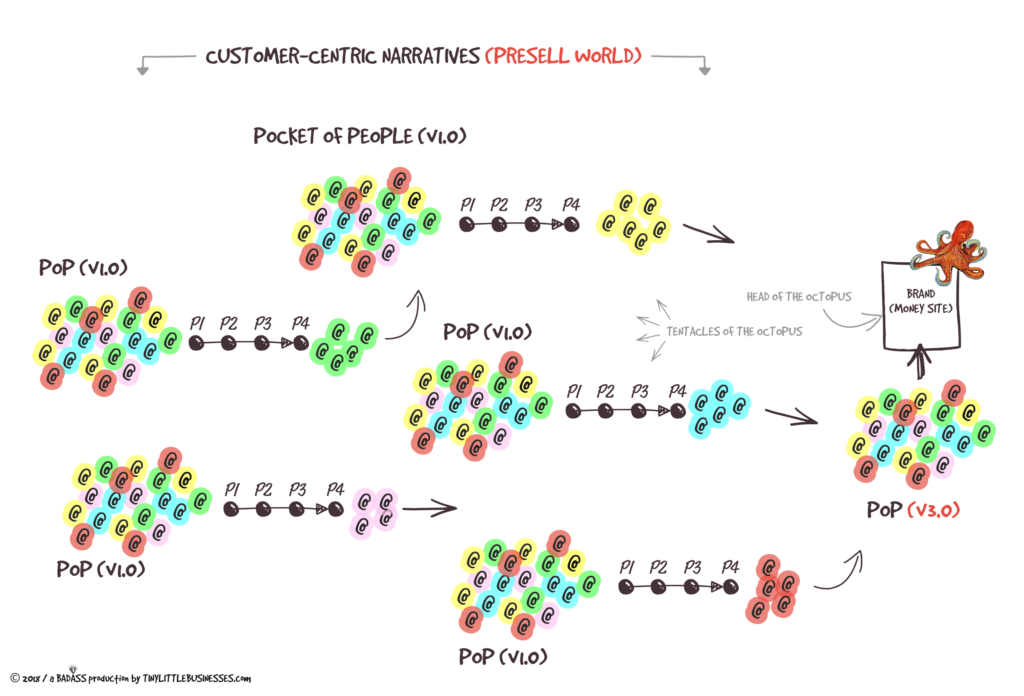
The different colors represent different Presell Sites. Each PS can take your reader on different paths or journeys (more about this shortly.)
I build out a “world” for my POP because its structure allows me to expose each group (according to their pain point) to an EXPERIENCE that feels UNIQUE to them, and is potentially transformational.
It’s like building out a choose-your-own-adventure Matrix movie — or Lord of The Rings world, or The Hobbit world, or Game of Thrones world.
… then allowing your POP to journey through it, and experience “AHA” moments, and find “Easter Eggs,” and overcome mental challenges that matter to them and which THEY need to overcome (through the reshaping and reframing of beliefs).
The Hero’s Journey
Every story (PS) has a visible OUTER journey (hero has a clear desire or goal — like in Die Hard, where John McClane soon realizes that there’s no one to save the hostages, but him).
Simultaneously, whether that’s a fiction book or Hollywood blockbuster movie — a character arc needs to occur (the transformation or INNER journey of a character over the course of the story).
If you’ve been around for any length of time, you’d have noticed that there’s not a movie or a story worth telling, where the lead character (hero) isn’t flawed — and in most cases, VERY FLAWED.
So it’s in the INNER journey where the real transformation happens.
And it’s the experiences from the OUTER journey — the conflict, the insurmountable obstacles, the mental breakthroughs, and having to overcome them all — that cause the inner transformation in the hero.
Same here.
It’s no different.
Only that it’s real life now and not a movie or a fiction book.
Your Customer is the Hero
The heroes of my world are not me; they are each person on their own journey.
I may end up being a hero to them, the person who has their back. But make no mistake, they’re the hero in their own movie.
So I build REAL EXPERIENCES for my POP, or rather, I create a “world” that allows them to have an EXPERIENCE that is potentially TRANSFORMATIONAL.
And when that happens, we both win.
I get a POP who are more closely aligned with me and consequently ATTRACTED to me because of how I do business, and how I help them solve problems.
I know it can seem somewhat overwhelming to think of building out an entire WORLD around your core business.
Resist the urge to be overwhelmed.
It’s not as hard as it may seem.
The Elephant Reality?
Rewatch the video below where Dave Gray explains The Pyramid of Belief (what he calls Liminal Thinking).
But only watch the FIRST 3 minutes, where he illustrates the story of the elephant (representing “REALITY”).
Watch the first 3 minutes now — then pause/stop the video, and then continue:
Here’s the insight…
For one guy the elephant was a wall.
For another guy — a snake.
For the other — a rope.
And finally: a fan.
The worldview of each person in the example Dave was illustrating, was limited to their own immediate reality, perceptions, and beliefs.
In that analogy, the elephant *IS* “reality.”
But because it’s so big, no one can see it all. Therefore much of it is UNKNOWABLE.
This is where my Presell World fits in.
I’m not trying to show my POP the entire reality.
It’s too big, and the firehose onslaught of too much new reality can be very overwhelming and push them away, back into the safety of their own limiting beliefs.
I’m going to digress quickly because I think the point will help demonstrate this part of the process.
Last summer I read an article about the AI (artificial intelligence) revolution and the road to super-intelligence.
It’s a fascinating read.
Here’s an extract that’s relevant to this lesson (read it all):
DPU, or Die Progress Unit
Imagine taking a time machine back to 1750 — a time when the world was in a permanent power outage, long-distance communication meant either yelling loudly or firing a cannon in the air, and all transportation ran on hay.
When you get there, you retrieve a dude, bring him to 2015, and then walk him around and watch him react to everything.
It’s impossible for us to understand what it would be like for him to see shiny capsules racing by on a highway, talk to people who had been on the other side of the ocean earlier in the day, watch sports that were being played 1,000 miles away, hear a musical performance that happened 50 years ago, and play with my magical wizard rectangle that he could use to capture a real-life image or record a living moment, generate a map with a paranormal moving blue dot that shows him where he is, look at someone’s face and chat with them even though they’re on the other side of the country, and worlds of other inconceivable sorcery.
This is all before you show him the internet or explain things like the International Space Station, the Large Hadron Collider, nuclear weapons, or general relativity.
This experience for him wouldn’t be surprising or shocking or even mind-blowing — those words aren’t big enough.
He might actually die.
But here’s the interesting thing — if he then went back to 1750 and got jealous that we got to see his reaction and decided he wanted to try the same thing, he’d take the time machine and go back the same distance, get someone from around the year 1500, bring him to 1750, and show him everything.
And the 1500 guy would be shocked by a lot of things — but he wouldn’t die.
It would be far less of an insane experience for him because while 1500 and 1750 were very different, they were much less different than 1750 to 2015.
The 1500 guy would learn some mind-bending shit about space and physics, he’d be impressed with how committed Europe turned out to be with that new imperialism fad, and he’d have to do some major revisions of his world map conception.
But watching everyday life go by in 1750 — transportation, communication, etc. — definitely wouldn’t make him die.
No, in order for the 1750 guy to have as much fun as we had with him, he’d have to go much farther back — maybe all the way back to about 12,000 BC, before the First Agricultural Revolution gave rise to the first cities and to the concept of civilization.
If someone from a purely hunter-gatherer world — from a time when humans were, more or less, just another animal species — saw the vast human empires of 1750 with their towering churches, their ocean-crossing ships, their concept of being “inside,” and their enormous mountain of collective, accumulated human knowledge and discovery — he’d likely die.
And then what if, after dying, he got jealous and wanted to do the same thing.
If he went back 12,000 years to 24,000 BC and got a guy and brought him to 12,000 BC, he’d show the guy everything and the guy would be like, “Okay what’s your point who cares.”
For the 12,000 BC guy to have the same fun, he’d have to go back over 100,000 years and get someone he could show fire and language to for the first time.
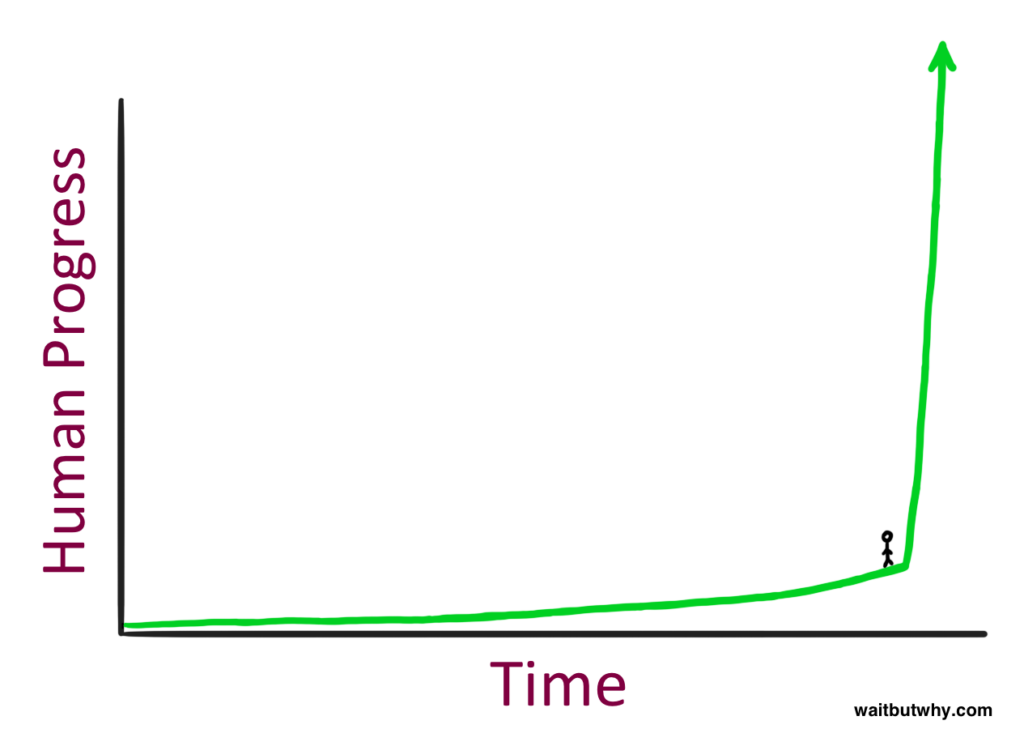
In order for someone to be transported into the future and die from the level of shock they’d experience, they have to go enough years ahead that a “die level of progress,” or a Die Progress Unit (DPU) has been achieved.
So a DPU took over 100,000 years in hunter-gatherer times, but at the post-Agricultural Revolution rate, it only took about 12,000 years.
The post-Industrial Revolution world has moved so quickly that a 1750 person only needs to go forward a couple hundred years for a DPU to have happened.
This pattern — human progress moving quicker and quicker as time goes on — is what futurist Ray Kurzweil calls human history’s Law of Accelerating Returns.
This happens because more advanced societies have the ability to progress at a faster rate than less advanced societies — because they’re more advanced.
19th century humanity knew more and had better technology than 15th century humanity, so it’s no surprise that humanity made far more advances in the 19th century than in the 15th century — 15th century humanity was no match for 19th century humanity.
This works on smaller scales too.
The movie Back to the Future came out in 1985, and “the past” took place in 1955. In the movie, when Michael J. Fox went back to 1955, he was caught off-guard by the newness of TVs, the prices of soda, the lack of love for shrill electric guitar, and the variation in slang.
It was a different world, yes — but if the movie were made today and the past took place in 1985, the movie could have had much more fun with much bigger differences.
The character would be in a time before personal computers, internet, or cell phones — today’s Marty McFly, a teenager born in the late 90s, would be much more out of place in 1985 than the movie’s Marty McFly was in 1955.
This is for the same reason we just discussed — the Law of Accelerating Returns.
The average rate of advancement between 1985 and 2015 was higher than the rate between 1955 and 1985—because the former was a more advanced world—so much more change happened in the most recent 30 years than in the prior 30.
So — advances are getting bigger and bigger and happening more and more quickly.
This suggests some pretty intense things about our future, right?
Kurzweil suggests that the progress of the entire 20th century would have been achieved in only 20 years at the rate of advancement in the year 2000—in other words, by 2000, the rate of progress was five times faster than the average rate of progress during the 20th century.
He believes another 20th century’s worth of progress happened between 2000 and 2014 and that another 20th century’s worth of progress will happen by 2021, in only seven years.
A couple decades later, he believes a 20th century’s worth of progress will happen multiple times in the same year, and even later, in less than one month.
All in all, because of the Law of Accelerating Returns, Kurzweil believes that the 21st century will achieve 1,000 times the progress of the 20th century.
If Kurzweil and others who agree with him are correct, then we may be as blown away by 2030 as our 1750 guy was by 2015—i.e. the next DPU might only take a couple decades–and the world in 2050 might be so vastly different than today’s world that we would barely recognize it.
This isn’t science fiction. It’s what many scientists smarter and more knowledgeable than you or I firmly believe — and if you look at history, it’s what we should logically predict.
Source: The AI Revolution: The Road to Superintelligence
Ok, that may have been a long-winded way of demonstrating a simple point.
Which is: exposing a brand new POP to too much of a reality shift too quickly (challenging their long-held beliefs that govern their world and their reality), can have a similar effect to the DPU (Die Progress Unit) mentioned in the extract above.
In our case, people won’t “die,” of course…
But they’ll bounce. Bye-bye. Never to be seen again. They’ll be scared away.
Kinda make sense?
For this reason, it’s essential to attract people into your world in a way that doesn’t completely violate and shatter their reality too quickly.
.
.
Back to Dave’s elephant example:
The guy perceiving the elephant as just “a wall,” could be shown the rope as a tail. This would expand his current reality and shift his belief systems (without overwhelming his internal programming).
For me, that “rope to tail experience” is the story of Frank & Matt.
Once I’ve won that battle, moving people further down the rabbit hole is 10x easier (and it strategically aligns with the type of people I want to matter to — and those I wish to REPEL — so it’s win-win).
In the same way that once the “wall guy” accepts that there’s also a “rope,” he’ll then be more inclined to accept that there’s also a fan (ear), etc.
Hope this is making sense.
This is why I build my worlds like this.
The paths people take will be different (on purpose).
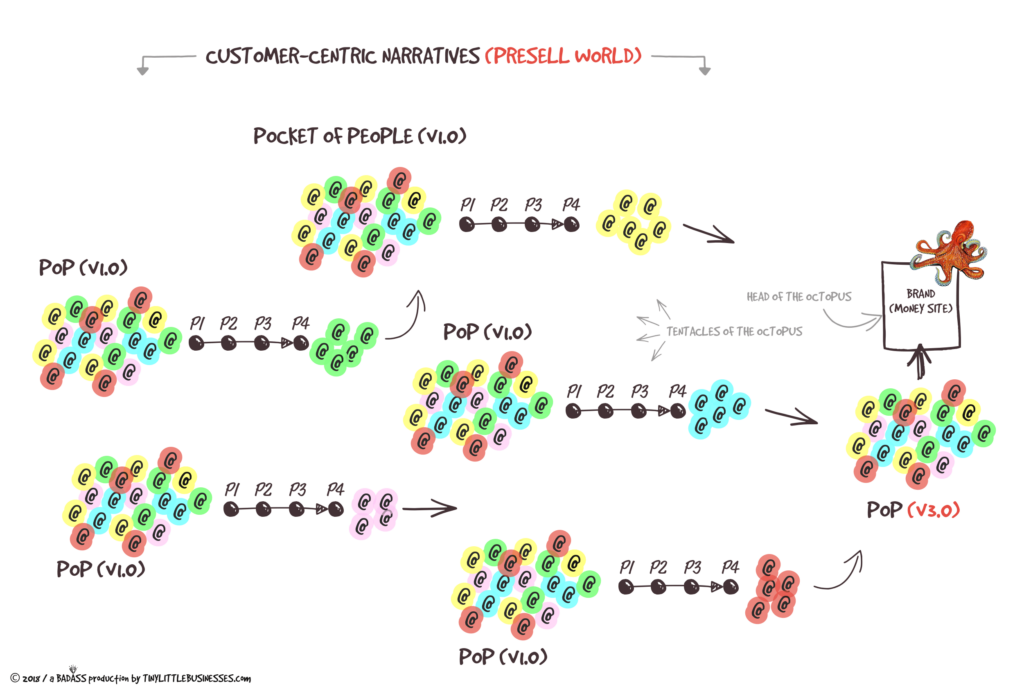
My desire and goal is to expand their worldview, and shift some of their (limiting) current perceptions of reality, just enough to move them closer to me (but not alienate them).
Let’s move on to Part 2 of this conversation…
NEXT: Presell World Structure: Part 2