Here’s that image I drew, again:
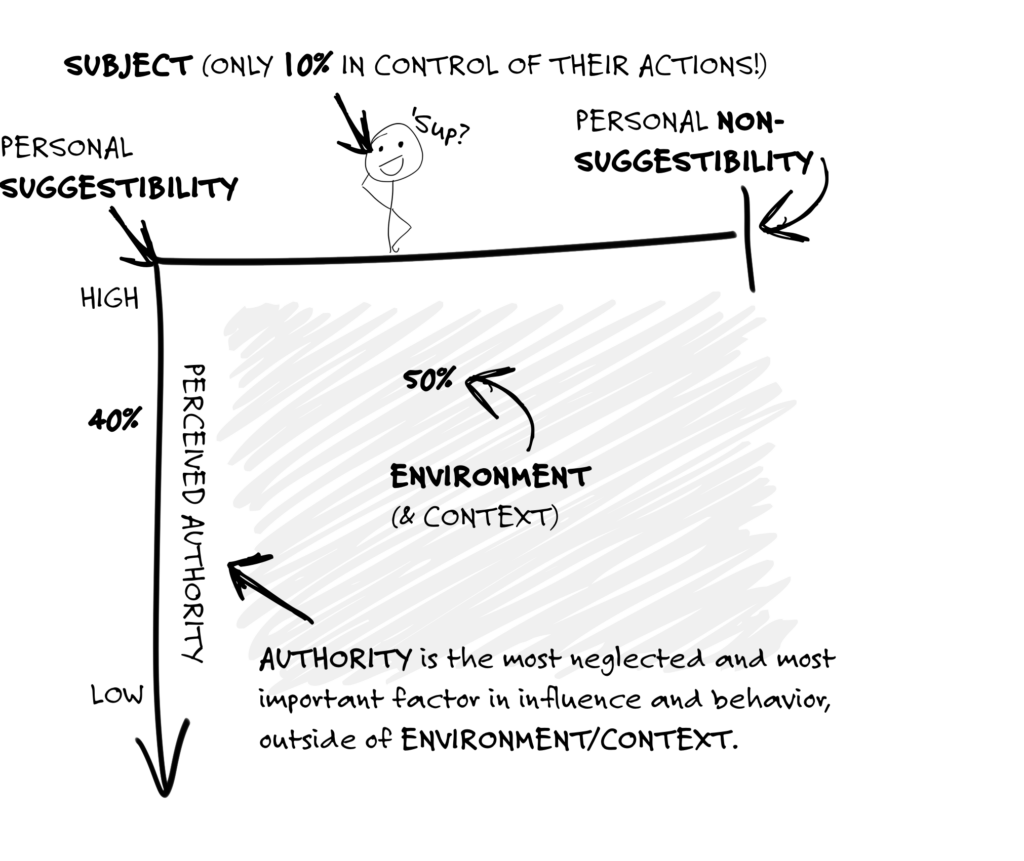
Environment and CONTEXT are the two most important factors influencing behavior. They account for (roughly) 50% of the “suggestibility” of a subject.
The environment can’t always be influenced (not the physical environment anyway, unless you’re presenting on stage to an audience who have had their mobile devices all confiscated).
Meaning that a prospect may be drinking a cup of Joe in Starbucks reading your presell on their iPhone.
Or they may be trying to look busy at work while avoiding the attention of their boss.
They may be in an Uber to the airport with only 9 minutes to kill.
Or in another boring office meeting.
Or at home at 1:20 am (kids all fast asleep).
That’s environment.
It can’t be influenced.
So I ignore the external physical environment (but still mindful that it’s there and can and will affect results).
Instead, focus on what you can control, like CONTEXT, reframing, and creating a virtual environment that is fascinating for the reader, which PULLS them in deeper down the rabbit hole.
This way, even if their initial touch point was a fleeting one, they’re COMPELLED to come back and consume the rest.
Much like the PULL of a good page-turner book. You may have to break away to eat dinner or take the kids to practice, but the pull of continuing is strong and consumes your thoughts.
Or a series of Game of Thrones or Breaking Bad. Once started, there’s no stopping (and for the record, I consumed all five seasons of Breaking Bad in two weeks flat! Just saying.).
Context is Everything
(Write that down and stick it somewhere you can see it every day.)
The context in which we present information, and how we frame that info, affects and shapes the reader’s viewpoint.
A frame is a like a filter; it colors their interpretation, experiences, and emotions. And it impacts how they think, feel, and behave.
Context will usually be the content that precedes a particular message, framed in a way that gives it MEANING.
And STORY is the perfect delivery vehicle for establishing CONTEXT, which sets up a FRAME that WE CONTROL, which then gives MEANING to something.
Here’s an example of context, but presented (for me, and maybe now for you) in a way that triggers another very powerful psychological human trait.
A million years ago, probably around 2004, I watched a video training by Dave Lakhani teaching persuasion (I think this was part of a Joe Vitale workshop, where Dave was a guest).
(Shawn and I were sad to learn that Dave Lakhani passed away unexpectedly in November 2022.)
I don’t have that video anymore (it was on a DVD). And I can’t remember the details of what he spoke about.
But I do remember the WARNING, the context, and frame that Dave gave BEFORE launching into the training.
(Dave used to work undercover for the FBI, infiltrating gangs of dangerous people.)
The warning went something like this:
“What I’m about to tell you is the most powerful stuff you’ll ever be exposed to in the field of persuasion and influence.
It can be used for evil or good. Many people use these same techniques for their own selfish gain and to destroy the lives of others. Don’t do that.
Only use this in a positive way, to influence behavior when it’s in their benefit.”
The context of being a former undercover FBI agent, and the warning Dave gave before anything else, set the context and frame for all that training.
I watched that video of Dave with a heightened sense that what was being delivered was SUPER POWERFUL (that it could destroy lives or be used for good — a powerful frame had been set up that shaped how I saw everything Dave said from then onwards).
It also worked to quickly establish Dave as an authority on the subject of influence and persuasion (I had never heard of Dave Lakhani before then).
That’s context and framing.
Here’s the other POWERFUL thing that happened (you want to pay close attention to this)…
Power Of The First Heard Story
Purpose — to cause people to believe something.
There’s a powerful psychological dynamic called the POWER OF THE FIRST HEARD STORY.
Professors have been running a social psychological project in some universities for the past 30+ years.
They divide subjects into two groups.
Each group receives a booklet that tells a story about the current president of America.
The story in the first booklet is negative and paints the president as a moron. The story in the other booklet is positive, and paints the president as a kind and loving person.
It’s important to note that neither story attacked the president. It was merely a story of the president biased in a positive or negative light.
What happens next wasn’t completely surprising.
The two groups of subjects were then asked a series of questions about the president to evaluate him on various character traits.
As you may have guessed, the first group gave responses that were more positive, whereas the second group gave answers that were more negative.
So far so good.
This next part is fascinating though.
The professors then revealed to each group that the story in the booklet they just read, was a COMPLETE lie; that they made it all up as part of a social experiment.
With me so far?
Well, it turns out, a month later they interviewed the same two groups again. Remember, this is AFTER they were told that the story they read was MADE UP.
They were asked the same set of questions — and both groups responded in the SAME WAY to their ORIGINAL responses.
No different, even after being told the story was fabricated. The story they heard first was the story they’re biased to believe. Period.
That’s the POWER of the FIRST HEARD STORY.
And it’s why CONTEXT and FRAMING are so important. Because if you don’t use context to establish the frame ON YOUR TERMS, they will use their own frame (based on their beliefs and how they see the world).
I could watch another 50 videos of Dave Lakhani, but I will always recall that first story, and it’ll always color the lens I see Dave through.
NEXT: Commitment and Consistency