Several years ago one of my employees wrote the following at the top of a white board in my office — “framework before work“. (Thanks Tyler.) That simple phrase has stuck with me ever since.
A framework is a way of understanding the world. For example, traffic + conversion* is a framework. It’s a useful model for distilling everything a business does into two broad categories — creating/channeling awareness (traffic) and transforming that awareness into a result (conversion).
*My good friend Jack Born expanded the traffic + conversion framework to include economics — it’s worth your time to study his model deeply. You’ll thank me later.
In my experience, taking the time to identify and validate frameworks has many benefits.
I’ll share two frameworks for paid traffic — the first in this lesson, and the second later in this series (day seven).
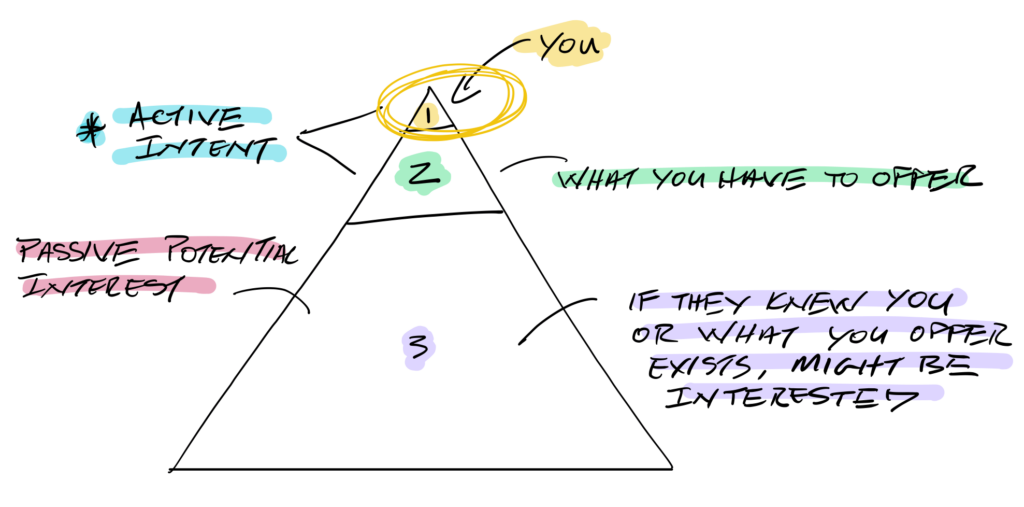
All online traffic — paid or organic — fits into one of three (and only three) categories. I’ve spent decades thinking about this, and I haven’t found a single exception.
First, there are people searching for you. “You” could be a person (e.g., a search for Andre Chaperon), something you have created and named (e.g., autoresponder madness), or a business (e.g., Netflix).
In general, this first type of traffic is the lowest volume and highest quality. It’s also the easiest to acquire — Google wouldn’t be Google if people didn’t find you when they search for you. Organic search drives most of this traffic — however, paid search also plays a role if your competitors bid on your branded keyword phrases.
Second, there are people searching for what you have to offer. The critical distinction in this second category is that the searches are not specific to you, but you provide a solution that matches the search.
For example, Art of Email would be a useful search result for “email marketing course,” but it’s not specific to any particular person or product.
This second category of traffic is high quality and often high volume. It’s often very competitive. (BTW, competitive is good. When there’s competition that means there’s money to be made.)
The third category of traffic are people who, if they knew you or what you have to offer exists, might be interested. This is the largest audience and also the lowest quality.
The critical distinction between these three types of traffic is intent. When someone searches they have active intent — they’re looking for something (often in terms of solving a problem or finding a known solution).
roofing contractor near me is a solution-focused search. how to fix a leaky roof is a problem-focused search.
The third category of traffic does not have active intent — they’re not looking. Instead, because of some combination of demographic and psychographic characteristics, they might have passive potential interest. Meaning they might like it (and buy it) when they see it, but they’re not looking.
For example, I have been a customer of GoRuck for several years. GoRuck makes special forces-grade backpacks and other gear. It never would have occurred to me to search for their products (by name or by type), and I was not actively looking to solve a problem. Instead, I stumbled on their story (awareness), found myself increasingly intrigued (interest/desire), and eventually became a repeat customer (action).
Here’s the framework, in brief:
- Category 1: People Searching for You. (Organic search, paid search — particularly Google and Bing.) Lower volume, ultra high-quality.
- Category 2: People Searching for What You Have to Offer. (Organic search, paid search — particularly Google and Bing. YouTube in certain circumstances.) Higher volume, varying quality depending on search terms, (usually) highly competitive.
- Category 3: People Who, If They Knew You or What You Have to Offer Exits, Might Be Interested. (Facebook, Google Display Network, YouTube, LinkedIn, affiliate emails, etc.) Enormous potential volume, very low overall quality.
Today’s assignment — identify how you’re currently getting traffic in each of these three categories. For example:
- Category 1: organic search.
- Category 2: Google Ads.
- Category 3: Facebook. YouTube.
For extra credit, identify the relative volume and quality of traffic using Google Analytics or a similar tool:
- What percentage of your traffic is acquired from each traffic category?
- What is the cost?
- What is the revenue? (If you don’t have revenue data, pick another meaningful metric like lead volume.)
Up next — why “media buying” is dead (and a much better way to think about paid traffic).
NEXT: Just Say No to “Media Buying”