Before we get into the content of this module, I’d like to give you some background about my agency experience so you know my perspective (and the limitations of that perspective). This context is important for everything that follows.
I opened a design/build and e-commerce agency in November 1998 after several years doing freelance website design/build work (in addition to my full-time job at the time). This was at the very beginning of the commercial Internet and design/build work was everywhere (and it was highly profitable).
As difficult as it is to imagine now, I remember many conversations where clients expressed reservations about projects because they were concerned that “this Internet thing might not take off”.
Seriously.
Since 1998, I and my team have completed more than six hundred and fifty projects on behalf of nearly two-hundred clients in a wide variety of industries, including B2B, B2C, higher education, U.S. and foreign governments, K-12 education, non-profits, and many more.
During that same period of time, I’ve managed many tens of millions of dollars in ad spend on behalf of clients, primarily on Google Ads (formerly AdWords) and Facebook.
In the early days, I had to learn most of what I sold after I had sold it, figuring out each new skill as necessary. Google AdWords was one of those early skills, and Facebook paid advertising followed many years later.
I’m incredibly curious in general and love learning, and for my entire professional career I have been drawn to projects where learning something new is a critical component. I would not dare guess how much money I have invested in training programs over the past two decades, but I am certain that’s measured in the hundreds of thousands of dollars (and worth 100x what I paid).
In recent years I’ve shifted more of my focus toward consulting, working primarily with large, established direct response businesses in some of the most difficult markets imaginable.
My agency has always been boutique, with each client’s strategy created specifically for that client. I have never product-ized my offers (which means I’ve left enormous amounts of money on the table).
With all of that as background, I’m going to discuss two topics in this first module — finding clients and working with clients. My examples will be specific to finding and working with clients who want paid traffic services (Google Ads and Facebook), but most of what I’ll share is useful well beyond that context and applies to a much broader view of working with clients as a service provider (freelancer or agency).
‘Conventional wisdom’ and ‘best practices’ suggest a seemingly infinite variety of ways to build a client-services business. I won’t repeat those here because, in general, I have not found those strategies to be particularly useful.
Instead, there are three core principles that have served me very well, and those principles are equally accessible to you.
I want to be transparent and completely honest. I did not see these principles in advance and then design my business around them following some brilliant master plan. Instead, I have fumbled my way through every mistake imaginable, gradually improving year after year as I developed greater clarity.
These principles emerged when I have looked back on my professional journey, and I hope they embody wisdom that you can use to avoid many of the headaches I endured with my trial and error approach.
Principle #1 — Positive Correlations Compound Over Time
This is an idea I first learned from an amazing (and exceptionally difficult) book entitled Diaminds: Decoding the Mental Habits of Successful Thinkers, by Minhea Moldoveanu and Roger Martin.
The authors explain that seemingly minor improvements in performance result in exponentially better results when measured over long periods of time, if there are sufficient opportunities to utilize those improvements.
“…even a small positive correlation between possessing a certain trait…and success compounds over time to very high effective rates of return, provided that the interactions that make use of that trait are dense!”
I know what you’re thinking — have I gone completely crazy? What does this have to do with attracting clients? Let me explain by asking a few questions and then sharing several examples.
What knowledge, experience, skills, traits, or quirks do you have that create opportunities to be even slightly better than your competitors?
- For example, do you communicate better verbally or in writing?
- Are you comfortable presenting on stage, or more comfortable in a room with decision-makers?
- Do you have high empathy, sensing what a client needs even if s/he isn’t able to articulate those needs exactly?
- Have you worked in a particular environment where you know the language and nuances better than others who are less familiar with that environment?
Make a list of possibilities. If you’re struggling, ask friends, family and colleagues for their input. Remember, you’re looking for comparative advantages, not necessarily factors that create opportunities to be world-class.
Next, who values those particular skills significantly more than the average? What type of business, or individual, or situation over-values the knowledge or skills where you have even a slight advantage?
Let’s consider some examples to better illustrate the point.
One of my professional advantages is decades of experience running paid search campaigns. That experience is valuable to the owner of a local pizzeria near where I live who is spending hundreds of dollars per month on Google Ads. It’s also valuable to multi-billion-dollar direct response companies spending millions of dollars per month on Google Ads.
Which of those two is likely to over-value my expertise? I may be able to increase the local pizza owner’s business by 10%. If that’s a $250,000/year business, my potential value to that client is $25,000. The obvious question to determine my earning potential in that relationship is what is the maximum the local pizzeria owner would be willing to pay to add $25,000 in revenue to her business, all things considered (e.g., margins)?
The short answer is not very much.
Now let’s consider the multi-billion-dollar direct response company. For easier (and more realistic) math, let’s assume I work with a small division within that company that generates $100 million per year in revenue. And my expertise contributes a very conservative 2% improvement, which is +$2 million.
What is the maximum that business would be willing to pay to add $2 million in revenue to her business, all things considered?
The short answer — a LOT more than the pizzeria owner.
No doubt the pizzeria owner would value my work. But, the direct response company will value it significantly more (and pay me accordingly) because I can contribute so much more on their behalf.
These are extreme examples used to illustrate the larger point. If there’s a secret to building an agency or freelance business, it’s this: combine the few things you naturally do better than most people with an audience that over-values those few things, and then let time compound the effects of that dynamic.
I can’t overstate how valuable this will be to your short and long-term success.
In the short-term, focusing more of your time and energy on what you do well dramatically increases your enjoyment of work. That creates a positive feedback loop that makes you even better at that work (which further increases your enjoyment, and creates more opportunities to be paid well to do that work).
In the medium and long-term, the advantages you gain from working with clients who over-value the things you do better than others is staggering. That, too, becomes a positive feedback loop that affects your satisfaction with your work and the financial impact it creates in your life.
There’s one last variable to consider before we move on, which wasn’t discussed in Diaminds, but has been very important in my experience.
The strength of the difference speeds up (or slows down) your results. In Diaminds, the example effect was a 1% improvement compounded over thirty years of dense interactions. If you’re significantly better at something — 10-20% better — the compounding effects occur much faster. And it’s not difficult to be 20% better at something. (This entire course is designed to make you orders of magnitude better at paid traffic, for example.)
The actual math doesn’t matter, and I don’t want any of us to get hung up on that. It’s the underlying concept of combining a significant competitive advantage with an audience that places a very high value on that particular advantage. Those two ingredients combine to produce exponentially better results. Each, on its own, is far less important, but their interaction creates spectacular results.
The challenge, of course, is to find your specific opportunities for advantages. Look broadly at your professional experience, interests, hobbies, strengths, and quirks. For example, if you served in the military, or worked in a particular field, or have a hobby you take seriously, you probably have insights that others outside those areas don’t.
Every endeavor has its own language, nuances, and core drivers. Where are you familiar with those factors that others are not? That’s a start.
Personal quirks can be fertile ground to explore too. For example, I love to learn and have honed my own method for identifying and learning the most important elements of a discipline quickly. I’ve done it so long it’s second nature to me, and more importantly, I absolutely love doing it.
That has given me an enormous long-term advantage in a field as new and rapidly changing at digital marketing. I lot of my success has come from the ease with which I’m able to acquire and execute new skills. That one advantage has had profound effects on my value to clients and enjoyment of my work.
My best friend of 30+ years, on the other hand, is an excellent, friendly communicator. He has spent decades in an IT career that traditionally does not have high-empathy individuals who communicate well, and he has continued to excel year after year because of his strong people skills that are less common (and therefore over-valued) in a field dominated by people with strong technology skills.
I can’t over-emphasize how important it is that you do this work for yourself. If you want to go really deep, Strategic Coach founder Dan Sullivan’s work on what he has called “unique ability” is the gold standard.
Here are a few resources that may help:
Unique Ability®: Simplify Your Time, Effort, And Teamwork
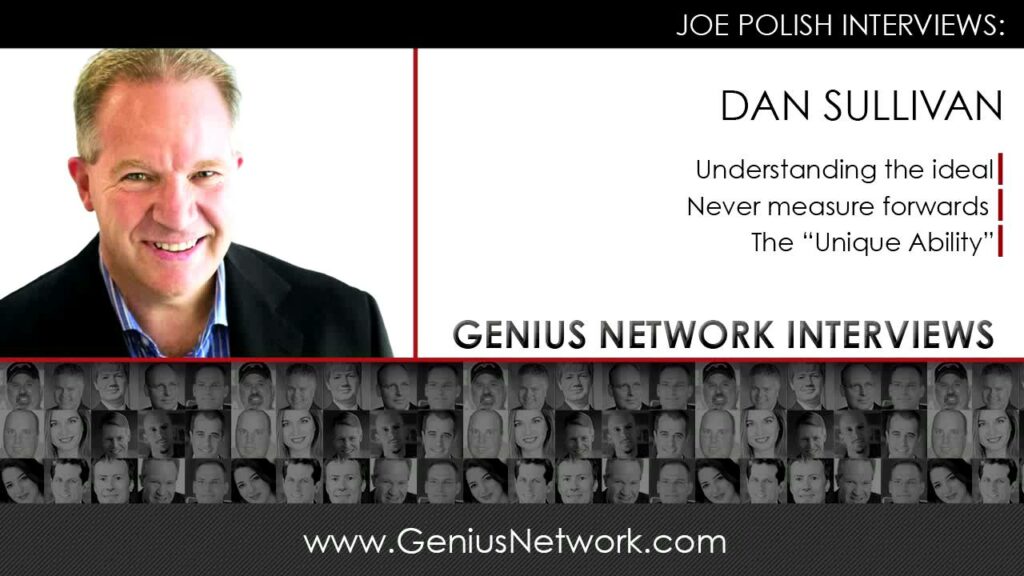
Dan Sullivan Unique Ability: Genius Network Interviews
- Unique Ability® 2.0: Discovery, Define Your Best Self ($44.95, book and companion notebook).
The two videos are worth your time. Watch both and think deeply about the ways in which you can use this information to identify your areas of potential competitive advantage. The book may be more detail than you need, but I’ve included it because it’s a great resource if you want to dive deep into the topic.
I want to emphasize this is not quick and easy work. There’s no checklist to follow to ensure you get it right. In my experience, it’s more like a series of course-corrections over time. Gradually, you’re increasingly clear about what you do well, who you work best with, and how those distinctions create a positive feedback loop for identifying and working with better clients.
Principle #2 — It’s the Clients You Avoid that Matter Most
Throughout the remainder of The Traffic Engine (and beyond), I’d like you to keep two lists easily accessible (digital or analog). One list will be titled “This”, and the other will be titled “Not This”.
Every time you find yourself enjoying your work, take a moment to understand the source of that enjoyment. Describe those observations succinctly on your “This” list.
In my experience, this will be the more difficult of the two because we’re easily immersed in work that we enjoy, often so much so that we forget to record it. Do your best, even if that means reflecting back on it a day or two later.
- What were you doing?
- Where were you working?
- What was your environment like (music, quiet, silent, etc.)?
- Who or what was the work for?
- Were you self-directed or responding to requests from others?
- What, specifically, made the work so enjoyable (content, process, or other characteristics)?
The list of questions is deliberately incomplete. Include your own questions (and improve those questions so they’re more valuable and more meaningful to you over time).
Every week, review the “This” list and lightly organize it. You’re looking for actionable insights and themes. The ultimate goal is to create your own professional user’s manual for how you work best.
The second list — “Not This” — will be a lot easier to create (and, if my experience is any indicator, a lot longer too). This list is a way to track everything that you don’t enjoy, big or small, significant or trivial.
Often you will have a physiological response — you literally feel that something is off, often in your stomach or chest. When that happens, stop and take the time to deconstruct what happened.
- What were you doing?
- What happened immediately before you felt that way?
- Where were you working (physically)?
- Where were you working (digitally — for example, were you using a particular app / tool that’s problematic)?
- Who or what was the work for?
- If the issue was with a client, on a scale of 1-10, how much do you like the client (you can’t choose 7)?
Pay particular attention to moments of transition, often from one client to the next, one project or task to the next, and one tool (app / software) to the next?
And pay very close attention to email, particularly from clients. You may be surprised how often, and how much, your day is affected by emails (or other messages) you receive.
As an example, here’s a partial list I’ve learned about myself from this exercise.
- I don’t manage transitions well. I’m very happy when I’m immersed in work, but I can go off the rails transitioning from one project to the next if I don’t know specifically what I’m doing next.
- I do not like unscheduled phone calls or other interruptions when I’m working. (This is a gentle understatement. I border on losing my mind if a client calls me expecting I’ll pick up the phone unless it’s a ‘something is on fire’ emergency.)
- I need my workspace to be silent — no music or background noise, including conversations.
- It’s easier for me to answer questions than it is to create content from thin air. (That’s one of the reasons I enjoy responding to comments — that helps frame my thinking more effectively than I do on my own naturally.)
- I can’t check my email at night. I’ve lost too many nights of sleep churning about irritating messages and the only way to avoid that is to avoid email after work, period.
This is a (very) small sampling of insights I’ve learned about myself from keeping my “This” and “Not This” lists.
But wait…there’s more…
Most of your “Not This” list should be devoted to whatever bothers you about clients as those issues arise. Your goal is to create one of the most important documents you’ll ever have in your business or career — the “client characteristics to avoid” list.
Here’s the big secret of working with clients — you get to choose who you work with, and avoiding bad clients is way more important than choosing great clients. Orders of magnitude more important.
I remember reading somewhere that it takes seventeen positive interactions to offset the effects of a single negative interaction (which I suspect may have been overstated in the first place, and then misremembered on my part).
Regardless, I’m willing to offer my own personal estimate that it takes ten good clients to offset one bad client. Possibly more.
I can’t overstate this — do not work with bad clients. This seems so obvious, yet I know so many service providers who suffer through miserable client relationships.
A client-services business isn’t a fast food franchise open to everyone. You get to choose your clients, and those choices will have an enormous impact on your happiness, well-being, enjoyment of your work, and yes, your financial opportunities.
Working with clients you don’t like is demoralizing and draining (often for both parties). You’re doing the client, and yourself, an enormous favor by politely declining work that does not fit the profile of clients you serve best. Or, if you entered the relationship with the best of intentions and it’s not working, firing bad clients is one of the most satisfying things you can do.
That doesn’t have to be mean-spirited and no one has to be at fault. However, the longer you wait the worse it’ll get. In twenty-one years I’ve never had a bad client turn into a good client. Never. And I’ve never regretted firing a client.
“Good” and “bad” clients are misnomers (usually). It’s better to think of clients as a “good fit” or a “bad fit” based on factors that bring out your best in a client-services relationship.
Here are a few factors to consider from my collection of agency war stories.
Do you like to be told what to accomplish, or told what to do? I had the privilege of spending a day with Peter Schutz, the first American CEO of Porsche, and he opened my eyes to the difference.
“You can tell people what you want them to accomplish, or you can tell them what you want them to do. Not both.”
That’s a critical distinction. You may like a client’s involvement in prioritizing tasks, and that may be important for the work you choose to do. There’s nothing wrong with that.
Or, if you’re like me, you may want to know the outcomes and metrics and then use your experience and expertise to achieve those outcomes (without any suggestions about how to do that, thank you very much…).
There’s no right way. There’s the way that’s right for you. But it’s critically important to understand there’s an enormous difference between these two types of work and, if you’re in a situation that’s not how you like to work, it can be maddening.
I, for example, will not work with clients who want to manage by tasks, even if they’re otherwise amazing clients. Too many times I’ve said yes to that arrangement, either explicitly or implicitly, and regretted it terribly.
I would rather walk barefoot through a half-mile of broken glass than have someone manage my work at the task level. (BTW, that’s .8 kilometers for those of you outside the U.S.)
Another consideration — are you a ‘vendor’, a ‘partner’, or a ‘service provider’? Again, there’s no right answer. You may think of yourself as a vendor responsible for a certain type of work and accomplishing that work may bring you joy (and wealth). Or, you may have a team and think of you and that team as a group of service providers, broadly responsible for work (and proud of all you and your team are able to accomplish).
Both are excellent choices if they’re the right choices for you.
I, on the other hand, consider my clients partners. Not in the legal or financial sense, but in terms of relationships. I still work with my first client (every week for twenty-one years and counting), and have had many clients for 15+ years. I care deeply about their success, I’ve seen their kids grow up (and they’ve seen mine grow up). When I work with new clients I think deeply about what it would be like to work with them for decades.
Conversely, I’m not particularly interested in short-term projects where I won’t have time to build real relationships. The real joy I get from my profession is working with amazing people — the work itself is just the vehicle that creates the opportunity. That’s true for me, but it’s certainly not true for everyone. I have colleagues who are amazing at building marketing systems and they get their excitement from creating something from nothing, then moving on to do it again.
We all have our things that lights us up — what matters is that you find yours and embrace the hell out of them. And to do that successfully, the best decision you can make is to avoid opportunities that are a bad fit for you.
I want to be clear that this is not easy. I have said yes to clients, projects, and professional relationships that I have quickly regretted far more often than I care to admit. It’s easy to make this mistake, especially if the financial compensation is attractive. If you have made this mistake too, don’t worry about it.
It’s not about being perfect, it’s about making consistently better choices going forward.
At a minimum, once you’ve started your “This” and “Not This” lists, begin to upgrade your clients over time to create more opportunities from your “This” list.
Every bad fit client you don’t take creates space for a good fit client. Take that very seriously.
Principle #3 — To Find Clients, Focus on The Horse, Not the Jockey
One of the questions I ask early in new client relationships is “who already aggregates your audience”? For example, if you sell financial and health advice to politically conservative Americans 55 years old and older, Fox News and Newsmax aggregate your audiences for you. They’ve done the work to attract and retain that audience, and they sell access to that audience through advertising.
Or, at the local level, if you’re a mortgage lender, real estate agents aggregate your audience. They’re in contact all day, every day, with your ideal prospects (i.e., people buying homes), and their recommendations for lenders are very valuable.
In our little corner of the digital marketing world, conferences like Digital Marketer’s Traffic & Conversion, Jeff Walker’s LaunchCon, and Russell Brunson’s Funnel Hacking Live aggregate thousands of digital marketing prospects and service providers physically (and virtually).
And, of course, Facebook and Google are enormous audience-aggregation platforms, using search intent (Google) and demographic/psychographic/behavioral characteristics (Facebook) to make audiences accessible for our messaging and offers.
Each of these is a “horse to ride”, according to Richard Koch (author of several profound books on the 80/20 principle). A horse, by Koch’s definition, is “something with inherent power to propel you”.
“When I was 30, I was more-or-less fired from one job (with the Boston Consulting Group) but talked my way into another with a smaller rival, Bain & Company. But the thing was — Bain had a great business formula and was growing much faster, at 40 percent a year. Yes, each year the firm got 40 percent bigger. You can imagine the opportunities presented by that growth rate. From being a failure I turned into an overnight success — doing exactly the same job. It wasn’t me, it was the growth rate. I was stretched, learned a lot and became so much more confident. I even started to enjoy what I did.” — Richard Koch
My agency has had many horses. The first was the Internet. Building and maintaining websites in the last 1990s and early 2000s generated millions of dollars in revenue because of the opportunities the Internet created for my clients who needed my expertise.
But make no mistake, the power that propelled that revenue and made everything possibly was the horse, i.e., the Internet. Prospects had been convinced they needed websites on their own, without my involvement, and they then turned to me to fulfill needs that other forces had created (that I then benefited from).
Later, Google AdWords propelled my career again when paid search became a viable platform for growing businesses online, followed years later when Facebook launched its advertising platform.
Both Google and Facebook promote and improve their advertising platforms and I, as the rider, benefit from that promotion (and from the platforms themselves).
How does this apply to attracting clients? I’m glad you asked.
Let’s imagine, for a moment, that we’re paid traffic specialists trying to decide how to grow our one-person shop into a larger agency. We could look around and see who might benefit from paid traffic, and then craft amazing value propositions to convince prospects to use paid traffic for their businesses.
We might be successful, but I’m guessing we would have an uphill climb.
Rather than spend our time trying to manufacture desire in the marketplace, we could turn our attention instead to where others have created that desire already, and then sell to them.
We could, for example, create a paid traffic strategy specific to the needs of Jeff Walker’s Product Launch Formula-style launches, and then go to LaunchCon and sell to people who are already receptive to our value proposition by virtue of the fact they’re at that conference.
Jeff has spent many years doing the work to create an audience of prospects for Product Launch Formula, teaching them the methodology and the language. PLF is the horse, and we’re simply letting that horse propel us forward.
And we don’t have to limit ourselves to PLF. We could just as easily familiarize ourselves with Digital Marketer’s methodology and language. Ryan Deiss and his team at Digital Marketer have educated tens of thousands of prospects about “tripwire offers”, “splinter offers”, “core offers”, and upsells. That audience is primed already because Digital Marketer has created an army of prospects for our paid traffic services.
Russell Brunson has done the same thing. Thousands of Funnel Hacking Live attendees learn Russell’s formula for a “perfect webinar”, copy his templates and use his software (ClickFunnels) to have an offer up and running in days.
The list goes on and on, and the point is that we don’t have to make waves to ride, we can ride waves that others have created already.
As service providers, we’re also not limited to a single methodology. I’ve mentioned repeatedly that our offers are expressions of our services, not the services themselves. Our services are paid traffic strategy and execution, but our offers can be paid traffic for PLF-style launches, paid traffic for a Digital Marketer inspired “tripwire” funnel, paid traffic to a “perfect webinar”, and more.
You can find your horses to ride everywhere. Audience aggregation is an easy starting point, but there are many others. Professional background, personal hobbies and interests, sub-groups you belong to — all of these (and more) have potential.
“Life is not just you or me — it is the vehicle (or vehicles) we find to develop our skills and express ourselves that counts. And even then, perhaps our skills matter little compared to the destiny of the horse.” — Richard Koch
Here’s how you can exploit this principle.
If you’re already working with clients, make a list of every client you’ve worked with and look for patterns. Did they all have something in common? Did some of them?
(If you’re not working with clients already, don’t worry. Just skip this step.)
Next, identify any digital marketing or paid traffic-specific training you are familiar with. (Please be aware that the examples I used — PLF, Digital Marketer, and ClickFunnels, all have paid service provider certification programs. I don’t have experience with any of those to make recommendations, but I do want to be clear that I’m not suggesting you represent yourself as a certified expert if you’re not. You need to do the work to create the value, whatever that entails.)
Then, identify the tools / platforms you’ve used, emphasizing any you know how to use particularly well (or that interested you enough that you would be interested in more in-depth learning).
Finally, make a list of any other relevant skills that you have (e.g., a background in copywriting).
Once you have these lists of ideas, start looking for potential “horses to ride”. Don’t worry about making the perfect choice yet — just start thinking. The larger the potential audience the more potential power your horse will have, and you have many options to choose from.
Start noticing the work you enjoy most too — that’s a huge factor. I fell in love with AdWords early because it’s a closed system that rewards excellence, and for some reason that just made a lot of sense to me . It was easier for me to ride the wave of Google AdWords in the early years because I loved the work.
Look for similar opportunities for your own wave to ride. If you write well, for example, SOI + AoE benefits enormously from good writing. That’s true for long-copy Facebook ads too. If you put those three things together, and create a positive feedback loop because you enjoy the work, you’re on the right track.
One last thought before I close. All of the work in this module is easy to skip. Please don’t. These seem like simple ideas, but the blood, sweat, and tears I shed to understand them was overwhelming. Study these three principles, rewrite them in your own words, and create your own examples. I promise you’ll be rewarded for that effort 1000x or more.
NEXT: Client-Services Module 2: Common Problems and Solutions, Including Pricing, Reporting, Managing Client Expectations, and Communication