The goal of the Discover Process is to define a minimum viable audience (MVA) you seek to serve and then identify 1-3 significant problems you can charge money to help that audience solve or 1-3 meaningful desires you can help them fulfill.
The three most important words in that paragraph are minimum, significant, and meaningful.
It is very easy to get this wrong. If an audience is too large, the feedback we get is less precise and therefore less useful.
If we focus our attention on problems that are not significant or desires that aren’t meaningful, we undermine our potential results because our prospects are less motivated to act (which means they’re less likely to buy eventually).
In the Discover Phase, we focus all of our attention on immersing ourselves in the needs of a minimum viable audience.
In the Validate Phase, we begin to test our ideas and hypotheses for potential solutions that we’ll later express as offers and expose pockets of people to.
Let’s begin …
We’re going to start from the assumption you don’t even have an idea yet for an offer.
Part 1 — The Venn Diagram
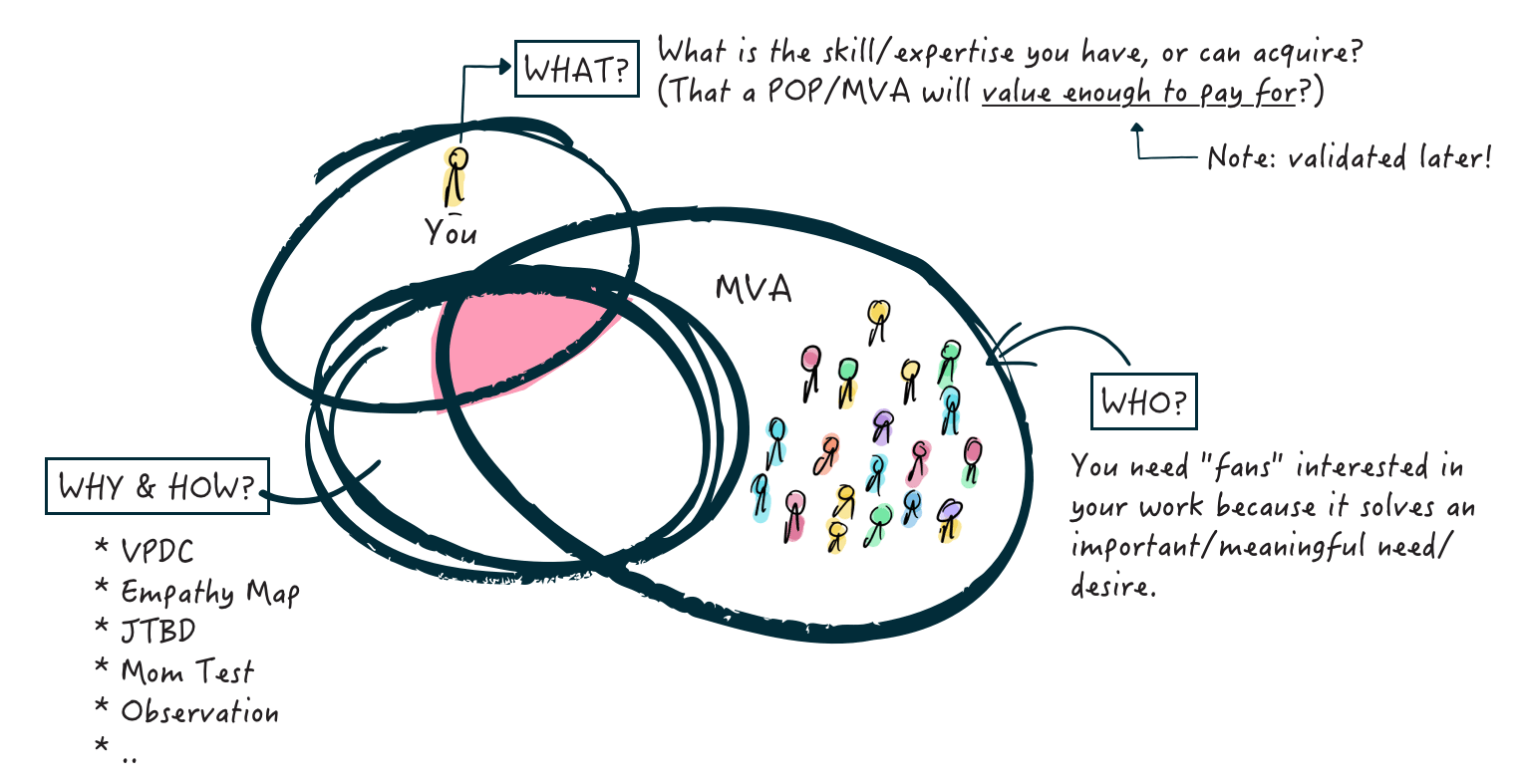
A really strong offer is a combination of:
- The creator’s interests, experience, and/or abilities;
- An audience that has a need for the outcomes created by those elements; and
- A clearly articulated description of the value — to the audience — those elements can create.
We’re going to focus on the first two in this module (the third will be included in the Validation Process).
Let’s start by identifying your interests, experiences, and/or abilities (skills).
Notice that we didn’t include your passions in that list. That was deliberate. In our experience, ‘finding your passion’ is quicksand to be avoided.
Why?
‘Finding your passion’ is a deliberate, reductionist attempt to identify something that is most likely an emergent property of a larger system. And this orientation focuses our attention inward — on what we want — vs. outward, toward what our customers want.
TDB emphasizes building a happy-customer-centric business which means we’ll focus our attention on our customers’ needs first.
Cal Newport calls this “The Passion Hypothesis,” which he defines as the belief that “The key to occupational happiness is to first figure out what you’re passionate about and then find a job that matches this passion.”
Newport systematically deconstructs that hypothesis in his book So Good They Can’t Ignore You: Why Skills Trump Passion in the Quest for Work You Love.
“There is, however, a problem lurking here: When you look past the feel-good slogans and go deeper into the details of how passionate people like Steve Jobs really got started, or ask scientists about what actually predicts workplace happiness, the issue becomes much more complicated. You begin to find threads of nuance that, once pulled, unravel the tight certainty of the passion hypothesis, eventually leading to an unsettling recognition: ‘Follow your passion’ might just be terrible advice.”
Instead, Newport suggest what he calls a craftsman’s mindset where we focus on the value we’re producing for others in our work.
“There’s something liberating about the craftsman mindset: It asks you to leave behind self-centered concerns about whether your job is ‘just right,’ and instead put your head down and plug away at getting really damn good.”
That’s the approach we suggest you take with TDB.
One final note on passion: The work you do doesn’t need to be “a passion” — (watch this then this) — but you do need to love doing the work. (That may sound similar, but loving the work you do is not the same thing as trying to figure out, in advance, perfect work that you’ll love.)
Here’s an extract from The Practice by Seth Godin (with permission from Seth to share here):
OK, let’s move on …
The first questions to answer are:
- What interests you?
- What skills have you learned, what hobbies have you pursued, what experiences have you had?
- How do you choose to spend your free time; what consumes a large part of your mindspace?
- What would your calendar and credit card statements say about your interests?
- How do you spend your time, attention, and discretionary money?
To capture the results from this exercise, make three lists:
- Your skills.
- Your hobbies/interests.
- Your experience (professional and personal).
Do not rush — expect to spend 2-3 hours, minimum, and to revisit the list over days (or weeks).
Once you have lists that feel reasonably complete, take one pass through all of them and cross out (or delete) anything that doesn’t really excite you.
Then, start asking “why” — repeatedly — for everything on your list (and capture your answers on a separate list). We prefer to do this with pencil and paper — digital works too, but in our experience it’s not as effective initially. (You will make a digital list later.)
Don’t just ask “why” once and move on. Dig deeply. You’re looking for the core drivers underneath your interests, hobbies, and most powerful experiences. Five Whys is the benchmark.
This process should take as long as it takes. If you want to finish in an afternoon that’s fine. Or, if you want to spend a week or two, that’s also fine. There is no right answer, there’s only your answer.
We strongly recommend that you plan on 10+ hours for this work. Remember, we’re going slowly now so we can go much faster later.
At the end of this process you should have a significantly shorter list that’s a collection of themes that show up consistently in your life.
(Shawn’s note: For example, when I’ve done this exercise curiosity and a love of learning shows up as a central theme in my life. That is foundational for me, and it’s a powerful motivator.)
(André’s note: I’ve added a supplemental piece at the end of this of how I uncovered the central theme and motivation in my life.)
Next, when you look at that revised list of themes, start to imagine who could benefit from what you already know. It’s very important to be as specific as possible for this part of the exercise.
Let’s look at an example.
Let’s assume that we have experience and expertise in helping people lose weight quickly. If we define our audience as ‘anyone who wants to lose weight quickly,’ we’re doomed from the start.
Our messaging won’t be relevant to most people, and the problems we solve and desires we fulfill will be generic (and boring).
Instead, we need to narrow our focus to a small subset of the market. For example, we could choose to work with brides who want to lose weight for their wedding.
Is that narrow enough?
Hell no!
We want to get even more specific and narrow our audience even more. Brides who have 6-8 weeks before their wedding AND (desperately) want to lose weight is more precise.
We could go further and include age, geography, and other factors to narrow our audience (and further stack the odds in our favor). For example, brides, who are 22 — 25 years old, live in the U.S., want to lose 5 — 10 lbs before their wedding day, and have less than two months to do it.
(In the spirit of gender neutrality, we could just as easily substitute groom for bride in our example for similar effect. However, we should not want to combine the two into a single audience because each gender can be motivated by different factors.)
Why is this level of specificity so important?
Think about how much easier it is to identify the most important problems and most meaningful desires for the narrower audience vs. ‘anyone who wants to lose weight quickly.’
We can very clearly imagine our prospect, her needs, and how we can adapt our experience and expertise to her specific situation. When we narrow our audience, we become more effective in meeting their needs, and our communication to our prospective audience is more precise and powerful.
Equally important, we can get actionable information about significant problems and meaningful desires more quickly with a narrower audience. The consistency among prospects works in our favor, and we can feel more confident about the results we get.
Now it’s your turn.
Who, specifically, would benefit from knowing something that you already know (or a skill you’re willing to acquire or sharpen)? Specificity is key. The more focused you are on the audience the more powerful the eventual offer will be.
For example, if you’re an American-born, English-speaking digital nomad who has lived and worked remotely in Paris for a year, and you learned to speak conversational French after you arrived, your experience and the lessons you’ve learned are valuable to anyone who is considering a similar move.
Your insights would be most valuable to other English-speaking Americans who have not yet learned to speak French. You would know their specific concerns and could speak to those authoritatively. That does not mean your insights wouldn’t be valuable to others contemplating a move to Paris. However, your insights would be most valuable to the subset of people perfectly matched to your experience. That’s where you want to start.
That subset of people is a minimum viable audience.
It’s important to note that you may be your own avatar. Often we pursue interests to ‘scratch our own itch,’ which often gives us precise insights into the needs of an audience.
When you are your own avatar, the challenge is that we often forget what it was like at the beginning of our journey. Be aware that the questions you’re thinking about now may not be the questions you had when you were first introduced to an idea, hobby, product, etc.
Use your memory of what it was like to be new to your topic or field of inquiry as a starting point for your research. Then proceed through the Discover Process.
Once we have identified an audience, we want to begin researching and compiling insights about their specific needs, desires, motivations, problems, etc.
And we want to capture those insights using the language that our audience uses.
To research and compile that information effectively, we’re going to use the Value Proposition Design Canvas and an Empathy Map.
The Value Proposition Design Canvas takes advantage of a crucial concept that may be difficult to understand at first. To make that easier for you to grasp and internalize, Shawn will share an example from his experience to make that concept more accessible.
Enter Shawn:
“Several years ago I paid more than $300 for a watch. For many of you that may not be remarkable. For me it was because I am not a ‘watch guy’. In fact, I rarely wear a watch.
Why a $300 watch? Your first thought might be that the features really mattered to me. This particular watch has an altimeter, barometer, and compass. Well … I assume it does. I’ve never used any of those functions.
I know what you’re thinking — who would buy a $300 watch and not use any of its features?
Before I answer that question I’ll share one more detail — the digital display of the watch is very difficult to read. I had LASIK eye surgery in 2010, and I’m forty-nine. I joke that I can see the International Space Station from my deck, but I can’t read a menu (or my watch) right in front of me.
Let’s recap — I paid $300 for a watch that I can barely read that has features I never use. What was I thinking?
Let’s step back and ask a better question. Why would someone pay $300 for a watch that’s difficult to read and has features he has no intention of using?
That’s a really great question, and it points to a profound insight about buying behavior.
The watch in question is a Suunto Core Military — All Black. (They are considerably less expensive now if you’re interested in buying one.) For months the watch was impossible to find because it was featured in one of my favorite movies — The Equalizer with Denzel Washington.
The watch appears during the turning point of the movie when Robert McCall, played by Denzel Washington, attempts to buy the freedom of a teenage prostitute he has recently befriended. When his offer of $9,800 is rejected by Russian mafia boss Slavi, McCall starts to leave the room, stops at the door, opens and closes it repeatedly, and then locks the door and turns to face a room full of bad guys.
We then see McCall — a former Marine, intelligence operative, and assassin who faked his own death to leave that career behind — look at everyone in the room in slow-motion detail before he says aloud, to himself, “16 seconds…”
That’s his estimate for how long it’ll take him to kill everyone in the room. Then, McCall raises his arm, starts the stopwatch of his Suunto Core Military — All Black watch, and proceeds to wreak havoc on everyone in the room.
(You can see the full scene here, just be aware that it’s violent and graphic.)
So returning to our original question, why did I buy the watch? Because it reminds me of a movie I really enjoyed based on an archetypal theme that resonates deeply with me. When I wear the watch I’m reminded of that theme (even if I can’t see what time it is).
For me the watch is a talisman, and its value has nothing to do with any of the functions it has.”
The insight here, which will be critical for our understanding of audiences and offers, is that people buy things for many reasons that are rarely obvious. Yes, we do buy for functional purposes, but we also buy for social and emotional reasons.
Enter André:
Anita was speaking to our late friend, Peter Spaepen, a few weeks ago as I write this. He was helping her with some ideas for the handmade jewelry she makes. She showed him one of the pieces, and he said, “Anita, I would totally buy that as a dreamcatcher!” and Anita was like, “a what-catcher, dude?” and he said, “yeah, you hang it from your car rearview mirror.”
Anita has no plan to sell her jewelry as dreamcatchers, but it highlights the reality that people buy things for many reasons that are rarely obvious.
Understanding the full spectrum of reasons someone might buy what you have to offer, beyond the obvious functional benefits, is very powerful.
This insight about buying behavior is derived from Jobs to Be Done Theory (JTBD) and is most closely associated with its creator, the late Harvard University business professor and management consultant Clayton Christensen. In his seminal Harvard Business Review article entitled Marketing Malpractice: The Cause and the Cure, Christensen and his co-authors explained the idea this way:
“With few exceptions, every job people need or want to do has a social, a functional, and an emotional dimension. If marketers understand each of these dimensions, then they can design a product that’s precisely targeted to the job. In other words, the job, not the customer, is the fundamental unit of analysis for a marketer who hopes to develop products that customers will buy.”
Unfortunately, discussions of JTBD have turned into intellectual hair-splitting and polarization. We’re going to ignore all of that and focus on one critical insight that we can use — purchasing decisions have functional, emotional, and social components.
In the watch example above, the purchasing decision had nothing to do with function, and everything to do with emotion. None of the features of the watch were important (Shawn can’t even use it to tell what time it is unless the lighting is perfect).
Take a moment to think about the last 5-10 purchases you’ve made, big and small. How many of them were purely functional?
Which purchases had an emotional component? Social?
(If you doubt the social element of purchases, take a quick look at your Facebook news feed and Instagram and you’ll see evidence of that everywhere.)
Jobs to Be Done Theory is a critical component in the framework we’ll use to understand our audience deeply (and eventually create compelling offers) — the Value Proposition Design Canvas (VPDC). In our experience, this is the most effective framework to identify the most powerful needs within an audience and match those needs precisely to the product or service that you offer.
Value Proposition Design, and the way we use it, differs slightly from Christensen’s approach. Instead of focusing only on jobs and not people, we’re going to start with the audience we seek to serve, and then identify the jobs they need to accomplish, the gains they hope to achieve, and the pains they hope to avoid.
This probably sounds confusing. Here’s a quick screencast that explains the basic framework.
Important: We’re only concerned about the right-hand side of the VDPC. We’ll explore the left-hand side when we move to the Validate Process.
The visual in the screencast is a paid tool from Strategyzer. You don’t need to use that tool (it’s expensive). We may use it for demonstration purposes, but it is absolutely not necessary. Paper, white boards, and sticky notes work very well too. Don’t worry about the mechanism — it’s how we use it that matters.
Here’s an overview of the process so you see the 10,000′ perspective:
Step 1 — Identify a specific, narrow, minimum viable audience that may benefit from your experience and/or expertise.
Step 2 — Research that audience’s functional, social, and emotional ‘jobs to be done’ as they relate to your experience or expertise. What desires is your audience trying to fulfill, or what problems is your audience trying to avoid, broadly speaking?
Step 3 — Identify the ‘pains’ that prevent your audience from accomplishing those jobs, risks associated with performing those jobs, or factors that annoy them along the way. Pains can be functional, social, and emotional.
Step 4 — Identify the ‘gains’ your audience hopes to achieve from accomplishing those jobs successfully. How will their lives be better? Gains can be functional, social, and emotional.
Steps 1 — 4 are captured on the right side of the Value Proposition Design Canvas. You’ll want to complete this part of the exercise for every audience you research.
The best way to confirm a minimum viable audience is through this exercise. When you find that members within your audience have different priorities for their jobs, pains, and gains, that’s a clue to create separate audiences.
Start with one audience and go deep. Don’t try to do this work as quickly as possible. Instead, aim to be as thorough as is valuable (think immersion). You’re looking for insights, not quick wins.
Rather than brainstorm our ideas about what we think our audience wants, we’re going to find them online and capture their jobs, pains, and gains in their own words.
Action Items
1 — Complete all of the exercises in this module:
- Create and refine your three lists (your skills, hobbies/interests, and your experience, professional and personal).
- Identify the themes in that list using the Five Whys technique. (Don’t be satisfied with good enough — dig deep.)
- Identify a minimum viable audience that would benefit from whatever combination of those elements most interests you.
- If you are your own ideal customer (or you were at some point in your journey), brainstorm the jobs, pains, and gains that were important to you (as best as you can remember).
- Assemble the analog resources to capture your insights, including pens/pencils, sticky notes, paper (or whiteboard).
- Draw (or download and print) a Value Proposition Canvas.
- Draw (or download and print) an Empathy Map.
2 — Extra credit:
- Read Accidental Genius (Mark Levy). It’s brilliant. You can thank us later.
- Read So Good They Can’t Ignore You: Why Skills Trump Passion in the Quest for Work You Love.
3 — Pro Tip: We both journal every day (Morning Pages), and whenever we need to ‘think on the page’ to make sense of and externalize our thinking (always analog, never digital). We then take insights discovered through analog journalling and free writing and capture in digital form. But digital is always a downstream activity.
That’s up next, in Part II.
André: In Uncovering my Interests, Motivation, & Unifying Theme in Life
It may help some of you see how I discovered and found meaning in three broad interests, which allowed me to unpack a hidden underlying motivation and the unifying theme that holds everything together.
Journaling revealed an underlying central theme in my life and a hidden underlying motivation that connected directly to the three creative activities I’ve been drawn to since childhood. It wasn’t until recently that I discovered a unified motivation behind my central theme of learning.
The three broad interests:
- programming
- creative writing
- building a business
Looking at this naked list is misleading because the insight only emerged when I unpacked the nuances and context joining them.
Programming
I’m a (terrible) self-taught programmer from back when I was in school and used Microsoft BASIC.
One of the things I used to code (create) was choose your own adventure narrative-based games, modeled on the popular Choose Your Own Adventure Series. I gave the narrative life by modeling a combat system inspired by D&D, where dice are rolled to score combat and defense.
The fun for me was learning by doing and creating something of value from thin air; just ideas expressed in lines of code. This was pure beautiful magic for me. At the time, I told myself I wanted to be a programmer when I left school. I loved it.
The insight for me was that learning needed to be derived through practice, not just intellectual theory from books.
A few years ago, I decided to revisit programming as a creative hobby, which I had not touched since leaving school. So I purchased a few courses on Udemy and picked up books from Amazon (image below).
But none of these connected with me in a meaningful way. They mostly just unpacked theory. Until I found a Ruby course from The Pragmatic Studio, where the bulk of the learning happened by creating programs that did something meaningful.
This reinforced the insight that something magical happens when learning happens through building something that has real utility.
Creative Writing
(Both fiction and creative nonfiction.)
I love reading, and I love writing. I’ve felt a pull to write fiction for a long time. I’ve procrastinated for years because writing is hard. It’s like mental coal mining. There’s nothing easy about it.
Yet I’m drawn to it like a moth to a flame because it’s a creative outlet where I get to create anything I can imagine from thin air and bring it to life on the page.
One morning in late December 2016, I heard a news piece that enraged me because of the injustice (I’m highly motivated by injustice). And just like that, in that moment, I decided to write a short story to create my own narrative with a very different outcome.
That weekend, over Saturday and Sunday, I wrote it. It was about 5,000 words. I learned more about the craft of writing fiction in that short story than I learned in all the books on craft I had collected like a squirrel over the years. I was finally “doing” fiction writing, and that’s when the real learning kicked in.
I re-wrote the ending of the news piece in a way that felt satisfactory, as if a powerful counseling session had just rewired my brain. The same two insights emerged as with the programming: learn by doing and create something of value from thin air.
Building a Business
From nearly two decades of doing this online marketing thing, the activity I’m drawn to — the love affair — is creating something that has meaningful utility from nothing (ideas coming together mixed with some level of expertise).
AoE and SOI are both expressions of this. TDB will be the most fun because it’s a collaboration with my creative partner, and perhaps because it’ll be the most challenging undertaking of all (which is highly motivating for us both).
The unifying theme is one of a deep curiosity, to understand the world better, and to create a reenforcing feedback loop to keep the flywheel rotating. The goal is just to be better than yesterday.
But the motivation to keep spinning the flywheel, keep learning, and keep building stuff that matters is tethered to a need to create something from thin air that has meaningful utility to others.
Programming was mostly internal, the value or utility inward-facing. It was to satiate a creative need to express an idea with lines of code — creative problem solving which had a downstream effect outside of programming — and for the result to be useful to only me.
But creative writing was different. The value I received was in wrangling with messy ideas, then making sense of them when they made contact with the page. The meaningful utility was always for others. It was external, not internal. Teaching — a downstream effect of learning by doing — became the activity I loved doing, even craved, because it was a reinforcing feedback loop, allowing me to keep learning, deepening my understanding, and getting better slowly over time (better than yesterday).
I discovered that building a business incorporated all the things that mattered to me — being insanely curious, expressing ideas and learning, and creating meaningful utility from thin air, all expressed through the medium of creative writing for other people to derive value from.
How is this helpful for the Discover Process?
Sometimes there’s value in starting your discovery process by only looking internally; what are the itches you’re driven to scratch that are deeply meaningful to you? Forget about the outside world for now.
The Validate Process is all about having a customer-first perspective on everything we do. We’re seeking to be of meaningful service to a minimum viable audience. What we want fades into the background and takes a supporting role.
For some people, like Shawn and me, we had to first get our own clarity:
- what is our underlying motivation?
- what is our central theme?
… which gave meaning and color to our interest circle of the Venn diagram, and clarity on how we can serve others in a way that’s meaningful to them.
Recap:
- My Interests: learning by doing and teaching (because doing and teaching are the ultimate reinforcing and balancing feedback loops).
- My Motivation: create something from nothing with just ideas, that has meaningful value and utility to others.
- My Unifying Theme: Learning. To be better than yesterday.
From just those three broad interests — programming, creative writing, and building a business — mapped to my unifying theme and driven by my motivation, an almost infinite world of possibilities and opportunities are available to me.
Hope that was helpful.
Now it’s your turn. Go discover, and enjoy the process.
NEXT: Discover, Part II: Research and Immersion