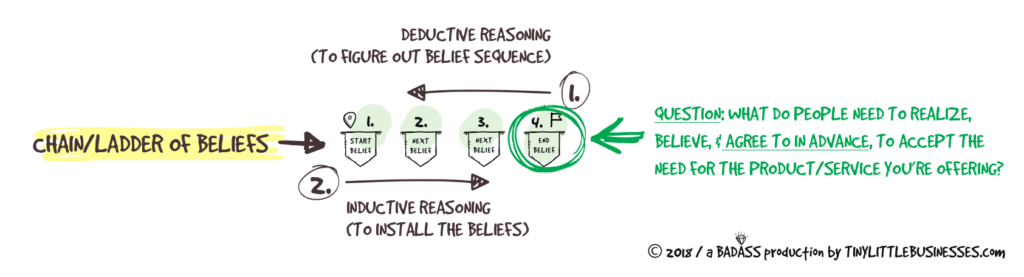
You should now have a sequence of beliefs.
Which means you have laid out what beliefs need to be instilled for someone to accept the need for what you have (when presented some time in the future).
Now let’s go a step deeper…
Pain > Symptom > Belief
As I mentioned, we will use inductive reasoning to take your reader from their current state of beliefs to where they need to be.
We’ll do that by first fleshing out the SYMPTOMS of each belief state (in the chain of beliefs you defined in the last lesson) on the journey they need to make.
Think of each symptom as the significant PAIN your reader feels, based on their behaviors, which is a result of their beliefs (again, think back to the Liminal Thinking pyramid video):
The aim is to construct your story so that it walks your reader through each step in your beliefs chain, by sequentially introducing the symptom (pain) of each belief.
In my Frank & Matt story I painted the picture of how Frank thinks and behaves to a tee.
It was painful for me to write because I used to be Frank, and it was even more damn painful for a prospect to read, as they suddenly IDENTIFIED THEMSELVES as Frank (“AHA” alarm bells going off in their head).
For Frank, the symptom of his current belief was his tendency to jump from opportunity to opportunity; never knuckling down and focusing on one thing long-term.
The SYMPTOM of this behavior caused Frank to never get to the point of building a business with leverage and traction, and ultimately never attaining a stable and predictable revenue stream (his pain).
You want to describe the PAIN your POP is going through really clearly:
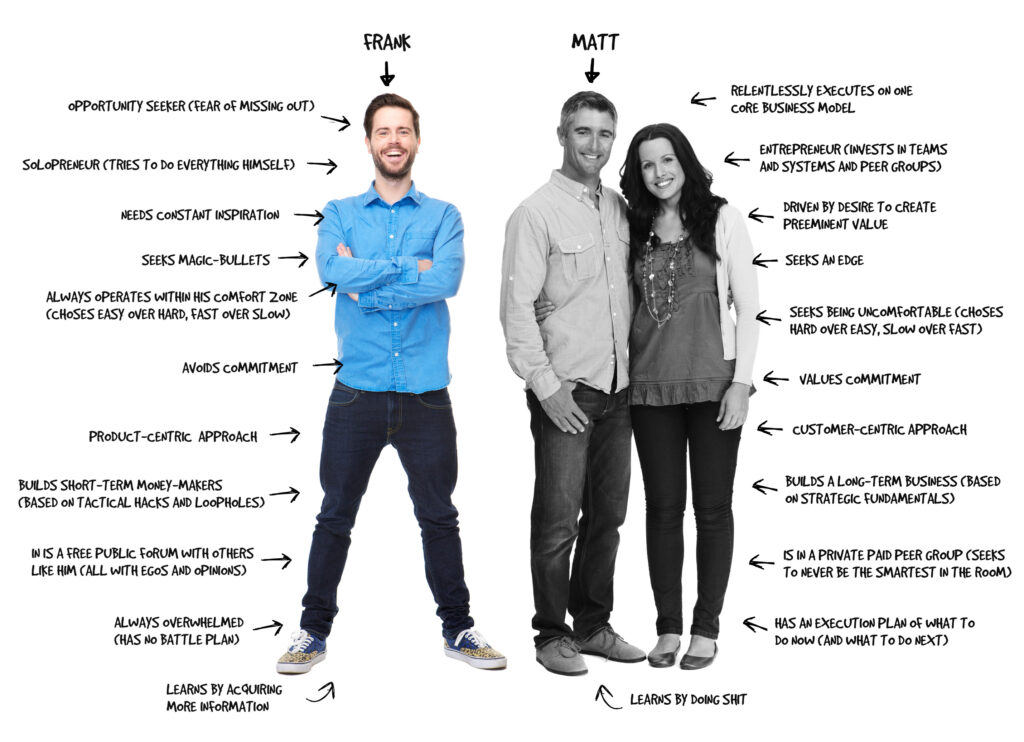
Doing this is essential because when you can describe their problem (pain) better than they can, they’ll believe you also have (and know) the solution.
This mental reframe is a crucial ingredient.
The Symptoms Bucket
Once you’ve distilled each belief from your chain of beliefs:
Belief -> Symptom -> Pain
The next step is to figure out a NAME that you can give this “bucket” that can HOLD ALL THE SYMPTOMS.
You give a name to the “symptoms bucket” that you’re calling (framing as) the root cause of the PAIN (problem).
It should be a name that people will easily accept (as opposed to calling it something that suggests they’re at fault).
IMPORTANT: It needs to be something they can willingly accept and identify with.
I named this “symptoms bucket” Frank.
Frank represented all the PAINS that my audience was experiencing, along with the root CAUSE of WHY.
In other words, merely being a Frank — which they had ALREADY self-selected as being — became the ROOT CAUSE of their problem.
The REASON WHY they were stuck in “perpetual purgatory.”
Doing this causes some critical shifts for them:
- it results in a massive “AHA!” moment in their mind,
- they feel ABSOLVED for their lack of success (it’s not their fault),
- and this gives them HOPE (a very powerful emotion), “WOW, THERE’S STILL HOPE FOR ME!”
And at this point, when done well, the competition becomes completely IRRELEVANT.
Let’s quickly recap:
At this point, they know WHAT their problems are (you being the one who created clarity by articulating their pain)…
They know WHY these problems are part of the deeper issue (the SYMPTOMS)…
And finally, they know the NAME of that problem bucket…
The Solution Bucket
At the right point in the sequence, revealing the “Solution Bucket” creates the pivot point where the answer/solution hits them in the face (the AHA moment!).
I named this “solution bucket” Matt.
Matt represented the 1%:
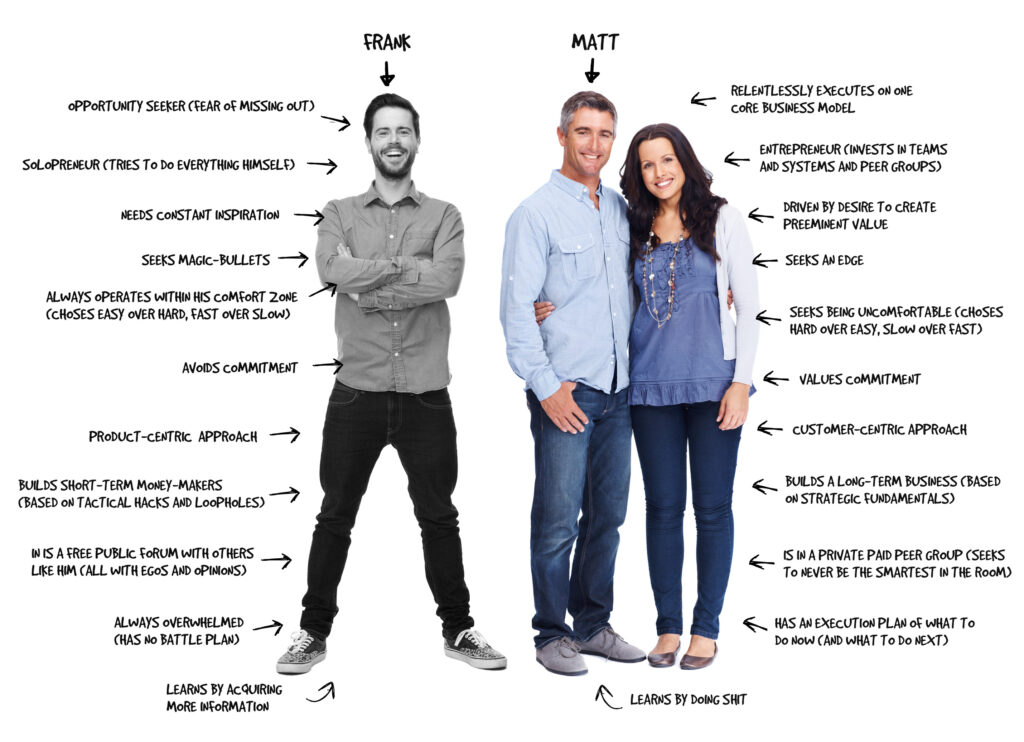
The smaller group of people who succeed because they operate and BEHAVE very differently compared to Frank.
And this creates CONTRAST which channels their DESIRE for the solution, through you.
They realize that they are the negative bucket (the cause) — a result of their behavior — and they’re absolved for their lack of success.
And you’re positioned as the person with the answer that can help them move from the negative cause-bucket to the positive solution-bucket.
(From Frank to Matt in my case.)
This insight gives them HOPE that you have the answer.
And believe me, at this point, you don’t have to do much “selling.”
For many, it’s simply a matter of, “Where the hell do I sign up or buy?”
(Remember, however, that at this point nothing is for sale! But the desire exists and is building.)
NOTE: The “negative bucket” shouldn’t sound too negative. And the “positive bucket” shouldn’t be too general.
You want to OWN the positive (success) bucket.
When you do this well, in their mind, they’ll FEEL that there is no other way but through you.
That there is NO WAY FORWARD WITHOUT your positive bucket solution.
Competitors become irrelevant because they’re lumped into the problem bucket by definition (because they’re a SYMPTOM of the bigger problem).
Consequently, this removes all other options/choices they have. Because you become the ONLY VIABLE SOLUTION/OPTION/CHOICE.
THIS IS HUGE!
Extra: Other People’s Methods
Next, you’ll hear (and read) how others are using this methodology.
In the following two lessons, Todd Brown was kind enough to permit me to include his and Rich Schefren’s presentations from his $10K Big Idea Bootcamp.
Watch these two videos carefully. We’ve included some notes for you to help out, and you should add your own.
Before you move on here’s a framework example you could use to drill down from belief to pain.
Agora (the BILLION dollar a year newsletter publisher) have an interesting workflow called Copy-Boarding.
Very briefly, it goes like this:
- Need a BIG IDEA (I cover this later),
- Brainstorm all OBJECTIONS to that idea (in no order) using sticky notes (left column in illustration below),
- Organize the objections (what objection needs to be overcome FIRST, before the next objection, then next, and so on),
- Write a sub-headline that sells the reader on overcoming each objection (right column),
- Fill in those sub-heads with sales copy,
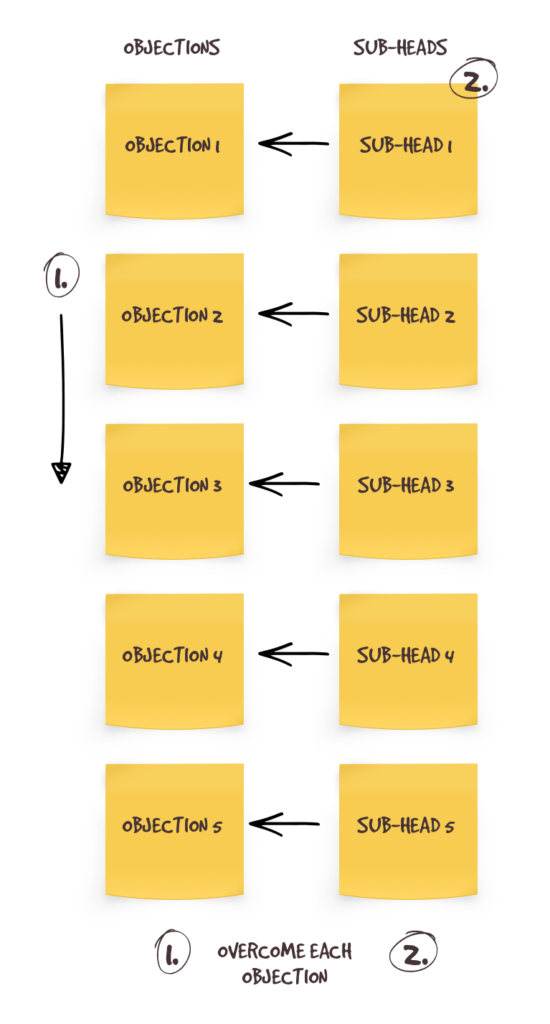
Copy-Boarding is how Agora brainstorms, then maps out the framework for what their direct response copy needs to say.
Agora Financial: Copy Camp (Copy-Boarding)
Joseph (Joe) Schriefer is the head honcho over at Agora Financial (AF). Agora are a BILLION dollar a year newsletter publisher. AF represents a $200 million a year division of Agora.
Joe is a friend. So I asked him if I could share their process (they shot a bunch of internal training videos for their copywriter with a GoPro, and called it Copy Camp).
Joe was kind enough to give me permission to share some of the lessons within Copy Camp for SOI (yay!). Later (in Module 3) I’ll share their process for generating million dollar Big Ideas.
Session #9: The Secret of Copy-Boarding (Part 1)
Session #9: The Secret of Copy-Boarding (Part 2)
This is not what you’re doing with SOI.
You’re not writing direct response copy.
You’re not directly selling anything.
That said, points 2 & 3 are a smart way to unpack all potential objections quickly, then sequence them out in the logical order that needs to play out (and be dealt with).
NOTE: Objections are NOT beliefs.
In a way, they can be thought of as “negative beliefs” (Jared & Kenrick think of objections this way).
So if you decide to use this workflow, be mindful that point #4 needs to be changed from sub-headline to BELIEF.
Also, know that it’s easy to make the mistake of chunking down specific objections to a level that are not actual beliefs (I believe Jared & Kenrick call these “supporting elements”).
So always ask yourself if what you have is an actual belief.
Okay, over to Todd and Rich.
NEXT: The Logic Chain (Todd Brown)