THIS COMES FIRST.
It sets the stage.
It establishes the “frame” in which the presell will play out.
It’s what GETS ATTENTION.
The BIG IDEA is the most important single element of your presells.
It will set you apart from the crowd.
Paul Hollingshead from AWAI says this:
“What makes the prospect want to read your promotion?
The headline and lead? Yes … but most importantly, it’s the idea behind the headline and the lead–the concept around which you wrap the whole package–that gets a prospect interested in your promotion.
And not just an idea, a BIG IDEA.
The Big Idea is the idea that drives the package and sets it apart from all the clutter. It’s a new and interesting way to say what everyone else is saying or has said many times before.
A promotion that contains a Big Idea will make your reader stop, take notice and want to find out more. A promotion that fails to pique your reader’s interest will most likely get thrown in the trash.
And these days your prospects have seen it all. They’re smart, sophisticated and skeptical. Plus, in addition to what they get in the mail, they’re now getting bombarded with sales messages on the Internet.
You can no longer get away with simply stating a powerful benefit in the headline. Every good, experienced marketer does that.
No, if you want to get your promotion read, it needs to be anchored in a strong, unique and compelling Big Idea. Keep those three keywords in mind. Strong, unique and compelling.
A Big Idea has to give the reader something they don’t know. It has to engage the reader and be intriguing enough to draw them into the promotion, while making an implied promise.
And most importantly, it has to jar the reader out of complacency — out of the sense that they’ve seen this all before.“
The company that’s among the best in the world at coming up with big ideas is Agora Financial (the BILLION dollar a year newsletter publisher).
They brainstorm BIG IDEAS every day. It’s the foundation on which everything they do rests.
Different Ways to “Present” a Big Idea
However…
There are, of course, different ways to “present” a big idea. It may not surprise you that once again I approach this very differently compared to everyone else who uses big ideas to gain attention.
Agora Financial is a company mostly made up of copywriters. They use bold headlines to get attention (usually with curiosity), then they follow it up with a video sales letter (VSL), and a text version too if a prospect leaves before the VSL finishes.
I hit up my buddy Joseph Schriefer who heads up Agora Financial and asked him for some of their most successful big ideas. Here’s what he shared with me:
- GMO (snippet)
- Kissinger’s Cross (snippet)
- IMPACT (snippet)
- Canadian Social Security (snippet)
- The Great Currency Shock of 2016 (snippet)
(HINT: To get a real education of a great big idea, you want to really study these.)
I also reached out to my other friend, Dan Ferrari, who used to work as a copywriter at The Motley Fool, and asked him for some of their most successful big ideas:
- Say Goodbye to ‘Made-In-China’ (snippet)
- The New Petroleum (snippet)
- Warren Buffett’s WORST NIGHTMARE Is About to Come True (snippet)
Agora Financial: Copy Camp (The Big Idea)
Joe Schriefer is the head honcho over at Agora Financial (AF), a BILLION dollar a year alternative financial newsletter publisher.
I’ve hung out for Joe many times, and the thing they’re world class at — perhaps more than anything else — is coming up with Big Ideas for their front-end customer acquisition offers (annual newsletter subscriptions).
Joe is a friend, so I asked him if I could share their process (they shot a bunch of internal training videos for their copywriters with a GoPro, and called it Copy Camp).
Joe was kind enough to give me permission to share some of the lessons within Copy Camp for SOI (thanks Joe!).
Enjoy!
Session #2: The Big Idea Template — Part 1
Session #2: The Big Idea Template — Part 2
Session #4: Technique For Producing Ideas — Part 1
Session #4: Technique For Producing Ideas — Part 2
Here’s How I Differ
I almost never use a headline to grab that initial attention.
One reason for that is because you need to be a VERY skilled copywriter to nail a great headline (and a headline can also scream “sales message follows next…”).
Having a great big idea helps, but there is still a significant level of skillful wordsmithing to nail it just right.
I’m not a copywriter, and perhaps you’re not either.
And I’m certainly not skilled at wordsmithing headlines.
So I (almost always) use an image instead.
The right image tells a story. Something that a headline just can’t (at least not in the same visual cortex kind of way).
And when I say image, I DO NOT mean a stock image!
What I love to do is to snap a pic from a magazine and use that.
Print is perhaps best. But digital works great, too (just screenshot, then open in Photoshop and add some filters to give the images some “age” and authenticity).
It’s VERY attention-grabbing.
NOTE ABOUT COPYRIGHT LAWS: It’s important to understand that many images from magazines, and indeed on the inter-webs, are copyrighted and protected under federal law (in the US) and international law.
While US law establishes protections for copyright holders, it also defines limitations to their rights. One such example is the doctrine of fair use (Section 107).
Individuals using copyrighted works for “purposes such as criticism, comment, news reporting, teaching (including multiple copies for classroom use), scholarship or research” can weigh their use against the four factors defined in Section 107 to determine if they need to seek permission from the copyright holder.
Fair use is not the same as free use. Fair use is a legal exception to the exclusive rights an owner has for his or her copyrighted work.
It has little to do with what we may think is fair, and everything to do with keeping the balance tipped in favor of the public interest.
Be aware that if you use a copyrighted image, there is a good chance you’re in violation of copyright laws, and potentially breaking the law.
Do your due diligence. If you do decide to use an image, even when citing the image source (image attribution), you do so with eyes wide open.
Although I’m not a fan of most stock image websites (to be fair, over the years I have spent a lot of money with iStockPhoto), the following sites are very good royalty-free alternatives:Unsplash (my favorite!), Pexels, Pixabay, Barnimages, Flickr.
Take the images below as an example. For the right audience –someone seeking for a way out of the depressing 9-5 rat race — these convey the full message instantly (WITHOUT the need to use a headline).
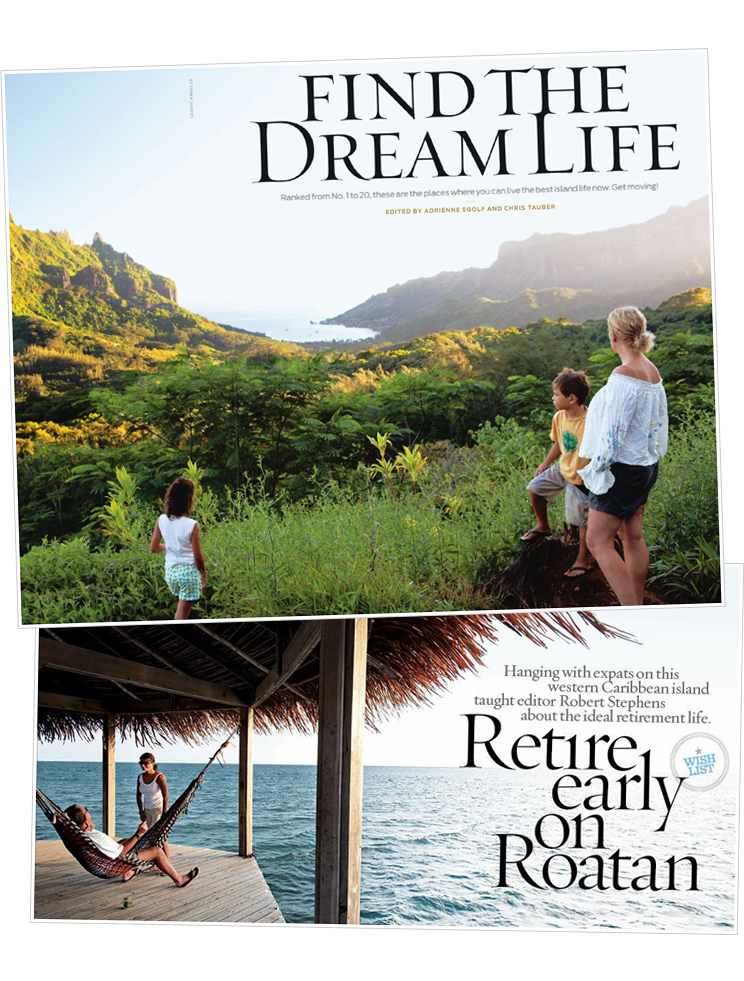
- The images TALK TO people considering retirement…
- They TALK TO people who want to ESCAPE the ordinary world (who feel there’s a better way to bring up a family)…
- They TALK TO professionals and execs who just want a simpler more rewarding life, free from the stress of a life that flies by at a million miles a second.
… and all of these thoughts are instantly and emotionally conveyed in just one image, powered by their own visual cortex.
An image evokes more visceral emotions than a headline ever could.
A headline is explicit.
It’s direct.
It talks to a very specific audience interest.
And an image allows the reader to TELL THEIR OWN STORY and “inject” THEMSELVES into the narrative in their head as the hero.
The impact of a well-used image happens almost instantly. The reader will associate themselves with a FUTURE THEM. They can see it vividly in their mind’s eye.
Just think about how powerful that is.
I’ve done this in a lot of different markets and niches, not just in the internet marketing space.
I’ve successfully stress-tested my presell formula in niches like male (and female) pattern baldness, weight loss (a variety of POPs), dog training (gun dogs), World of Warcraft, satellite TV, golf, baby modeling (back in the day Rich Schefren sold a baby modeling ebook; so I built a presell site to promote his product), cleaning business, relationship repair, home energy, bridal, beauty, and more I can’t even remember anymore.
I was a full-time affiliate for five years before I created my first product in the marketing space about how I was using story-driven email as a super-affiliate. (That was AutoResponder Madness, which became the Art of Email in 2021.)
Here’s one final example that I used back in 2010:

The big idea I used was to demonstrate how it was possible to live an insanely beautiful “island life” on Vanuatu in the South Pacific by building an online business that earns just $3,000/month.
And I attached the fact that it was voted the “happiest place in the world.”
The point of this wasn’t to suggest to readers to quit their job and move to an island in the South Pacific. That’s not realistic.
Instead, I took the IDEA of earning just $100 per day and REFRAMED what’s possible.
People have mistaken impressions that living in exotic places in the sun is reserved for the super-rich.
Anita and I moved to the sun and started living a life some people only dream of back in 2008. So, I more than most, know how possible this is.
So I REFRAMED that perception and applied it to building an income stream of just $100 per day.
The entire first page on Affiliate Bully was to set up that frame. Then only when I had their attention, did I lead them deeper down the rabbit hole into my world.
The big idea on Affiliate Bully worked so well I left it unchanged for almost seven years now (I’ve since shut it down, however).
Let’s move on.
Next is establishing authority.