The names Amos Tversky and Daniel Kahneman may not mean anything to you.
Their work introduced the notion of cognitive biases and illusions, and their contributions to behavioral economics and decision-making have been called “breathtakingly important.”
That’s how Michael Lewis described their collaboration, which is the subject of his 2016 book, The Undoing Project.
The work produced from their collaboration was not only completely different than either of them had done on his own, but orders of magnitude better.
In a touching, and wonderfully understated description of their work together twenty-one years after Amos Tversky died, Kahneman described their collaboration, saying:
“… we did work that was the best that either of us did over our long careers, and both of us did pretty good work, but together we were quite special…”
That last part of the sentence — “together we were quite special” — is particularly important because of the underlying principle it represents.
Their brilliance wasn’t 1 + 1 = 2. Instead, ideas emerged from their collaboration that neither of them could have achieved on his own.
This lesson isn’t about two brilliant Israeli psychologists, but rather the idea behind their brilliance — emergence — the outcome of the synergies of parts interacting together.
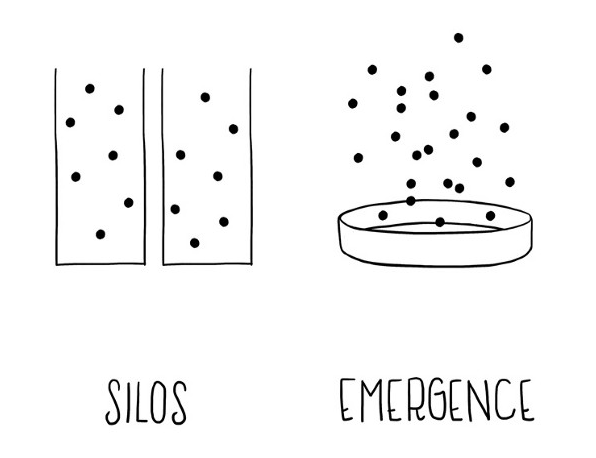
There is untold power when we see everything as interconnectedness…
We can identify patterns and trends that produce positive emergent effects (to amplify them), and negative emergent effects (to dissolve them upstream).
“A system is a set of related components that work together in a particular environment to perform whatever functions are required to achieve the system’s objective.” — Donella Meadows (Thinking in Systems)
When we understand and internalize this idea, we can engineer environments and situations that produce positive emergence. Instead of linear thinking, where 1 + 1 = 2, we can think in terms of 1 + 1 = 5, 9, 15 or more.
It’s this emergent effect of “1 + 1 = 9” that allows us to create customers before they buy anything, and even before there is an opportunity to buy.
NEXT: Systems Theory for Marketing