“Problems are just unaddressed opportunities waiting for creative minds to tackle them.” — Dr. Leyla Acaroglu
We’ve decided to organize the following two newsletters around the counter-intuitive idea that better prospects are created, not acquired.
And we’ll discuss this theme through the lens of modern email marketing.
We’re going to unpack two big ideas…
These two big ideas have nothing to do (directly) with selling and promotion, but…
… doing them makes selling and promotions 10x easier, and in many cases, almost effortless.
Effortless selling without trying to sell…
… what’s not to love, right?
We’re going to take you on this journey individually. André first, then Shawn.
Hey, it’s André…
I’m going to narrate this email because there is some perspective I need to set up first. An old story, really.
Shawn will write the following newsletter, unpacking the second big idea, and we feel it’ll be more powerful with that perspective narrated through Shawn’s point of view.
Anyhoo…
It was 2007.
Which feels like a million years ago.
If you’re also a dinosaur and have been at this game for that long, you’ll recognize it as the time when the $7 front-end loss leader (“tripwire”) report was all the rage.
It was an attempt to increase customer flow by lowering the barrier-to-entry to become a customer.
And to a degree, it worked pretty well…
… sort of.
If your goal was to attract and capture $7 customers, it worked like gangbusters.
The sound of champagne corks and party poppers could be heard echoing all around our little internet marketing ecosystem.
But as you can probably guess, customers aren’t created equal…
For example, there’s a world of difference between a $7 customer and a $700 customer. The two categories couldn’t be more different.
A $700 customer will rarely respond to a $7 offer.
However, the critical distinction is that the $7 customer will never respond to a $700 offer.
If you want $700 customers, leading with a $7 offer (and proliferating that offer all over the internet) is a pretty dumb strategy.
It seemed weird to me that the masses didn’t see this as an obvious flaw unless, of course, they actually wanted $7 customers.
So I decided to run an experiment to attract higher-caliber customers without the need for a $700 offer (or the obvious negatives associated with a $7 “tripwire” offer)…
I wanted to create a scenario where I would get high-quality leads (a precursor to a better customer willing to respond to more expensive offers) worth a hundred bucks, but cost them nothing.
It’s the framing that was important.
I have that old 2007 (evil) experiment archived below:
Please note: I created that copy nearly 15 years ago when the internet was a very different place at a very different time. So keep that as the context. After running the experiment, I discontinued it shortly after. I had learned a lesson, gained an insight and new perspective, and used that to further inform my marketing, which showed up in how I thought about multi-page presell pages/sites, and narrative-based emails.
My “Evil” Experiment
It was 2007.
To build an email list, the hot new craze was to create a $7 front-end loss leader report as a barrier-to-entry.
It was an attempt to weed out the freebie seekers. And to a degree it worked quite well. Meaning, lead quality went up some.
Job done. List owners were happy.
Problem was—in my opinion anyway—$7 isn’t really much of a “barrier” per se, even for someone on a small budget.
Sure, the complete waste of time tire-kickers thought twice. So from that perspective, it was a result.
Not me though…
I wanted to create a scenario where I would get leads that were worth $97 a pop, not 7 bucks.
But putting up a $97 report on the frontend was a sure-fire way to kill list building efforts stone dead. It just wouldn’t work well. Too expensive.
The brief of my “evil experiment” was simple:
- Create a barrier-to-entry scenario that would act like a $97 report, but,
- also build a list almost as fast as a free offer.
I wanted to achieve the best of both worlds.
Now…
There were a few interesting “side effects” to this evil experiment.
My opt-in rate was running at around 20%.
Nothing fantastic.
Average at best.
I was happy to sacrifice my opt-in rate some if I could bump my lead quality up.
That would have been a good tradeoff.
But what ended up happening… well, kinda shocked even me. Instead of going down… my opt-in rate more than DOUBLED, from 20% to 50% and some change.
In hindsight is made perfect sense. But at the time it was a pleasant surprise.
Here’s what I did…
I retooled my opt-in offer to look like this (sorry about the non-styling but I couldn’t find the stylesheet I used, so this screenshot is kinda ugly looking):
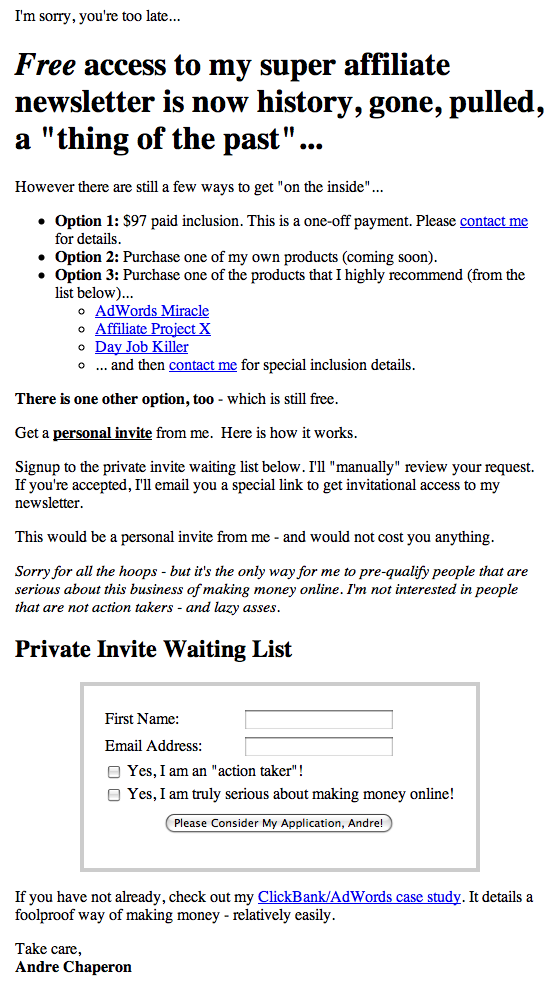
Notice the reframe.
Option 1 — $97 in cash. Option 2 was to buy one of my products (which wasn’t ready at the time) … and Option 3, if I remember correctly, was $77 a pop (meaning the affiliate products cost that much).
Which ever way they looked at it — the “entrance free” wasn’t cheap.
But…
… then where was the little “loophole”. And although it was free, it didn’t FEEL that way (from their perspective).
Because there was no guarantee of getting in. It was a total crapshoot.
Free, but NOT free. This set the frame for what was about to follow.
Muhahahaha!
There’s the first email the autoresponder sent them:
SUBJECT: {!firstname_fix}, give me 3 days…
Hi {!firstname_fix},
This is just a quick automated response to let you know that I have received your request to be added to my ‘Super Affiliate Newsletter’.
You don’t have to do anything. No further action is required by you.
Just give me a few days (as I get a *lot* of these requests).
I may even email you personally to ask you a few questions – just to make sure that you are serious about making money online.
If you do end up getting a personal invite from me, I’ll send you special instructions on what to do next.
If you don’t hear back from me within 3 days, then I’m sorry. Your request has been declined – for now.
Thanks again for your interest in my private “closed door” newsletter.
I wish you all the best!
Until later…
Take care,
Andre
Did you notice what I said? …
“If you don’t hear back from me within 3 days, then I’m sorry. Your request has been declined…”
It was in the subject line too.
I wanted the 3 DAY part to be crystal clear. Because I WANTED them to feel as if they had missed out if the next email didn’t arrive in 3 days.
Two reasons:
- People want what they can’t have (or what’s HARD to get) and,
- the fear of loss is the massively powerful persuasion technique.
… and guess what? I didn’t email them for a full WEEK (think about that for a second … as in what THEY may have been feeling).
Here’s the autoresponder email that went out ONE WEEK later:
SUBJECT: {!firstname_fix}, you’re in!
Hi {!firstname_fix},
This is an automated response to let you know that you’ve made it in.
… almost.
Here is what you need to do to add yourself to my “closed door” super affiliate newsletter…
1. Send a blank email to: private-newsletter@andrechaperon.com
2. Click the confirmation link within the email that is sent back to you.
That’s it.
You’re done!
To Your Success…
Take care,
Andre
Look at all the hoops I made people jump through.
Yet, when that email hit their inbox 4 days LATE, it was like a lifeline—a second chance was given to them. They JUMPED through that final hoop with enthusiasm and gusto.
Opt-in rate went up by 30%.
… and lead quality went through the freakin’ roof!
Go figure.
The lesson in this email is not — read, not! — what I did in that experiment. It’s not a template to use now.
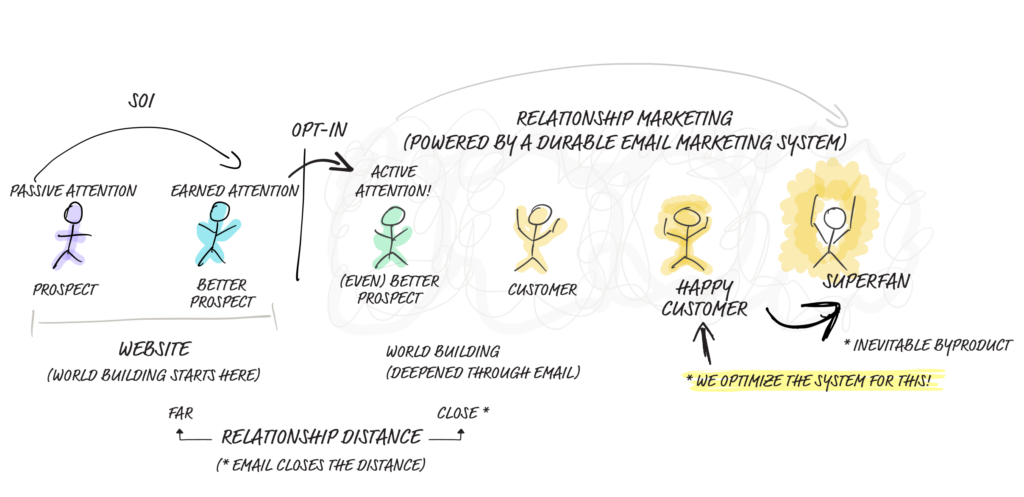
The insight is that better prospects are created (or can be created) when an experience is carefully designed for them to interact with.
We have opportunities to create experiences on our web properties, and through the intimacy of email.
Each of these opportunities, pre and post someone adding themselves to our email list, are places where we can carefully design an experience that pulls the best people closer to us, as trust and attention are earned, interaction by interaction, bit by bit, over time.
To be clear, and to end on a controversial note…
… we don’t believe the classic idea of a “lead magnet” or “opt-in for my report” or “four-part video series” rises to the level of a powerful experience that’s memorable and leaves a lasting impressing on someone.
Creating a better prospect starts at first contact, which is before — and probably long before — they add themself to our email list.
An interesting aside, which we may unpack in a future EM Newsletter, is that the same person can add themself to two different email lists on the same day, but how they view and interact with those businesses will be night and day different. Business A did something to create a better prospect, where Business B did something else, and as a result, the level of attention and trust they receive from the same person is a world apart.
The old days of: Lander > Opt-in (Lead Magnet) > Email > Offer
… is insufficient today and will be obsolete tomorrow.
There is a lot in this email to unpack if you’re willing to invest the time to read between the lines, follow the links, and internalize the implications of building a better system that’s experience-driven (the essence of world building).
Part II
Hey, it’s Shawn…
In Part 1 of this two-part series, André described some of the ways we can create better prospects before they opt-in.
I’m going to focus on how we can improve prospect quality over time after someone opts-in.
To do that, let’s first take a step back and get some perspective.
If you distill marketing down to its essential ingredients, you’re left with only two things that matter: offer and audience.
In simple terms, the offer is what you’re selling, and the audience is who you’re selling it to.
When you get offers and audiences right, everything is easy. Get either of them wrong, and nothing is easy.
While working with clients for more than two decades, I’ve seen a lot of offers, and I’ve been responsible for finding and engaging with a lot of audiences.
Looking back across twenty-two years and more than two hundred and twenty-five clients, I can’t point to a single factor that guaranteed success.
Despite what you might see advertised on the Interwebs, there are no magic offer templates, no guaranteed-to-convert bonuses, no top secret copy hacks, and no audience research tools that make the difference between success and failure.
In my experience, business success is about stacking probabilities in our favor, not stumbling on a (non-existent) digital marketing Holy Grail.
However, if I zoom out to a 30,000′ view of my years in the trenches working with clients, there was one thing that seemed to matter more than anything else, and it’s available to each of us, free of charge.
That one thing is trust.
Before I dive deep into this topic, let me steer you away from some potential quicksand. It’s easy to dismiss the importance of trust in the success of your marketing efforts and think to yourself:
“I know that already.”
Suspend that thought for a moment and stay with me…
Trust isn’t one thing that you have or your don’t. Instead, trust is a combination of factors that interact, over time, in ways that can dramatically affect your results, for better, or worse.
If you get many of those factors right, you’re far more likely to succeed. When you get all of them right, you’re in a class by yourself.
And it’s not difficult to get all of them right if you’re willing to do the work.
Let’s look at four elements of trust, and how each contributes to creating better prospects over time.
Trust Element #1: Empathy
When a new prospect arrives in our world, the first thing they’re looking for is confirmation that we understand who they are, what they want, the problems they’re trying to solve, and the pain they’re trying to alleviate or avoid as those relate to our area of expertise / value proposition.
Developing a solid foundation of trust requires that we acknowledge we understand what our audience needs and wants before we start offering potential solutions.
We build trust when we explicitly and implicitly acknowledge how our audience wants to feel when their needs and desires are met, especially in contrast to how they likely feel right now.
Bottom line: lead with empathy. (This is a good rule for life in general too.)
Trust Element #2: Credibility
Once people begin to trust our intentions, the next step is confirming that we have the experience and expertise to help them solve (or avoid) problems or fulfill their desires.
Our intentions matter to our prospects (a lot), AND we have to be able to deliver the goods when we offer solutions.
The digital landscape is littered with BS offers and it’s highly likely that your prospects have been disappointed before. (That’s why they’re still looking for solutions.)
Credibility is built when we can honestly say that we can deliver on our promises, and credibility is reinforced when we have evidence that we’ve done that for others as well.
Great content that demonstrates our understanding and showcases our expertise is the foundation of credibility. Reviews, testimonials, and case studies contribute to credibility as well.
Trust Element #3: Integrity
An easy way to simplify integrity is with a simple question — do our prospects believe that we’ll do what we say we’ll do, when we say we’ll do it, now and in the future, regardless if anyone is looking or not?
Deep down, our prospects want to trust us.
However, it’s important to recognize that our prospects are taking a risk by believing in us — especially when money changes hands.
Reassuring them that they’ve made the right decision by staying true to our word, and true to our principles, reinforces perceptions of our integrity.
Integrity doesn’t mean we can’t make mistakes. We don’t have to be perfect. However, we should acknowledge mistakes when they happen and make things right.
And integrity doesn’t specify what our values should be. It simply means that we are who we say we are all the time, and we act accordingly.
Trust Element #4: Consistency
Trust isn’t something we acquire once and then move on. It’s not a box to check on the way to something else.
Instead, trust is a thread that winds through everything that we do.
It’s a promise that says this is who I am, this is what I believe, this is how I choose to show up in the world, and this is what you can expect from me now and in the future.
Every time we interact with our audience is an opportunity to build — or erode — trust. Take those opportunities very seriously.
Now, let’s put these trust elements into a familiar context — email marketing after opt in — and see how they work together to develop better prospects over time.
(These frameworks are from the Art of Email.)
Immediately after opt-in, a Relationship Building Series starts. The focus of that series is to demonstrate empathy and credibility — not to make a sale.
Building relationships after opt in is not to be confused with ‘indoctrination’ or ‘onboarding’ sequences. We’re not trying to get through a quick introduction on the way to something else.
Instead, we’re acknowledging that we have work to do to build a relationship with our prospects. Empathy and credibility are the building blocks of a great Relationship Building Series.
That means, in practice, our first series of emails (5-10+, depending on your audience’s needs), are primarily about THEM, not US.
What pain are they feeling, what desires do they want to fulfill, and what have we learned that may be useful for them that we can share without expectation of anything in return?
After a prospect completes a Relationship Building Series, they’re added to our Value Newsletter. That’s our vehicle for building trust over time. (You’re reading one right now.)
Newsletter frequency depends on your specific business and what best serves your audience, and there are many ways to organize newsletters (thematically, curation, new content, etc.)
Value Newsletters deepen relationships over time (integrity, consistency), and create opportunities to share expertise valuable to your audience (credibility, empathy).
Next is a Soap Opera Series…
André pioneered using principles of serialized story telling in email marketing to pull an audience’s attention forward with open loops, nested loops, and cliffhangers.
An SOS doesn’t sell. Instead, it’s a vehicle for sharing value with an audience that’s as interesting and engaging as your favorite TV series.
A Soap Opera Series has a beginning and an end. It takes your audience on a journey where some transformation (for them) is possible.
An SOS can be something as simple as an insight that reframes how they perceive a problem or an opportunity, or something more complex like a mini-course, a parable, or more.
I know what you’re thinking…
Relationship building is great, but when do we sell something? A business that doesn’t sell isn’t a business for long (it’s an expensive hobby).
Part of building and reinforcing trust is rewarding our audience’s attention when they’re interested in something we have to offer, and respecting their inattention when they’re not interested.
The mechanism for that is a Bridge Email.
A Bridge Email is an opportunity for us to notify our audience when we have something for sale, and for them to virtually ‘raise their hand’ if they’re interested.
Anyone who raises his/her hand gives explicit permission for the promotion (and is far more receptive to it). Anyone who doesn’t raise his/her hand never sees the promotion at all.
Here are two examples of Bridge Emails for a previous Art of Email promotion:
- AoE Announcement Email (sent Sept. 14).
- AoE Manifesto Email (sent Sept. 21).
(Please note that the interest list links in the web version do not work.)
All of these campaigns — Relationship Building Series, Value Newsletter, Soap Opera Series, and Bridge Emails — are part of what we call the Art of Email’s Trust Engine.
They work together with AoE’s Revenue Engine (Story-Powered Promotions, Product Launch Series, and Customer Onboarding Series).
Returning to the original insight that trust is the critical ingredient in business success, we suggest that trust-building campaigns should be 80% or more of all email marketing.
Read that sentence again.
If my experience is an accurate guide, the greatest advantage you can have in business is your audience’s trust. Take the time to get that right and everything else will be easier, more effective, and much more enjoyable.
NEXT: Structural Tension